Can a Power Bank Charge a Laptop? The Wattage Rules You Need to Know
Yes — a modern power bank can charge a laptop, but only if it speaks USB-C Power Delivery (PD) and outputs at least as much wattage as the laptop draws. The cheapest 5,000mAh packs on Amazon will not do it. A 20,000mAh pack with 65W PD output will comfortably top up a MacBook Air on a long flight. The difference is the protocol, not the brand.
This is a question I field from new buyers almost every week. The short answer is yes for most laptops made after 2018, but the specifics matter. Here is the full breakdown — what works, what does not, and how to read the spec sheet to know before you plug in.
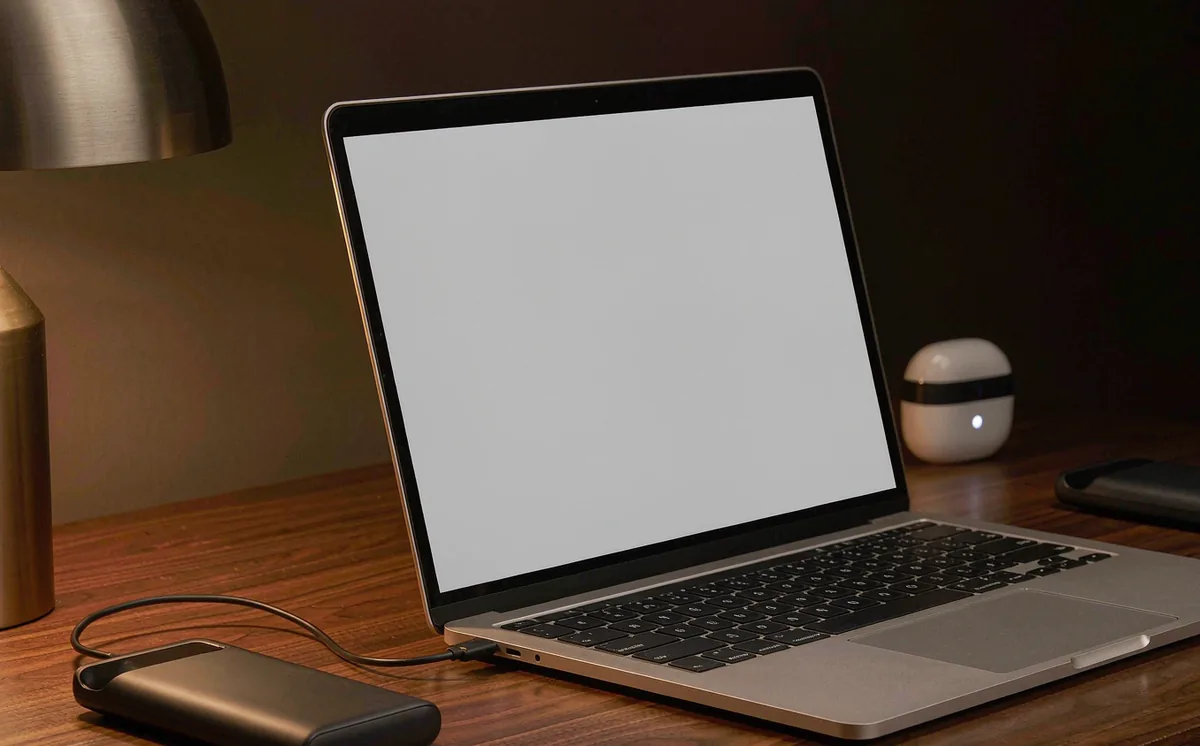
The Short Answer
Quick answer: a power bank can charge a laptop if it has a USB-C PD output rated at 30W or higher, and the laptop charges via USB-C. Most modern ultrabooks (MacBook Air, Dell XPS 13, Lenovo ThinkPad X1, HP EliteBook) draw 30 to 65W, so a 65W PD power bank is the safe pick. Anything under 30W will either fail to charge or charge so slowly the laptop drains faster than the pack refills it.
Two things have to be true at the same time: the pack outputs the right protocol (USB-C PD, not just USB-C), and the wattage is at least equal to what the laptop wants.
How Laptop Charging Over USB-C Actually Works
USB-C is just a connector shape. The protocol on top of it is what determines whether charging happens. There are three common protocols in the wild:
- USB-C PD (Power Delivery) — the universal standard. Negotiates voltage and current up to 100W (PD 3.0) or 240W (PD 3.1). This is what laptops use.
- Qualcomm Quick Charge (QC 3.0/4.0/5.0) — a phone-focused fast-charge standard. Does not negotiate with laptops.
- Proprietary protocols — Huawei SuperCharge, Oppo VOOC, OnePlus Warp. Phone-only, not laptop.
A pack that says “USB-C output” without specifying PD usually means 5V/3A = 15W max, which is enough to trickle-charge a phone but not enough to power a laptop. A pack that says “USB-C PD 65W” can negotiate 5V, 9V, 12V, 15V, or 20V at the right current to match the laptop’s input spec.
What Wattage Does Your Laptop Need?
This is the part most buyers skip, and it is the reason a 30W pack charges some laptops and not others. A rough cheat sheet:
| Laptop | Typical draw | Minimum PD wattage | Comfortable |
|---|---|---|---|
| MacBook Air M1/M2/M3 | 30W | 30W | 45W |
| MacBook Pro 13″ | 60W | 45W | 60W |
| MacBook Pro 14″ | 70W | 65W | 96W |
| MacBook Pro 16″ | 96–140W | 96W | 140W |
| Dell XPS 13 | 45W | 45W | 65W |
| Dell XPS 15 | 100W | 100W | 130W |
| Lenovo ThinkPad X1 Carbon | 45W | 45W | 65W |
| HP EliteBook / Spectre | 45–65W | 45W | 65W |
| Microsoft Surface Laptop | 44W | 45W | 60W |
| iPad Pro 11″/12.9″ | 20–30W | 30W | 45W |
Two rules of thumb from this table:
- 30W PD is the floor for any modern USB-C ultrabook. Below that, the laptop will warn “slow charger” or refuse to charge under load.
- Match or exceed the laptop’s stock charger wattage. A 65W laptop charger replaced by a 100W pack will work fine; a 96W laptop replaced by a 65W pack will charge slowly while the laptop is in use, but it will charge when the lid is closed.
Will a Power Bank Actually Fully Charge a Laptop?
It depends on pack capacity. A laptop battery is measured in watt-hours, and a power bank’s usable capacity is also measured in watt-hours. A 20,000mAh / 74Wh pack will deliver roughly 50 to 55Wh to a laptop after conversion losses. That covers about 70 to 80% of a MacBook Air 13 (battery ~50Wh) or 35 to 40% of a MacBook Pro 16.
For most travel use cases — long flight, train ride, hotel room with no outlet near the bed — a 20,000mAh / 65W PD pack is the sweet spot. It stays under the 100Wh airline limit, fits in a coat pocket, and gives you one full MacBook Air charge plus a phone top-up. Our 20000mAh solar power bank (65W) is built exactly for that use case, and at 65W PD output it handles every USB-C ultrabook on the market without complaint.
For heavier workstations (MacBook Pro 16, Dell XPS 15, mobile workstations that draw 100W+), you need a 30,000mAh / 100W+ PD pack. The 30000mAh Solar Power Bank pushes 100W PD output and is sized for a full day of laptop work away from a wall outlet.
Common Mistakes When Using a Power Bank to Charge a Laptop
Three pitfalls I see every week from new buyers:
- Using a USB-C cable that does not carry 5A current. USB-C cables are rated for 3A (60W) or 5A (100W). If the cable is 3A-rated and the pack is 100W, the pack will throttle to 60W and may disconnect under load. Use the 5A cable that ships with the laptop, or buy one labeled “100W” or “5A e-marked.”
- Plugging into a USB-A port on the pack instead of USB-C. USB-A on a power bank is almost always 5V/2.4A = 12W. The laptop will either refuse to charge or drain faster than the pack can refill. Always use the USB-C PD output for laptops.
- Expecting pass-through to work the same as wall power. Pass-through means the pack charges its own cells while powering the laptop. It works, but the input current is split, so the laptop typically charges at half the normal speed, and the pack itself charges slowly. For a fast top-up, charge the pack first, then the laptop.
What About Charging a Laptop From a Solar Power Bank?
Same rules apply — the solar panel is just a slow input method, not an output. The pack still needs to negotiate 65W or 100W USB-C PD output to the laptop, regardless of whether the input is a wall brick or a sun-facing solar panel. Solar input is a 5V/2A trickle at best (10 to 15W peak in full direct sun), so the pack will lose charge faster than solar can refill it if you are simultaneously running a laptop. Use solar for emergency top-ups, not as the primary laptop charging method.
For field work where you might be off-grid for a few days, the 20000mAh Solar Power Bank pairs a 65W PD output with a 5V solar trickle on the back panel. During the day you let the solar panel top up the pack slowly, and in the evening you plug the laptop in for a full charge cycle.
The Bottom Line
Yes, a power bank can charge a laptop — but only if the pack speaks USB-C PD and outputs at least 30W (for ultrabooks) or 65 to 100W (for heavier laptops). A 20,000mAh / 65W PD pack covers most travel scenarios for a MacBook Air or Dell XPS 13. A 30,000mAh / 100W pack is the right pick for heavier workstations.
The most important spec to look at is not capacity — it is output wattage and protocol. Capacity determines how many charges you get; wattage determines whether the laptop will charge at all.
If you are building a portable laptop-charging kit for your team, our OEM/ODM line covers 65W to 100W PD output across 20,000 to 30,000mAh capacity, with custom logo and packaging. Reach out to wang@outdoorpowerbank.com and I will send samples and a quote within one business day.
— Wang Zhenfei, founder of YHR Technology. OEM/ODM of power banks and portable power, Dongguan, China.