A power bank is a spare lithium battery for air-travel purposes. Keep it in your carry-on bag, never in checked baggage, and check the watt-hour (Wh) label before you leave for the airport. Rules changed in March 2026, so an older blog post or a rule for spare camera batteries may give you the wrong answer for a power bank.
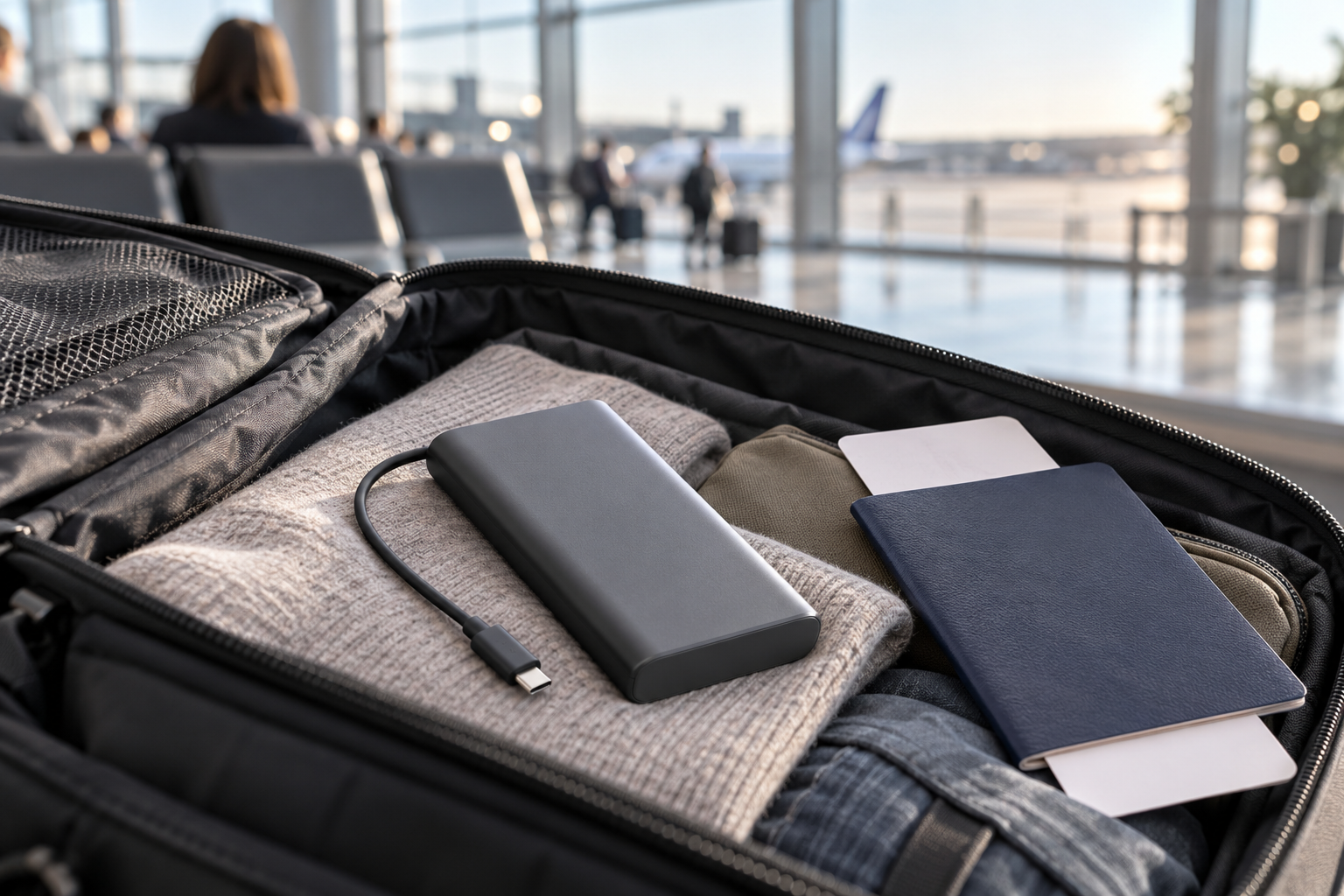
The practical packing rule in 2026
- Carry-on only: If your cabin bag is gate-checked, remove the power bank and take it into the cabin. Protect it from damage and short circuits.
- Stay at or below 100Wh: This is the straightforward travel choice. A power bank above 100Wh may require airline approval or be refused, depending on the applicable rules and operator.
- Take no more than two: ICAO’s March 2026 change limits passengers to two power banks for personal use. Your airline may impose additional restrictions.
- Do not recharge the power bank in flight: The new rule prohibits replenishing the bank from an aircraft outlet. IATA also recommends against using a power bank to recharge another device in flight; follow the crew’s instructions and your airline’s policy.
The 2026 IATA operator guidance explains the new two-bank and in-flight rules. The FAA PackSafe guidance explains U.S. baggage and watt-hour limits. International journeys involve multiple authorities, so confirm the rules for every carrier on your itinerary.
Calculate watt-hours from the battery label
Wh = rated capacity in amp-hours (Ah) × nominal battery voltage (V). If the label gives milliamp-hours, divide by 1,000 first. At a stated nominal cell voltage of 3.7V, a 10,000mAh pack is about 37Wh and a 20,000mAh pack is about 74Wh. A 30,000mAh pack would be about 111Wh at that voltage, so do not assume it is ordinary carry-on equipment.
Use the voltage and Wh value printed on your actual pack; do not use the USB output voltage of 5V as the cell voltage. A clear, legible manufacturer label is easier to assess than a handwritten conversion. If the markings are missing, ask the airline before travel rather than assuming security will accept your calculation.
What about 100–160Wh?
FAA guidance allows some larger lithium batteries with carrier approval. However, 2026 international power-bank guidance treats power banks separately from other spare batteries, and its operator table lists power banks above 100Wh as forbidden. The same guidance discusses a transitional approval provision that is not expected to continue in the next edition. For a power bank in this range, obtain explicit approval from every carrier before travel; if you cannot, choose a pack no larger than 100Wh. Do not treat approval for a spare camera battery as approval for a power bank.
Check a real model: Our 20,000mAh 65W power bank is an example of the capacity category discussed here. Open the product listing for its features, then confirm the Wh printed on the actual unit and your airline’s current rules before packing it; a 20,000mAh headline alone is not flight approval.
Before you leave
- Read the Wh marking and look up your airline’s current power-bank policy.
- Check the number of banks allowed on each flight, including connections.
- Place each pack in a separate protective pouch or its original packaging. Keep ports away from loose metal objects.
- Put the packs somewhere accessible in your carry-on, so you can remove them if the bag is checked at the gate.
- Leave damaged, swollen or recalled packs at home.
For the underlying energy calculation, see our guide to small and large power-bank capacities. Airline requirements can change; the carrier’s published policy and crew instructions control your specific flight.
Decision table: common capacities and the 2026 rule
The figures below assume a battery label based on a 3.7V nominal cell. They are examples, not substitute labels for a particular product. A 20,000mAh marketing claim at USB output voltage is not equivalent to a 20,000mAh cell rating. Read the physical Wh marking and the carrier policy.
| Label example | Illustrative calculation | Practical travel decision |
|---|---|---|
| 10,000mAh at 3.7V | 10Ah × 3.7V = 37Wh | Below 100Wh; carry in cabin, within two-bank limit |
| 20,000mAh at 3.7V | 20Ah × 3.7V = 74Wh | Below 100Wh; check individual airline restrictions |
| 26,800mAh at 3.7V | 26.8Ah × 3.7V ≈ 99.2Wh | Near threshold; verify the manufacturer’s printed Wh |
| 30,000mAh at 3.7V | 30Ah × 3.7V = 111Wh | Above 100Wh; do not presume it is allowed |
| Unmarked or illegible | Cannot confirm capacity from a reliable label | Ask carrier in advance; consider a clearly marked replacement |
These examples also show why dividing or multiplying by 5V is a common mistake. Five volts describes a USB port, not necessarily the internal cell’s nominal voltage. A pack can have several cells in series or parallel; the maker’s rated Wh is the better reference than a guessed topology. If two different figures appear on packaging and the device, resolve the discrepancy with the manufacturer and carrier before travel.
International guidance, national guidance and airline policy are not identical
The IATA operator guidance dated 31 March 2026 explains the ICAO addendum: no more than two personal-use power banks, cabin carriage, individual short-circuit protection and no recharging the bank on board. Its operator table lists power banks above 100Wh as forbidden, while the narrative describes a transitional approval provision for 100–160Wh that is expected to disappear in the next edition. That combination is why a blanket “under 160Wh is fine with approval” answer is unsafe for an international itinerary. The FAA PackSafe page still describes carrier approval for certain larger spare lithium batteries. It is important to confirm whether the operator treats your item as a power bank under the newer guidance rather than a different spare battery category.
A connecting trip can involve two airlines, different airports and different national implementations. Written approval from one carrier is not a general passport for another. Record the model, Wh, flight number and carrier response if you need an exception. For ordinary travel, a clearly labelled bank below 100Wh is the simpler choice. This is a risk-management recommendation, not a claim that every airport applies identical screening.
What happens at the gate and in the cabin?
A frequent failure is packing a bank in a small cabin bag that gets gate-checked because overhead space runs out. The FAA explicitly says to remove power banks and spare lithium batteries from a gate-checked bag and keep them with the passenger. Put yours in a pocket or small pouch you can reach without unpacking the whole bag. Protect exposed terminals from metal objects; do not leave a damaged unit loose beside keys. If a bank heats, swells or smokes in the cabin, stop handling it and alert the crew immediately. Crew members have procedures and equipment for a battery event.
| Situation | Best immediate action | Reason |
|---|---|---|
| Cabin bag is gate-checked | Remove the power bank and carry it into the cabin | Power banks are not checked-baggage items |
| Security asks about capacity | Show the printed Wh label and model | mAh alone can be ambiguous |
| Bank is damaged or swollen | Do not travel with or charge it; seek safe disposal advice | Damage increases safety concerns |
| Bank becomes hot in flight | Notify cabin crew promptly | Do not improvise a response to a possible battery event |
| Need to charge a phone on board | Check the airline’s current policy; use permitted aircraft power where available | IATA discourages use of a personal bank to recharge another device |
A preflight checklist for a real itinerary
Write down the number of banks, each model’s Wh and the airlines on all legs. Compare the carrier’s current dangerous-goods page with the IATA and relevant national guidance. If a bank is 100–160Wh, request explicit written permission, and have a below-100Wh alternative ready; do not rely on an old forum reply. If the power bank is built into “smart luggage,” check whether it is removable and how the airline classifies the bag. Finally, leave enough time for screening questions. A safe plan is one you can explain from the labels, not from a speculative calculation on a phone screen at the boarding gate.
Source note: The thresholds and March 2026 changes above come from the linked IATA guidance and FAA PackSafe page. Examples and packing decisions are editorial interpretations, not official airline approval for a particular product. Reviewed 27 October 2026.