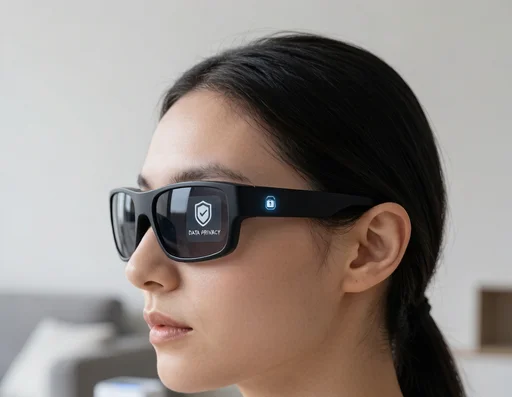
Are Smart Glasses Safe
Smart glasses are safe for daily use by adults — the core audio and camera hardware poses no known health risk when used normally, and Bluetooth output is well within established exposure limits. The real safety questions aren’t about radiation, they’re about distraction while driving, privacy in public, and choosing the right frame for low-age users.
I get asked this constantly, so let me separate what’s genuinely worth worrying about from what isn’t:
- Audio radiation: open-ear Bluetooth earbuds and glasses use the same short-range tech as your phone — no credible evidence of harm.
- Camera privacy: this is the real one. Camera glasses are banned in gyms, cruise ships, and exam halls — Royal Caribbean, for example, restricts camera glasses in certain onboard areas. If that tension bothers you, a smart camera glasses free audio frame sidesteps the whole issue.
- Driving distraction: handling calls hands-free is generally safer than a handset, but you must stay focused on the road; check your local rules.
- Low-age users: I don’t recommend smart glasses for young children — there isn’t enough peer-reviewed research on long-term use by kids, so we steer clear of recommending them for minors.

How Does Meta Smart Glasses Work
Meta smart glasses work by packing a Bluetooth audio module and camera into the frame, then pairing to your phone — the glasses handle sound and capture, while the Meta View app handles the AI and media management. The hardware on your face is deliberately light; the intelligence lives in the phone.
In practical terms, here’s the flow:
- Pair once through the Meta View app on your phone.
- Use audio standalone — music, calls, voice assistant over Bluetooth.
- Capture hands-free — tap the temple to shoot photos or video from your line of sight.
- Manage in the app — transfer media, run AI features, update firmware.
The same architecture drives meta ray ban smart glasses and the broader Meta line. If you want the deeper hardware story — speaker placement, chips, battery — I wrote a full breakdown in our guide on how a smart glass works.
What Does a Smart Glasses Do
A smart glasses does three everyday jobs: takes Bluetooth calls, plays music through open-ear speakers, and — in camera models — captures first-person photos and video. Everything else (AI, translation, display) is an add-on tier above these basics.
For most people, the value is the two audio jobs done without earbuds. You keep your situational awareness (hear traffic, hear colleagues) and your ears stay unblocked for hours without fatigue. That’s why is smart buy glasses legit and similar questions miss the point: the product class works fine, the question is which tier fits your use case.
| Task | Audio-only frame | Camera/AI frame |
|---|---|---|
| Calls | Yes | Yes |
| Music | Yes | Yes |
| Voice assistant | Yes | Yes + on-device AI |
| Photos/video | No | Yes |
| Translation / display | No | Flagship only |
What Is AI Smart Glasses
AI smart glasses are the same wearable frame with an added assistant layer — voice-answer questions, translate, and process hands-free commands using cloud AI connected to your phone. They’re a big step up in usefulness, but still not a standalone computer.
What’s genuinely useful today: quick facts by voice, real-time translation (our YJ-AR002 does offline translation with a camera, useful when traveling), and hands-free capture for creators. The honest limit: AI features depend on connectivity and a companion app. Offline, the glasses are just audio. Buy for the daily reality of your signal strength, not the demo.
How to Tell If Someone Is Wearing Smart Glasses
You can usually spot smart glasses by small tells: a slightly thicker temple with a visible speaker grille or camera dot, a charging connector, and sometimes a faint LED. But well-designed audio frames — like our transparent YJ005-A02 — are built to be indistinguishable from normal glasses, which is exactly the point for everyday wear.
Here’s what to look for if you’re trying to identify them:
- Thicker temples hiding a battery and speaker module.
- A camera lens in the corner of the frame (camera models only).
- Charging contacts or a magnetic snap for the case.
- Occasional LED indicators for pairing or recording.
That’s why how to tell if someone is wearing smart glasses is genuinely hard for the discreet audio class — which is a privacy feature in itself. If being unnoticed matters, choose a frame that looks like a normal optical frame.
How Smart Glass Technology Works
Smart glass technology works by placing a compact module — Bluetooth chip, speaker, microphone, battery — into the frame, driving calls and music through open-ear audio and pairing to your phone for the smart features. It’s surprisingly simple at the hardware level, which is why prices have dropped fast.
From the factory side, I can tell you the engineering centers on three things: battery density (where to hide the cells), acoustic tuning (how to make open-ear sound decent), and power efficiency. That’s why battery life ranges from 4 to 8 hours across models — it’s a direct trade-off with frame weight. Our YJ009-M2, for instance, hits 7–8 hours by using its magnetic dual-lens frame efficiently.
Is Apple Going to Make Smart Glasses
Apple has not released mass-produced consumer smart glasses, and there’s no official product on shelves — current Apple “smart glasses” talk is rumor and patent speculation, not a buyable product. If you’re deciding whether to wait, the practical answer is: don’t hold your purchase for an unannounced release.
This is the same trap as “is samsung making smart glasses” and “when will google release smart glasses” — the big platforms generate endless rumor headlines, but none have a mainstream consumer frame for sale today. Genuinely available options are the Meta/Ray-Ban line, Amazon Echo Frames, Solos, and factory-direct brands like ours. If a need exists now, buy now; if you’re only curious, set an official-announcement alert and move on.
Bottom Line
Smart glasses are safe for adult daily use, with real considerations around privacy, driving, and children rather than radiation. Meta-class frames pair audio-plus-camera hardware to a phone app, audio-only frames cover most daily needs discreetly, and the big-platform “coming soon” rumors aren’t buyable products yet. Choose by capability and use case, not hype.
A Safer, More Private Option
If privacy is your main concern, a camera-free frame sidesteps most of the worry. Our YJ005-A02 has no camera and no mandatory app, so there’s less to manage and less to be questioned about in public spaces. For the AI-camera experience when you do want capture, the YJ-AR002 keeps features like translation on-device. Both come factory-direct from our production line.
If you’re interested in our smart glasses series, feel free to get in touch with us. As an original manufacturer with full production capacity, we offer direct factory supply and customizable solutions to meet your business demands. We look forward to establishing long-term win-win cooperation with you. We offer a full range of smart glasses equipped with diverse functions tailored for all usage scenarios.