Introduction
A power bank, also called a portable charger, is a compact independent energy storage device assembled with lithium battery cells and intelligent power management circuits. It stores electricity in advance and provides stable power output to charge portable electronic devices without connecting to fixed wall power outlets.
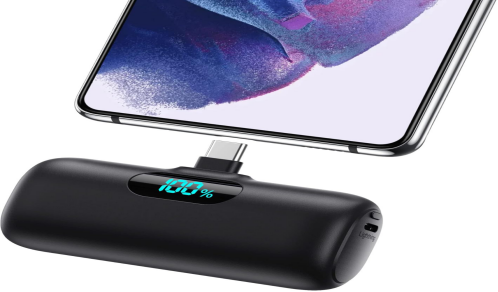
Unlike traditional chargers that require constant access to household powers, power banks carry built-in stored energy, effectively solving the low-battery problem of portable gadgets in offline scenarios. Users can rely on power banks to charge smartphones during daily commutes, long trips, camping and outdoor photography, This allows users to power TWS earbuds, smartwatches, digital cameras and portable game consoles at any location.
There are two core advantages of modern power banks: Safety and portability. For safety, Power banks are equipped with multi-layer protection circuits to avoid risks such as overcharging, over-discharging, short circuits and overheating. Meanwhile, the technology of lithium battery has greatly improved, reducing product size and weight, making portable power supplies an indispensable daily digital accessory for global consumers.
As the most popular mobile energy storage product, power banks have undergone multiple rounds of technical upgrades over the past 15 years. The following chapters will elaborate on its development history, internal hardware composition, complete charge-discharge working logic and industry standard terminology.
What You Will Learn
This tutorial covers the following core topics in detail:
The development history of power banks
Core internal components that constitute a power bank
Full charge and discharge operation principles
Standard professional terminology for portable power storage
The development history of power banks
Power bank technology evolves with smartphones, lithium-ion batteries and fast-charging standards. The technology has grown from early lab prototypes into a mainstream daily necessity more than 20 years. Their full development timeline can be divided into four verifiable stages, with all key milestones documented in CES exhibition archives, national standard documents and authoritative digital industry research reports.
Concept & Prototype Stage (2001–2006)
The first portable power bank prototype debuted at the 2001 CES Consumer Electronics Show. It was built with AA batteries and simple control circuits to deliver external power, putting forward the original idea of portable off-grid energy storage. However, the prototype was extremely bulky with low energy conversion efficiency; it only served as an exhibition demo without mass commercial production.
In 2004, Haqi launched Power Cabin, China’s first mass-produced portable power bank brand. In 2005, Kstar released a serialized product line called Easy Charger, and Haqi rolled out early solar-powered power bank prototypes in 2006. Early products mostly adopted lead-acid batteries or basic lithium modules, lacking complete charge-discharge protection circuits. Their capacity was generally below 1500mAh, suited only for niche groups such as field workers and outdoor researchers, so they were rarely ordinary purchased by average consumers.
Mass Popularization Stage (2007–2016)
In 2007, the iphone was launched, it abandoned removable phone batteries, triggering widespread consumer demand for external backup power. Around 2009, power banks built with 18650 cylindrical lithium cells entered mass production, marking the first popular generation of portable chargers to consumers. Most models featured a single USB port with basic 5V slow charging, yet lacked sufficient protection against overcharging and overheating. The market was flooded with no-brand products carrying false capacity labels and concealed fire risks.
From 2011 to 2013, mainstream digital brands including Xiaomi and Pisen released affordable high-capacity power banks, turning portable chargers into a daily travel essential. In 2016, the USB-PD fast charging protocol entered commercial use, allowing high-end power banks to support 18W fast charging and low-power charging for laptops.
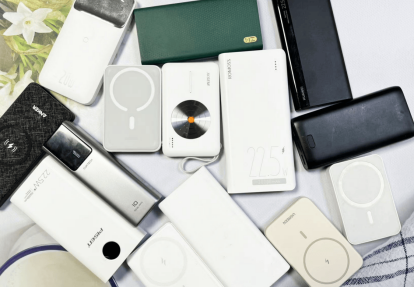
Standardized Fast-Charging Iteration (2017–2022)
Released on December 29, 2017, GB/T 35590 General Specification for Portable Power Banks for IT Digital Devices became China’s first official national standard for power banks. It unified mandatory rules for capacity labeling, safety circuits and output power, ending the unregulated chaotic phase of the industry.
After 2018, slim lithium polymer pouch cells gradually replaced traditional 18650 cylindrical cells, The thickness of power banks has been greatly reduced. High-power PD fast charging (30W, 45W, 65W) had gained widespread popularity, this power bank can charge normal electric products such as smartphones, tablets and lightweight laptops simultaneously. In August 2023, mandatory CCC certification was fully enforced in China; any power bank without valid CCC marks was banned from sales, greatly reducing thermal runaway risks.
During this period, manufacturers focused on lightweight, multi-port output, universal fast-charging compatibility and multi-layer temperature control protection circuits, forming the basic type of wired power banks at that time.
Multi-Functional Wireless Innovation Stage (2023–Present)
Apple launched MagSafe magnetic wireless charging in 2020, and the WPC Consortium released the unified Qi2 magnetic wireless standard in 2023, pushing slim magnetic power banks to become the top choice for daily commuters.
The market split into two distinct product lines: compact 5000–10000mAh magnetic wireless power banks for daily travel, and high-capacity 20000mAh+ high-output outdoor power stations supporting cameras, drones and vehicle equipment. Semi-solid battery cells and low-temperature thermal control technology have been gradually commercialized, further improving charging speed and safety. Power banks have evolved from simple emergency accessories into all-scenario portable energy storage devices.
Core Internal Components
A power bank is a highly integrated portable energy storage device. Its system consists of six core parts: lithium battery cells, main control PCB board, voltage conversion ICs, output port modules, temperature control protection components and structural shell. All components are miniaturized to keep the device lightweight, while balancing charging safety, energy conversion efficiency and compatibility with multiple digital devices.
Lithium Battery Cells
Battery cells serve as the core energy storage unit of power banks. There are two major types widely used on the market:
18650 cylindrical lithium cells: The classic solution for early power banks It only needs low production costs. Encased in metal cylinders, each cell holds a capacity of 2000–3000 mAh. However, they are bulky and heavy with low space utilization, now only applied to large-capacity outdoor power banks.
Lithium Polymer (Li-Po) pouch cells: The popular power banks with slim body. Sealed with aluminum plastic film, they can be cut into custom shapes to fit compact frames. Li-Po cells are lighter, thinner and safer than cylindrical cells, becoming the primary option for daily portable chargers.
Cells are connected in series and parallel to adjust the total capacity and rated voltage. All final power banks are equipped with cell protection substrates to avoid damage from overcharging or over-discharging single cells.
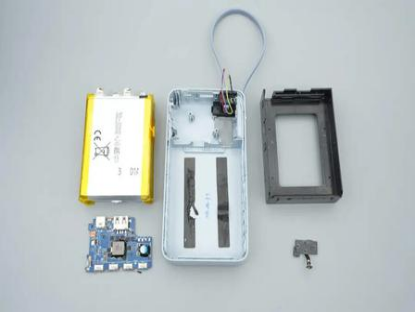
Main Control PCB Board
The PCB board acts as the central brain of the power bank, carries all control and protection circuits, integrating electronic components and managing overall operation:
Identify fast-charging protocols including PD, QC and Qi2;
Monitor real-time voltage, current and temperature data of cells;
Activate all safety protection mechanisms automatically;
Coordinate step-up and step-down ICs for energy conversion.
A qualified main control board is built with multi-layer protective circuits, which is a key factor to differ certified safe products or unbranded low-quality models.
Step-up & Step-down Conversion ICs
Lithium cells only carry a nominal voltage of 3.7V, while smartphones, tablets and other electronics require different charging voltages such as 5V, 9V and 12V. Conversion ICs handle voltage regulation:
Self-charging mode: Step-down ICs reduce external input voltage (5V/9V) to stable 3.7V for cell storage;
Discharging mode: Step-up ICs boost the cell’s 3.7V low voltage to the standard voltage required by external devices and deliver steady current.
High-power PD power banks adopt independent multi-channel conversion ICs to maintain stable fast charging when multiple ports are used simultaneously.
Output Port Module
This module transmits power to external gadgets, covering mainstream port types:
USB-A: Traditional wire output port with older charging cables;
USB-C: The core bidirectional fast-charging port, which can recharge the power bank itself and deliver high-power to phones and laptops;
Magnetic wireless coil: Exclusive for magnetic power banks, transferring power via electromagnetic induction without cables.
Premium power banks are equipped with multiple ports to charge mobile phones, earbuds and smartwatches at the same time.
Temperature Sensing & Protection Components
This set includes thermistors, fuses and short-circuit resistors to guarantee safe operation:
Thermistors continuously detect the temperature of cells and PCB boards; the system cuts off power output once overheating;
Disposable fuses will immediately disconnect the circuit in case of short circuits or overcurrent to eliminate fire hazards.
Five critical protection functions can be realized: overcharge protection, over-discharge protection, over-current protection, short-circuit protection and over-temperature protection.
Outer Shell & Structural Frame
Shells are made of flame-retardant PC, ABS composite materials or aluminum alloy, featuring insulation, drop resistance and fire resistance. Internal brackets fix cells and circuit boards to prevent loose wiring caused by shaking during transportation. Manufacturers adopt curved and ultra-slim designs to improve grip comfort, while reserving heat dissipation gaps for component cooling.
Operation Principle of Power Banks
A power bank runs on two core closed-loop cycles: self-charging (energy storage) and external discharging (power supply). All core parts — the main PCB, voltage conversion ICs, lithium cells and temperature sensors — work in tandem throughout operation. All power banks follow this basic operating logic; fast-charging versions only add extra protocol recognition steps.
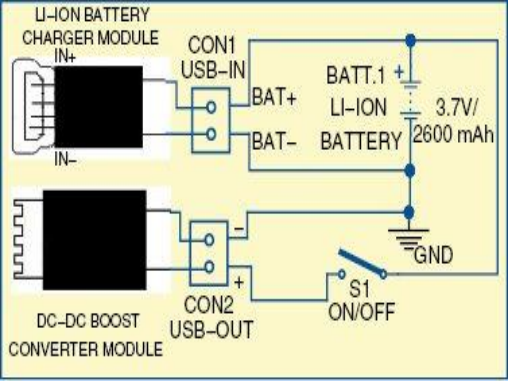
Self-Charging Cycle (Store Energy into Cells)
When users plug the Type‑C port of the power bank into a wall charger, external current rated at 5V, 9V or 12V will first pass through built-in fuses and thermistors for real-time safety inspection. If short-circuit risks or excessive temperature are detected during this process, the circuit will be cut off instantly to eliminate hidden dangers. Afterwards, the current flows into the step-down conversion IC, which steadily reduces the high input voltage to 3.7V — the standard storage voltage for lithium battery cells. The stabilized electric current then enters the internal cell pack connected in series and parallel for energy storage. Beyond that, the main control PCB balances every cell strings to make sure no single battery cell gets overcharged.
When voltage hits the 4.2V ,the full-charge cutoff point, the onboard control chip cuts off the charging circuit timely. This design effectively avoids battery overheating, premature aging and irreversible damage brought on by overlong charging sessions.
Discharging Cycle (Charge External Devices)
Once charging cables or magnetic wireless coils connect smartphones, earbuds, smartwatches or other gadgets, the main circuit board detects the external load and activates discharge mode. Fast-charging power banks can automatically recognize charging signals from connected devices, identifying the different standards and adjust output power. The 3.7V low-voltage current released from the battery cells is then sent to the step-up IC, which intelligently boosts the voltage to 5V, 9V, 12V or 15V according to the power requirements of electronic devices. Even when multiple ports are used simultaneously, the chip distributes power evenly to sustain steady power output. Regulated stable current is delivered through USB-A ports, Type-C ports or wireless magnetic coils to recharge the built-in batteries of digital devices. When the cell voltage drops to the 3.0V cut-off discharge limit, the system shuts down power output entirely, so as to prevent irreversible permanent degradation of battery cells resulting from deep over-discharging.
Full-Range Safety Protection (Works During All Operations)
The system monitors voltage, current and temperature in real time and halts operation once abnormalities appear:
Overcharge protection: Stop charging when electric cells are full
Over-discharge protection: Cut output of power when battery runs out.
Over-current & short-circuit protection: Fuses break the circuit to avoid hazards
Over-temperature protection: Suspend charging/discharging for cooling when overheated
No-load sleep: Enter low-power standby after 30 seconds without connected devices to save power
Glossary of General Professional Terms
This chapter sorts out standard industry terminologies widely applied to power banks and portable energy storage products. All definitions comply with China national standard GB/T 35590 and universal specifications of the consumer electronics sector. It unifies all technical expressions mentioned above, helping ordinary users comprehend product parameters while serving as a professional reference for practitioners.
Rated Capacity
Rated capacity refers to the effective electric quantity that a portable charger can stably output under standard test conditions, measured in mAh. It differs from the nominal capacity of individual battery cells. Rated capacity represents the actual usable power remaining after energy losses from voltage conversion and circuit consumption, and it is the only valid marking standard recognized by national quality inspection authorities. Many unbranded products mislead consumers by mixing up cell capacity and rated capacity with exaggerated figures.
Nominal Cell Voltage
The standard operating voltage of lithium-ion cells is universally set at 3.7V, which serves as the basic storage voltage inside power banks. This low voltage cannot directly charge smartphones or laptops; voltage adjustment via step-up and step-down chips is mandatory to complete charging and discharging cycles, laying the foundation for the power bank’s entire voltage conversion mechanism.
Full-charge & Discharge Cut-off Voltage
These two voltages are designed to protect lithium cells against damage. The charging circuit will automatically disconnect when the cell voltage rises to 4.2V (full-charge cut-off voltage) to avoid hazards from overcharging. When the voltage drops to 3.0V (discharge cut-off voltage), the whole system stop provide power to prevent cell degradation caused by deep over-discharging and extend battery life.
Energy Conversion Efficiency
It is the ratio of output electricity to stored electricity inside battery cells, a key indicator to evaluate the performance of power management circuits. Energy loss is inevitable during voltage conversion and electric transmission. Certified high-quality power banks achieve a conversion efficiency of 85% to 95%, while inferior unqualified goods suffer severe energy waste, resulting in far less usable power than marked on the shell.
Fast-charging Protocol
Fast-charging protocols are interactive communication rules between power banks and digital devices to realize high-power rapid charging. Widely adopted mainstream standards include PD, QC and Qi2. PD is a universal wired fast charging standard compatible with iPhones, laptops and most electronic gadgets; QC is specially developed by Qualcomm for Android smartphones; Qi2 is the global standard for magnetic wireless charging. Fast-charging power banks can automatically identify matched protocols and adjust output power accordingly to speed up charging.
Overcharge / Over-discharge / Over-current Protection
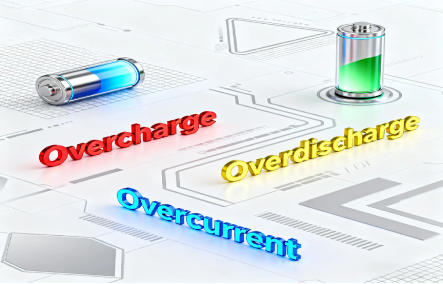
These three fundamental safety protection functions are mandatory requirements stipulated by national standards for all portable power supplies. Overcharge protection cuts off charging input once batteries are fully charged; over-discharge protection forbids forced power output when battery power is exhausted; over-current protection breaks the circuit when excessive abnormal current emerges. Working alongside short-circuit and over-temperature protection, these functions comprehensively prevent hidden dangers including battery swelling, overheating and combustion.
No-load Sleep Mode
No-load sleep mode is a standard low-power energy-saving design adopted by modern power banks. When no digital device is connected to the output ports, the power bank will automatically enter standby sleep mode in roughly 30 seconds, greatly reducing static power consumption and preventing unnecessary power loss during idle storage.
Series-parallel Cell Connection
Manufacturers assemble lithium cells in series and parallel combinations to produce power banks with diverse capacities and output power ratings. Series connection elevates the overall voltage of the battery pack, whereas parallel connection expands total storage capacity. Meanwhile, the main control board balances the voltage of every individual cell to ensure stable operation of the whole device.
CCC (China Compulsory Certification)
CCC certification is a statutory mandatory access qualification for all power banks sold on the Chinese mainland market, which has been fully enforced since August 2023. Products that pass CCC certification have undergone rigorous tests covering safety circuits, flame-retardant housing materials and battery protection systems. Any power bank without a valid CCC label is classified as non-compliant and prohibited from production and sales within China.
Li-Po Pouch Cell & 18650 Cylindrical Cell
They are the two most prevalent energy storage cells used in power banks nowadays. The 18650 cylindrical cell with low cost has stable physical structure, and is primarily adopted for large-capacity outdoor portable power stations. Lithium polymer soft pouch cells are thinner, lighter, safer and customizable in shape, becoming the primary choice for slim portable power banks of daily commuting.