Risposta rapida: La potenza di ingresso di un power bank descrive la velocità con cui può ricevere potenza durante la ricarica. Il wattaggio di uscita descrive cosa può fornire a un altro dispositivo. Sono valutazioni separate, spesso con limiti diversi e profili di alimentazione USB. Una banca pubblicizzata come "65W" può significare 65 W da una porta di uscita mentre il suo input è inferiore. Leggere le tabelle di input per porta, output per porta e output simultaneo prima di prevedere il tempo di ricarica o le prestazioni del laptop.
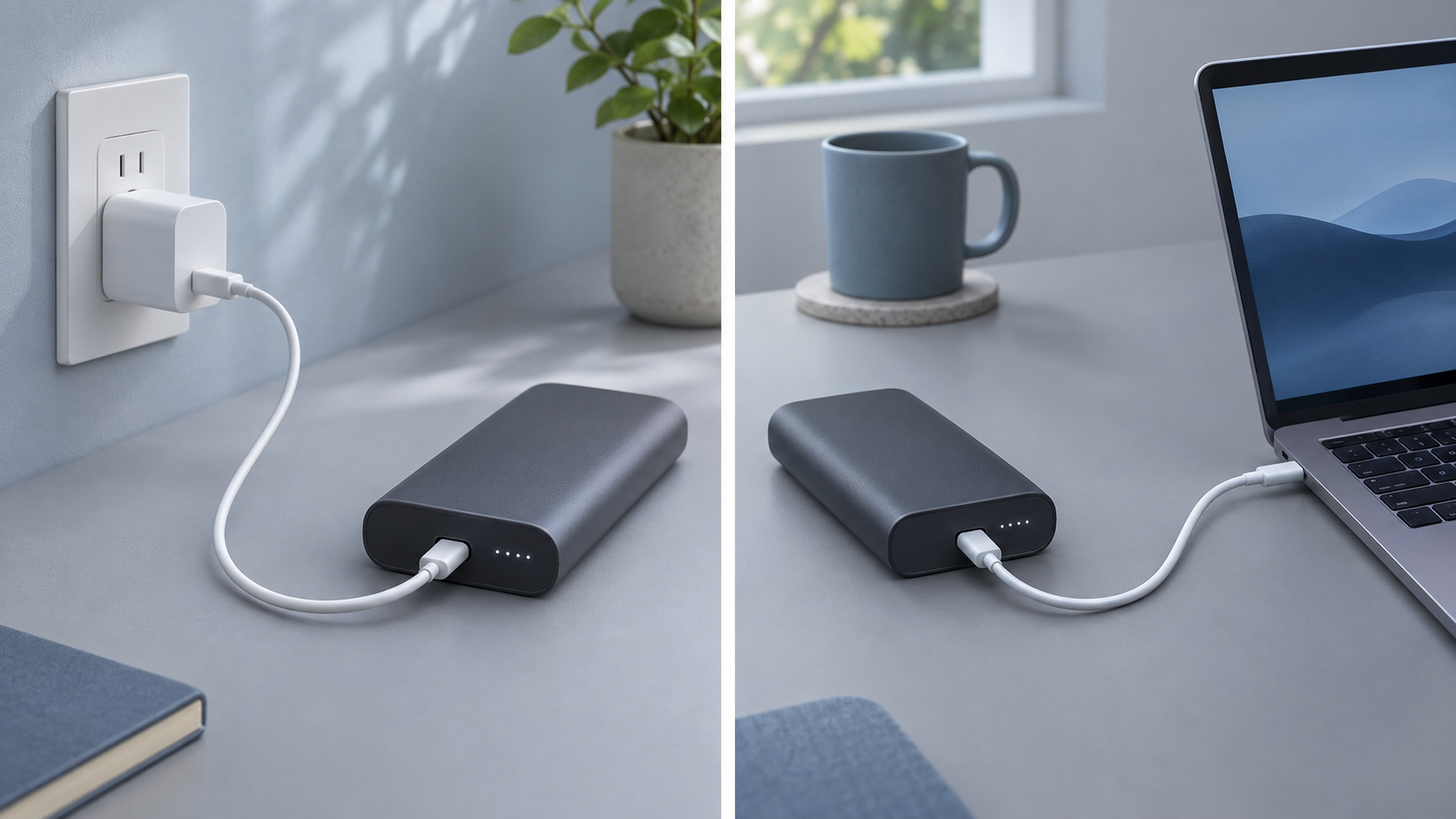
In che modo si muove il potere?
Quando un adattatore da parete carica la banca, la banca è il dispositivo ricevente. Quando la banca addebita un telefono o un laptop, è la fonte di alimentazione. USB-C può supportare diversi ruoli di alimentazione e una porta a doppio ruolo può cambiare il suo ruolo a seconda di ciò che è collegato. Le Panoramica di Type-C di USB Implementaters Forum Distingue la sorgente, il lavandino e l'alimentazione a doppio ruolo. Un connettore che sembra identico in entrambe le direzioni non significa che la potenza sia identica in entrambe le direzioni.
Look for label phrases such as “USB-C IN,” “USB-C OUT” or “IN/OUT.” Then read the voltage/current lines below each one. A hypothetical label might list input up to 30W and output up to 65W on a USB-C port. That means a compatible laptop may receive a higher peak power than the bank can accept from a charger. The example is for reading labels, not a specification of a product sold here.
| Specificazione | Direzione | Cosa può dirti | Cosa non può promettere |
|---|---|---|---|
| Ingresso USB-C: 30W max | Caricatore da parete in banca | una modalità di picco accettata in condizioni dichiarate | A full recharge in battery Wh divided by 30W exactly |
| Uscita USB-C: max 65W | da banca a dispositivo | Modalità massima offerta di una porta | Ogni laptop disegnerà 65 W |
| Uscita a due porte: totale di 45W | Banca a due dispositivi | un soffitto condiviso per quella combinazione | Ogni dispositivo ottiene una quota uguale |
| Energia cellulare: 74Wh | Energia immagazzinata | una quantità di energia nominale | 74Wh consegnato al connettore USB |
Perché una banca ad alto rendimento può ricaricarsi lentamente
L'elettronica di uscita e l'elettronica di carica in ingresso possono essere progettati a limiti diversi. Una banca orientata al laptop può dare la priorità a un'uscita USB-C alta mentre accetta un input più modesto dal muro. L'adattatore a parete e il cavo fissano anche un soffitto. Una banca che accetta 30 W non può ricaricarsi a 65 W semplicemente perché l'adattatore dice 65 W e un adattatore con solo una modalità a bassa potenza potrebbe non raggiungere l'ingresso massimo della banca. USB Power Delivery richiede la negoziazione compatibile con la sorgente e la ricezione del dispositivo; La Panoramica USB-IF spiega il protocollo.
Do not divide the printed battery watt-hours by peak input wattage and treat the result as a guaranteed full-charge time. Charging power changes as the battery fills, and conversion creates losses. For a meaningful comparison, use the same starting charge indication, adapter, cable and room conditions; record time to the maker’s full-charge signal. If a pack has several input paths, verify whether they can be used together rather than assuming their maxima add.
Perché un laptop può disegnare meno dell'etichetta di output
The laptop must support charging through the specific USB-C port, accept one of the bank’s offered voltage/current profiles and use a suitable cable. A sleeping laptop may draw differently from one under a heavy workload. Near full charge, many devices taper their draw. A bank may also reduce its output when its own battery is low or when another port is occupied. The largest number on the box is not a constant power guarantee.
Read the simultaneous-output table when charging a laptop and phone together. If it is absent, ask the supplier for the full port matrix. A USB power meter can reveal the negotiated voltage and current during a test, provided the meter supports that range and protocol. A laptop’s battery percentage alone mixes incoming power with its own consumption, so it cannot establish the bank’s electrical output by itself.
Input, output e pass-through sono tre diverse affermazioni
Some banks can recharge themselves while they power another device; others cannot, or they restrict speed or features when both directions are active. That behavior is commonly called pass-through charging, but it is not guaranteed by an “IN/OUT” label. An IN/OUT port may simply switch between roles at different times. Do not connect a wall adapter and a laptop simultaneously expecting a pass-through function unless the exact manual supports it and identifies a safe connection pattern.
Per un campione OEM, chiedere se l'input e l'output possono funzionare insieme, quali combinazioni di porte sono consentite, se il banco dà priorità a se stesso o al dispositivo collegato e cosa succede se l'alimentazione a parete è disconnessa. Registrare il calore e il comportamento di riconnessione sotto il carico previsto. Una pagina del prodotto del sito senza queste informazioni non è sufficiente per pubblicizzare la capacità pass-through.
| Sintomo | possibile spiegazione | Controlla prima |
|---|---|---|
| La banca si ricarica lentamente | Input rating below adapter rating | Profili di ingresso del banco, uscita dell'adattatore e cavo |
| Il telefono costa ma il laptop no | Output voltage/profile mismatch | Supporto USB-C per laptop e uscita bancaria per porta |
| Il laptop rallenta quando il telefono è collegato | Budget di output condiviso | Matrice di uscita simultanea |
| Il banco interrompe l'uscita quando è collegato il caricatore a muro | pass-through o modifica della modalità non supportata | Manuale del modello esatto, non forma del connettore |
| Visualizza le variazioni di potenza durante la ricarica | Cambio di carico cono o dispositivo | Ripetere in condizioni controllate |
Confronta i modelli effettivi in base alla loro matrice di porte completa
Le 20.000mAh 65W Power Bank e 20.000mAh 35W Banca solare are different design starting points. Their listing titles alone do not establish input wattage, usable energy, pass-through support or suitability for a particular laptop. Request the latest label, user manual and tested input/output table for each exact SKU before comparing them. Solar replenishment is a separate input question; it does not change the USB-C output protocol by itself.
Per un brief all'ingrosso, indicare il caricabatterie da parete target, il modello di laptop, il cavo, l'uscita a porta singola richiesta e il tempo di ricarica accettabile. Definire se l'operazione simultanea è importante. Quindi chiedi i risultati del campione con letture dello strumento, condizioni di inizio e fine della batteria e note di temperatura. Questo trasforma la "carica veloce" in un requisito verificabile e impedisce che un titolo di uscita venga scambiato per una promessa di input.
Come leggere una specifica di vendita confusa
If a page says “65W fast charge” without a direction, look for a detailed image of the rear label or downloadable manual. Write a separate line for each port and role: USB-C1 input, USB-C1 output, USB-C2 output and combined output. Then write the voltage/current profiles alongside the claimed maximum. If the information is unavailable, ask the seller rather than reverse-engineering it from a single phone test. The same principle applies to solar-assisted banks: the solar panel’s rated peak, the bank’s USB input limit and the bank’s USB output limit are three distinct figures. Panel production also depends on sunlight, orientation and temperature. No single headline number describes all three paths.