Introduction
Smart glasses, unlike traditional eyewear, are wearable devices integrated with built-in chips, sensors, audio systems and display modules. Users can control this device purely via voice commands to receive real-time alerts, capture images and enable multilingual translation, seamlessly bridging digital information and real-life scenarios.They fit a wide range of daily scenarios including work, entertainment and outdoor travel, and have grown into one of the most popular mainstream wearable products on the market.
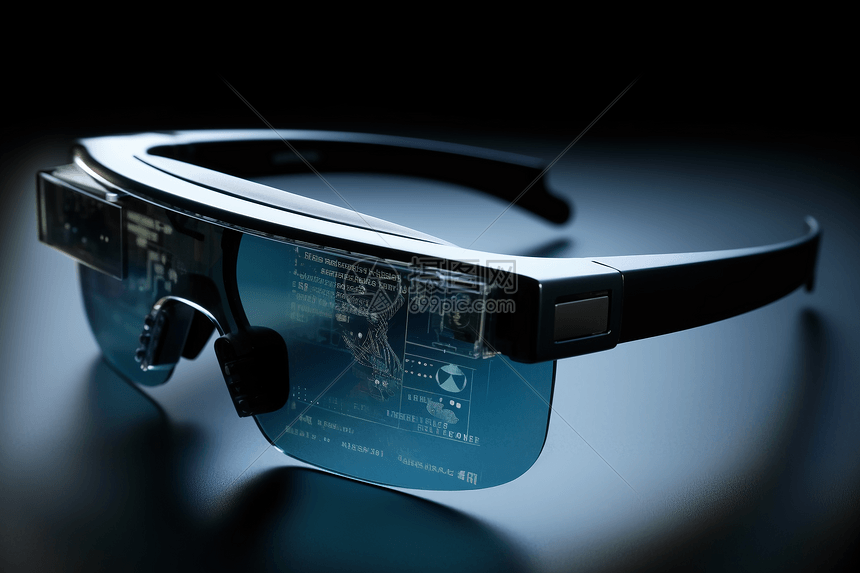
There are some useful types of smart glasses. Firstly, audio-only voice -controlled smart glasses. This type has no screen, only uses microphones and open audio speakers. Its appearance is identical to regular glasses. It is light, long battery life which is suitable for commuting, driving and doing sports. It is used for answering calls, playing music, activating voice assistants and basic voice translation. Secondly, voice interaction smart glasses with built-in camera. It adds a front-facing camera. This type realize one click photo, first-person video recording, object recognition and real-time conversation translation. All content can be checked on paired mobile phones without an on-lens screen. Thanks to its low-profile, wearable design, users can rely on it for life recording, cross-linguistic communication and quick QR code scanning. Thirdly, AR Projection Display Smart Glasses. These glasses can project a floating virtual large screen with waveguide optical lenses. They are compatible with mobile phones, computers, and game consoles to support portable movie watching, external display for office work, and pop-up navigation prompts within the field of vision.
What you will learn
The following topics will be covered in detail in this tutorial:
The invention and evolution of smart glasses
Core components that constitute smart glasses
Standard professional terminology for smart glasses
History
Smart glasses are not an overnight technological invention. They have evolved from conceptual prototypes in labs into mature consumer-grade wearable devices after six decades of continuous iteration. There is no single inventor of smart glasses; their development is driven by cross-industry theoretical innovations, hardware upgrades and market-oriented optimization.
Conceptual Initiation(1930-1990)
The earliest concept of smart glasses can date back to 1935. In the short story Pygmalion’s Spectacles, science fiction writer Stanley G. Weinbaum first proposed the idea of eyewear integrated with visual information interaction, laying the initial theoretical foundation for head-mounted intelligent display technology.
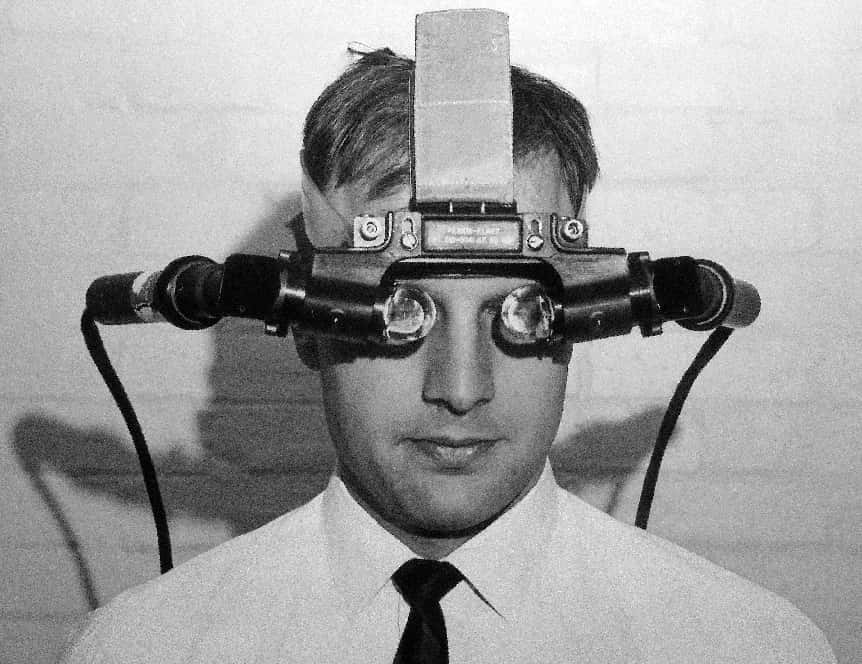
In 1968, Ivan E.Sutherland, a pioneer in computer graphics, developed the first head-mounted(HMD) Display around the world and nicknamed the “Sword of Damocles”. Although this equipment was heavy and need suspended overhead to be stable. It had initially realized the superposition of virtual graphics and real-world vision, becoming the technical origin of modern VR and smart glasses.
In the 1990s, Augmented Reality (AR) was formally established as independent and technical subject. Researcher Ronald T. Azuma defined three core technical criteria of AR: real-virtual fusion, real-time interaction, and three-dimensional spatial registration. These criteria clarify the technical direction for subsequent industrialization of smart glasses. However, the relevant equipment were only deployed in project-based labs and industries. and failed to meet civilian wearable requirements due to excessive weight and insufficient battery performance.
Industry trial (2000-2016)
At the beginning of the 21st century, benefiting from miniaturization development of sensors, chips and communication modules, head-mounted display devices were gradually deployed in commercial scenarios such as industrial maintenance, remote medical service, and outdoor navigation, verifying the practical value of head-level interaction technology.
2012 is the turning point for consumer smart glasses. Google launched Project Glass at its Google I/O Developer Conference and released The Google Glasses Explorer Edition. This equipment, equipped with a prism display, built-in camera, and voice control system,could support hands-free photography, recording, navigating and notice push, bringing smart glasses into global consumer market for the first time.
This generation of products failed to achieve large-scale mass-market popularity because of their high price, limited battery life, and insufficient daily application scenarios. In 2014, Recon instruments launched Recon Jet, the first smart glasses used for sports, combining GPS and motion sensing modules and drove the industry to classify products according to different scenarios. In 2016, Microsoft released HoloLens, updating spatial computing and AR display technology. which promoted the iterative upgrading of industrial-grade smart glasses.
Diverse and consumer Adoption (2017-2022)
After the cooling of early AR large-screen boom, the industry abandoned a single high-end display solution, and shifted toward differentiated, lightweight, and consumer-oriented iteration. Manufacturers released new smart glasses with no-screen voice version, slim camera version to solve bulky build, high recognition appearance, insufficient battery life and poor daily application. The silhouette of smart glasses is similar to traditional glasses. This era greatly remedied the core flaws of early products such as cumbersome build and poor wearing comfort. But their function focus on frequent necessary applications such as voice calling, music playback, real-time translation and daily recording. With the development of mini-battery products and low-power chip technologies,consumer smart glasses have made great improvements in the battery life, wearing comfort and privacy, fully adapting to mass scenarios such as daily commuting, sports and office use, and realizing preliminary popularization in the consumer market.
AI Empowerment and Full-scenario Popularization (2023–Present)
Starting from 2023, the in-depth integration of large AI models technologies has driven explosive growth across the smart glasses industry. The AI model are highly compatible with wearable and lightweight equipment enabling it realizes multilingual translation, object recognition and instant information retrieval, compensating for drawbacks of early smart glasses with limited applicable scenarios.
At present, the industry has built a systematic product portfolio including three mainstream categories of smart glasses: audio-only voice-controlled, camera-equipped interactive recording and AR waveguide projection display. New-generation products feature lighter weight, stronger privacy protection and broader scenario compatibility. Shipments of consumer-grade smart glasses keep surging globally, making them one of the most promising wearable hardware products following smartwatches and TWS (True Wireless Stereo) earbuds.
Components
Core Components of Smart Glasses
As a comprehensive wearable intelligent terminal, smart glasses integrate optical structure, sensing modules, computing chips, audio units and power systems. All core components are miniaturized and highly integrated to balance lightweight wearing experience, low power consumption and multi-functional expansion.
Main Control Chip
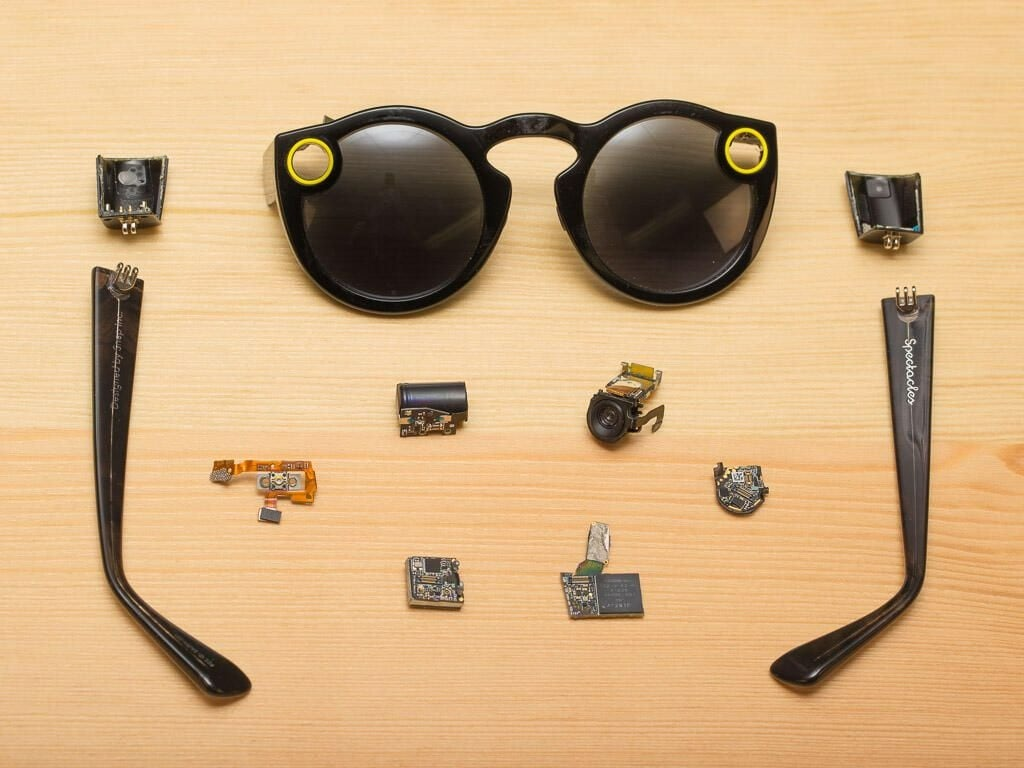
The main control chip is the core computing center of smart glasses, responsible for system operation, voice algorithm processing, sensor data calculation, device linkage and power management. Modern consumer smart glasses adopt ultra-low-power wearable dedicated chips, which ensure stable daily operation to reduce heat generation and extend battery life. AI smart glasses are additionally equipped with built-in AI computing units to support local real-time translation, scene recognition and intelligent analysis.
Optical Module & Lens System
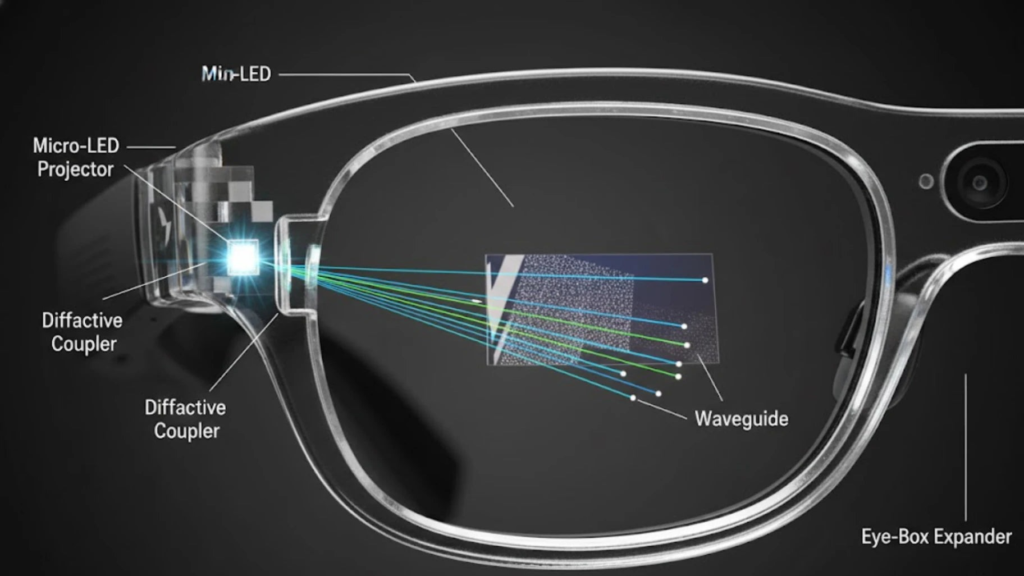
The optical system determines the visual experience of smart glasses and distinguishes different product types.Audio-only smart glasses adopt traditional transparent lens structure, focusing on wearing comfort and light transmittance without display module.Camera-equipped smart glasses remain high-transparency daily lenses, matching front-facing camera sensors for first-person shooting and recording. AR display smart glasses apply mainstream waveguide optical technology, including surface wave guide and diffraction wave guide. The ultra-thin optical structure realizes virtual screen projection without blocking the real field of view, achieving real-virtual fusion display.
Sensor Group
Smart glasses are equipped with a complete miniaturized sensor array to realize perception and interaction:
Microphone Array: Supports voice capture, noise reduction, wake-up recognition and real-time translation.
IMU Sensor (Accelerometer + Gyroscope): Detects head posture, motion state and wearing status to realize intelligent pause and power saving control.
Camera Sensor: Applied for image capture, video recording, object recognition and visual translation.
Positioning & Environment Sensors: High-end sports and AR models are equipped with GPS, ambient light sensors and proximity sensors to adapt to outdoor and scene switching scenarios.
Audio Output Module
Most consumer smart glasses adopt open-ear audio conduction technology. Instead of sealing off the ear canal like conventional in-ear headsets, open-ear audio units transmit sound through air conduction, leaving users’ ears unobstructed. This design has greatly improved comfort and safety of driving, commuting and sports scenarios.
Battery & Power Management Module
Limited by ultra-light body design, smart glasses are equipped with miniaturized high-density lithium polymer batteries. Combined with low-power chip scheduling and intelligent power management algorithms, the equipment achieves long battery life in lightweight size. The power management system also controls overcharge, over-discharge and temperature protection to ensure safe daily wearable use.
Structural & Wearable Shell
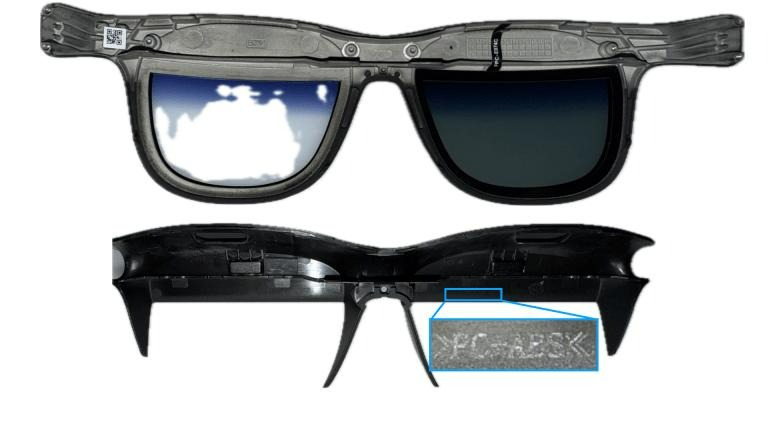
The shell frame is made of lightweight, high-toughness and skin-friendly materials such as titanium alloy, TR90 and PC composite materials. The ergonomic frame structure reduces facial pressure, ensuring long-time wearing comfort while integrating and protecting all internal precision components.
Operation
Operation Principle of Smart Glasses
The whole working logic of smart glasses can be simplified into four phases: signal collection → data calculation & processing → instruction execution → user feedback. Different types of smart glasses follow the same basic operational framework, but differences are only presented in the final output form of information.
Signal Input & Information Collection
Multiple built-in sensors complete external information acquisition at the input end.
The microphone array collects voice signals from the environment and human speech; the IMU inertial sensor continuously captures head movement and wearing state; the built-in camera collects real-time image frames when activated; ambient light and proximity sensors perceive external light intensity and whether the glasses are being worn.
All collected raw data is transmitted to the main control chip for unified reception.
Central Calculation and Data Processing
As the core computing hub, the main chip filters noise data first.
For voice commands: the system conducts noise reduction, voice wake-up and speech recognition, converts voice content into text instructions, and invokes corresponding functional programs.
For image data: the chip uses local AI algorithms or connects to the paired mobile phone for cloud computing to finish object identification, text translation and QR code recognition.
For motion sensing data: the system judges the user’s usage state, automatically standby when the glasses are taken off, and optimizes power consumption in real time.
In AI-enabled smart glasses, most identification and translation tasks can be completed on the device without relying on mobile phone network transmission, which reduces delay and improves response speed.
Instruction Execution & Information Output
According to processed instructions, the device triggers corresponding hardware modules to realize information output, which varies by product category:
Audio smart glasses: Push audio content such as calls, music and translation results through open-ear speakers. No visual display is generated.
Camera-equipped smart glasses: Store photographed photos and recorded videos in local storage or synchronize files to the bound mobile terminal; all text and translation information is displayed on the connected mobile phone screen instead of the lens.
AR projection smart glasses: The chip transmits image signals to the wave guide optical module, projecting virtual pictures, navigation interfaces and video screens into the user’s field of view to realize overlay display of virtual content and real scenes.
Power Loop and End of Work Cycle
When no clear instruction is received for a certain time, the power management module automatically reduces the chip operating frequency and enters low-power standby mode to save electricity.
Once the user takes off the glasses, the proximity sensor sends a shutdown signal, the system terminates all tasks and cuts off most power supply.
When the battery power is exhausted, the equipment will automatically shut down; after connecting the charging power source, the power management chip restores the battery chemical state to complete charging and resume operation.
Brief Note on Connection Mechanism
Most consumer smart glasses establish a Bluetooth Low-energy connection (BLE) with smartphones. The mobile phone serves as an auxiliary computing and storage terminal, expanding the storage space, network access capability and software functions of the glasses, which is an indispensable part of the overall operation system.
What 30+ Private-Model Projects Taught Us About Smart Glasses
We build smart glasses for a living — more than 30 private-model projects have come off our Dongguan production lines in recent years, from simple audio frames to AI camera glasses. That experience gives us a slightly different answer to “what are smart glasses” than most blogs: in volume terms, the market is dominated by audio-first glasses (speakers, mic, calls, a voice assistant). True AR displays remain a niche, high-cost segment — the optics alone can multiply the bill of materials several times over.
When a brand approaches us to develop a model, the first conversation is almost always about which of those tiers the product actually belongs to, because it drives everything downstream: BOM cost, tooling, certification scope, and target retail price. If you’re evaluating smart glasses as a buyer, it helps to ask that same question first.
Terminology
To help users better understand product parameters, functional differences and purchasing standards, this chapter systematically explains the core professional terms commonly used in consumer-grade smart glasses. These standard definitions are universally adopted in the wearable device industry and apply to audio smart glasses, camera interactive glasses, and AR display smart glasses.
Wearable Terminal
A wearable terminal refers to miniaturized intelligent hardware that can be worn on the human body, equipped with built-in sensors, computing units and interactive modules. Unlike traditional passive glasses, smart glasses are typical wearable terminals that realize active perception, data processing and human-computer interaction.
Open-ear Audio Technology
Open-ear audio is the mainstream audio solution for consumer smart glasses. Instead of blocking the ear canal like traditional earphones, it transmits sound through air conduction. It allows users to clearly hear media audio while retaining real-world environmental sounds, ensuring safety during driving, commuting and sports.
IMU Sensor (Inertial Measurement Unit)
IMU is a composite sensor composed of an accelerometer and a gyroscope. It tracks the user’s head posture, movement angle, wearing state and motion track in real time. It supports automatic sleep, wake-up control and motion scene recognition, and is the core sensing component for intelligent power saving and interactive experience.
Wave guide Optical Display
Wave guide optics is the core display technology of AR smart glasses. It transmits virtual image light through ultra-thin optical wave guide layers and projects floating images into the user’s field of view. Compared with traditional screen projection, wave guide display features high transparency, no visual obstruction, and real-virtual fusion effects, which is the key to lightweight AR display.
Field of View (FOV)
Field of View refers to the effective viewing range of AR display content, measured in degrees (°). A wider FOV means a larger virtual screen size and a more immersive visual experience. It is one of the core parameters to evaluate AR projection performance.
Low-power Bluetooth Connection
Most consumer smart glasses adopt Bluetooth Low Energy (BLE) connection. It realizes stable wireless linkage between glasses and mobile phones with extremely low power consumption, supporting data synchronization, real-time translation transmission, file backup and device control.
On-device AI Computing
On-device AI means that smart glasses complete algorithm calculation, voice recognition, scene identification and translation processing locally through the built-in AI chip, instead of relying on mobile phones or cloud servers. It effectively reduces network delay, improves response speed and protects user privacy.
Standby Time & Working Time
Working time refers to the continuous usable duration under functional working states such as music playback, call and translation. Standby time refers to the longest idle time when the device is powered on but keeps no functional operation. Smart glasses adopt intelligent power management to balance lightweight design and battery durability.
First-person Perspective Recording
First-person perspective recording is a unique visual function of camera-equipped smart glasses. The built-in front camera captures footage completely consistent with the user’s viewing angle, realizing real-life recording without handheld devices.
If you’re interested in our smart glasses series, feel free to get in touch with us. As an original manufacturer with full production capacity, we offer direct factory supply and customizable solutions to meet your business demands. We look forward to establishing long-term win-win cooperation with you.We offer a full range of smart glasses equipped with diverse functions tailored for all usage scenarios.
If you’re mapping out a smart glasses product line, we can help you pressure-test the concept. YHR Technology is the original manufacturer — in-house tooling, SMT, assembly and QC, a 500-piece MOQ, and full ODM support. Send us your target spec and market, and we’ll come back with a straight, factory-based answer.