Short answer: There is no reliable charge count from “30000mAh” alone. The bank’s cell voltage, its usable USB output, the phone battery’s energy, and what the phone does while charging all matter. A practical estimate starts in watt-hours (Wh), then treats conversion losses as a planning range rather than a universal efficiency promise. For a hypothetical 30000mAh pack rated at 3.7V and a hypothetical 15Wh phone, a 60–80% usable-energy scenario gives roughly 4.4–5.9 equivalent full charges. That is an illustration, not a test result or a promise for any product.
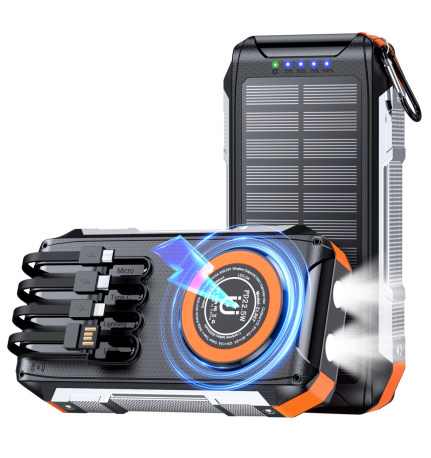
Comience con la etiqueta, no un recuento de cargos de marketing
A milliamp-hour value describes charge at a specified voltage. It is not, by itself, the energy delivered through a 5V USB port. The US Federal Aviation Administration explains the basic calculation for lithium batteries: divide mAh by 1000 to obtain Ah, then multiply by the battery voltage to obtain Wh. See the FAA battery guidance. If a listing gives both mAh and Wh, use the actual Wh printed on that specific unit and resolve any discrepancy with the seller. Do not substitute a voltage from another model.
The 30000mAh number may describe the internal cells, while a phone accepts power after voltage conversion. The bank also uses energy to run its electronics; the cable and phone charging circuit introduce further losses. As a result, dividing 30000 by a phone’s advertised mAh is an invalid shortcut. It mixes capacities stated at potentially different voltages and assumes every stored joule reaches the phone battery. Even when the phone and bank use similar cell voltages, conversion and standby losses still matter.
| Entrada | donde encontrarlo | Por qué importa |
|---|---|---|
| Bank rated capacity in Wh | Etiqueta de producto o especificación específica del modelo | Starting energy budget; use the printed value rather than an assumed cell voltage |
| Phone battery energy in Wh | Documentación técnica del teléfono o etiqueta de batería | Denominador por cargos completos equivalentes |
| Usable USB output in Wh | Prueba de descarga específica del modelo en el puerto y carga correspondientes | Captura la conversión y las pérdidas internas |
| Energía del teléfono utilizada durante la carga | Su patrón de uso, como navegación o video | Puede reducir la ganancia neta en la batería del teléfono |
Calcule los cargos completos equivalentes en tres pasos
1. Convert the bank rating to watt-hours
For illustration only, suppose a 30000mAh pack is explicitly rated at 3.7V. The arithmetic is 30Ah × 3.7V = 111Wh. If a different 30000mAh model has a different stated voltage or Wh rating, this example does not describe that model. Check the actual label before buying, especially when the calculation will inform travel or business purchasing. A missing or inconsistent label is a reason to ask the supplier for the model’s electrical specifications, not a reason to infer them from a product photograph.
2. Estimar la producción utilizable de forma conservadora
La mejor entrada es una cifra de energía de salida USB medida para el banco, el puerto, el cable y la carga exactos. Cuando no está disponible, puede usar un escenario de planificación deliberadamente amplio y etiquetarlo como una suposición. Para el hipotético banco de 111Wh, los escenarios del 60%, 70% y 80% implican 66.6Wh, 77.7Wh y 88.8Wh llegando a la salida USB. Estos porcentajes son no eficiencias reclamadas para nuestros productos o para bancos de energía en general. Son casos de sensibilidad que hacen visible la incertidumbre. Los resultados reales podrían quedar fuera del rango.
3. Divida por la energía de la batería del teléfono
If the phone has a hypothetical 15Wh battery, the three cases above yield 4.44, 5.18 and 5.92 equivalent full charges before accounting for power the phone consumes while it is on. A phone that starts at 40% and ends at 90% has gained roughly half a full charge, not one full charge. Several top-ups may add up to one equivalent cycle. Keep the unit of comparison consistent when reading reviews: count net energy added to the phone battery, not merely the number of times a cable was plugged in.
| Escenario de planificación | Suposición de salida utilizable | Energía de salida | Cargos equivalentes a 15 Wh |
|---|---|---|---|
| Conservador | 60% | 66.6Wh | 4.4 |
| Medio | 70% | 77.7Wh | 5.2 |
| Optimista | 80% | 88.8Wh | 5.9 |
La tabla es un ejemplo de calculadora, no evidencia de laboratorio. Para reutilizarlo, reemplace tanto 111Wh como 15Wh con las especificaciones del modelo relevantes, luego reemplace el porcentaje de salida asumido con la salida medida si está disponible. El rango debe ampliarse si el banco es viejo, frío, inusualmente caliente o cargando múltiples dispositivos. Es más útil decir “alrededor de cinco cargos equivalentes bajo supuestos declarados” que publicar un número exacto que no se puede defender.
Por qué su resultado real puede diferir
Un teléfono que está en streaming, navegando o anclando está generando energía mientras carga; Por lo tanto, la energía neta almacenada en su batería puede ser sustancialmente menor que la producción del banco. El brillo de la pantalla, las radios y la actividad de fondo hacen que dos sesiones de carga similares sean diferentes. El banco también puede cerrarse en un umbral de protección en lugar de vaciar cada celda. Un cable con resistencia excesiva o un modo de carga incompatible puede hacer que una sesión sea más lenta, y una sesión lenta deja más tiempo para que el teléfono consuma energía. USB-IF explica que USB Power Delivery utiliza la negociación entre la fuente y el dispositivo. La potencia máxima impresa no es lo que cada teléfono dibujará en cada momento.
Los paneles solares integrados en un banco deben tratarse por separado del cálculo de energía almacenada. La luz del día puede agregar energía, pero la cantidad depende del área del panel, orientación, luz solar, temperatura y comportamiento de control de carga. Una etiqueta solar no justifica agregar un número arbitrario de cargos telefónicos. Si la reposición solar es importante, solicite una clasificación de potencia de entrada real y mediciones de campo específicas del modelo en las condiciones descritas. De lo contrario, planifique la energía almacenada de la batería y vea la energía solar como una función de contingencia.
Compare products without confusing capacity and speed
A 30000mAh bank can store more energy than a smaller model yet still charge a phone slowly if its output modes are limited. Conversely, a high-output port can charge a compatible phone quickly but does not create extra stored energy. Check the port-by-port voltage/current or USB PD profile, the number of ports that can work together, and whether the printed output changes when two devices are attached. USB-IF warns that a USB-C connector alone does not establish USB Power Delivery support; its product and packaging guidance says manufacturers should state supported protocols and performance clearly.
For a concrete comparison on this site, see the 30000mAh solar power bank y la 20000mAh solar power bank listed with 35W. Their different capacity labels and product configurations can help frame a shortlist. Before ordering either, ask for the current model label showing Wh, USB output profiles, available test data and dimensions. This article does not assert measured charge counts for either product.
Do not use the charge estimate as an airline allowance
The hypothetical 30000mAh × 3.7V calculation equals 111Wh. Under the FAA’s US passenger-battery guidance, the commonly referenced 100Wh threshold and the treatment of larger spare batteries require particular care. A real product may have a different printed Wh rating, and airline, country and route rules can be more restrictive. Check the actual label and the applicable airline before travel; do not infer cabin eligibility from the mAh figure, a seller title, or the charge-count range above. This is a purchasing and usage calculation, not an aviation clearance.
Una lista de verificación rápida del comprador
- Record the exact product model and printed Wh, mAh and voltage.
- Find the phone battery Wh for your exact model, or clearly mark an estimate.
- Pregunte si se midió la energía de salida USB utilizable y bajo qué carga.
- Check the output protocol and port power separately from stored capacity.
- Planifique la actividad del teléfono durante la carga y para varias recargas parciales.
- Confirme las reglas de la aerolínea por separado si el banco viajará por aire.
The useful answer to “how many charges?” is a transparent calculation with assumptions you can replace. That lets you compare banks on the energy you can actually use, while acknowledging that no single mAh label can predict every phone, cable or charging session.