Short answer: There is no reliable charge count from “30000mAh” alone. The bank’s cell voltage, its usable USB output, the phone battery’s energy, and what the phone does while charging all matter. A practical estimate starts in watt-hours (Wh), then treats conversion losses as a planning range rather than a universal efficiency promise. For a hypothetical 30000mAh pack rated at 3.7V and a hypothetical 15Wh phone, a 60–80% usable-energy scenario gives roughly 4.4–5.9 equivalent full charges. That is an illustration, not a test result or a promise for any product.
Comece com o rótulo, não com uma contagem de cobranças de marketing
A milliamp-hour value describes charge at a specified voltage. It is not, by itself, the energy delivered through a 5V USB port. The US Federal Aviation Administration explains the basic calculation for lithium batteries: divide mAh by 1000 to obtain Ah, then multiply by the battery voltage to obtain Wh. See the FAA battery guidance. If a listing gives both mAh and Wh, use the actual Wh printed on that specific unit and resolve any discrepancy with the seller. Do not substitute a voltage from another model.
The 30000mAh number may describe the internal cells, while a phone accepts power after voltage conversion. The bank also uses energy to run its electronics; the cable and phone charging circuit introduce further losses. As a result, dividing 30000 by a phone’s advertised mAh is an invalid shortcut. It mixes capacities stated at potentially different voltages and assumes every stored joule reaches the phone battery. Even when the phone and bank use similar cell voltages, conversion and standby losses still matter.
| Entrada | onde encontrá-lo | Por que isso importa |
|---|---|---|
| Bank rated capacity in Wh | Etiqueta do produto ou especificação específica do modelo | Starting energy budget; use the printed value rather than an assumed cell voltage |
| Phone battery energy in Wh | Documentação técnica do telefone ou etiqueta da bateria | denominador para cargas completas equivalentes |
| Usable USB output in Wh | Teste de descarga específico do modelo na porta e carga relevantes | Captura a conversão e as perdas internas |
| Energia do telefone usada durante o carregamento | Seu padrão de uso, como navegação ou vídeo | Pode diminuir o ganho líquido na bateria do telefone |
Calcule cobranças completas equivalentes em três etapas
1. Convert the bank rating to watt-hours
For illustration only, suppose a 30000mAh pack is explicitly rated at 3.7V. The arithmetic is 30Ah × 3.7V = 111Wh. If a different 30000mAh model has a different stated voltage or Wh rating, this example does not describe that model. Check the actual label before buying, especially when the calculation will inform travel or business purchasing. A missing or inconsistent label is a reason to ask the supplier for the model’s electrical specifications, not a reason to infer them from a product photograph.
2. Estime a produção utilizável de forma conservadora
A melhor entrada é uma figura de energia de saída USB medida para o banco exato, porta, cabo e carga. Quando isso não estiver disponível, você pode usar um cenário de planejamento deliberadamente amplo e rotulá-lo como uma suposição. Para os cenários hipotéticos de 111Wh, 60%, 70% e 80%, os cenários implicam 66,6Wh, 77,7Wh e 88,8Wh atingindo a saída USB. Essas porcentagens são não eficiências alegadas para nossos produtos ou para bancos de energia em geral. São casos de sensibilidade que tornam a incerteza visível. Os resultados reais podem ficar fora do intervalo.
3. Divida pela energia da bateria do telefone
If the phone has a hypothetical 15Wh battery, the three cases above yield 4.44, 5.18 and 5.92 equivalent full charges before accounting for power the phone consumes while it is on. A phone that starts at 40% and ends at 90% has gained roughly half a full charge, not one full charge. Several top-ups may add up to one equivalent cycle. Keep the unit of comparison consistent when reading reviews: count net energy added to the phone battery, not merely the number of times a cable was plugged in.
| Cenário de planejamento | Assunção de saída utilizável | energia de saída | Cargas equivalentes de 15Wh |
|---|---|---|---|
| Conservador | 60% | 66.6Wh | 4.4 |
| Meio | 70% | 77.7Wh | 5.2 |
| Otimista | 80% | 88.8Wh | 5.9 |
A tabela é um exemplo de calculadora, não de evidências de laboratório. Para reutilizá-lo, substitua 111Wh e 15Wh pelas especificações relevantes do modelo e, em seguida, substitua a porcentagem de saída presumida pela saída medida, se disponível. O alcance deve ser ampliado se o banco for antigo, frio, excepcionalmente quente ou carregando vários dispositivos. É mais útil dizer “cerca de cinco cobranças equivalentes sob suposições declaradas” do que publicar um número exato que não pode ser defendido.
Por que seu resultado real pode ser diferente
Um telefone que está transmitindo, navegando ou conectando está atraindo energia enquanto carrega; A energia líquida armazenada em sua bateria pode, portanto, ser substancialmente menor do que a produção do banco. O brilho da tela, rádios e atividades em segundo plano tornam diferentes duas sessões de carregamento semelhantes. O banco também pode fechar em um limite de proteção em vez de esvaziar todas as células. Um cabo com resistência excessiva ou modo de carregamento incompatível pode tornar uma sessão mais lenta e uma sessão lenta deixa mais tempo para o telefone consumir energia. O USB-IF explica que USB Power Delivery usa negociação entre a origem e o dispositivo. A potência máxima impressa não é o que todo telefone irá desenhar a cada momento.
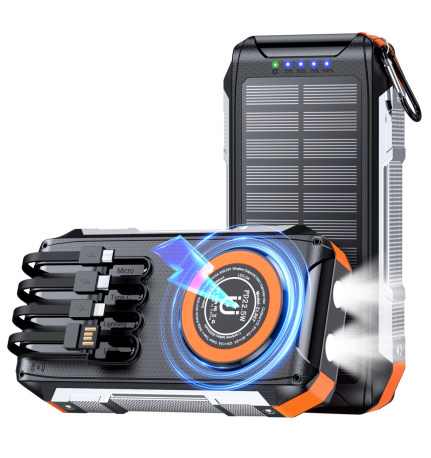
Os painéis solares integrados em um banco devem ser tratados separadamente do cálculo de energia armazenada. A luz do dia pode adicionar energia, mas a quantidade depende da área do painel, orientação, luz solar, temperatura e comportamento de controle de carga. Uma etiqueta solar não justifica a adição de um número arbitrário de taxas telefônicas. Se o reabastecimento solar for importante, solicite uma classificação real de potência de entrada e medições de campo específicas do modelo nas condições descritas. Caso contrário, planeje em torno da energia armazenada da bateria e veja a energia solar como um recurso de contingência.
Compare products without confusing capacity and speed
A 30000mAh bank can store more energy than a smaller model yet still charge a phone slowly if its output modes are limited. Conversely, a high-output port can charge a compatible phone quickly but does not create extra stored energy. Check the port-by-port voltage/current or USB PD profile, the number of ports that can work together, and whether the printed output changes when two devices are attached. USB-IF warns that a USB-C connector alone does not establish USB Power Delivery support; its product and packaging guidance says manufacturers should state supported protocols and performance clearly.
For a concrete comparison on this site, see the 30000mAh solar power bank e o 20000mAh solar power bank listed with 35W. Their different capacity labels and product configurations can help frame a shortlist. Before ordering either, ask for the current model label showing Wh, USB output profiles, available test data and dimensions. This article does not assert measured charge counts for either product.
Do not use the charge estimate as an airline allowance
The hypothetical 30000mAh × 3.7V calculation equals 111Wh. Under the FAA’s US passenger-battery guidance, the commonly referenced 100Wh threshold and the treatment of larger spare batteries require particular care. A real product may have a different printed Wh rating, and airline, country and route rules can be more restrictive. Check the actual label and the applicable airline before travel; do not infer cabin eligibility from the mAh figure, a seller title, or the charge-count range above. This is a purchasing and usage calculation, not an aviation clearance.
uma lista de verificação rápida do comprador
- Record the exact product model and printed Wh, mAh and voltage.
- Find the phone battery Wh for your exact model, or clearly mark an estimate.
- Pergunte se a energia de saída USB utilizável foi medida e sob que carga.
- Check the output protocol and port power separately from stored capacity.
- Planeje a atividade do telefone durante o carregamento e para várias recargas parciais.
- Confirme as regras das companhias aéreas separadamente se o banco viajará por via aérea.
The useful answer to “how many charges?” is a transparent calculation with assumptions you can replace. That lets you compare banks on the energy you can actually use, while acknowledging that no single mAh label can predict every phone, cable or charging session.