Short answer: There is no reliable charge count from “30000mAh” alone. The bank’s cell voltage, its usable USB output, the phone battery’s energy, and what the phone does while charging all matter. A practical estimate starts in watt-hours (Wh), then treats conversion losses as a planning range rather than a universal efficiency promise. For a hypothetical 30000mAh pack rated at 3.7V and a hypothetical 15Wh phone, a 60–80% usable-energy scenario gives roughly 4.4–5.9 equivalent full charges. That is an illustration, not a test result or a promise for any product.
Start with the label, not a marketing charge count
A milliamp-hour value describes charge at a specified voltage. It is not, by itself, the energy delivered through a 5V USB port. The US Federal Aviation Administration explains the basic calculation for lithium batteries: divide mAh by 1000 to obtain Ah, then multiply by the battery voltage to obtain Wh. See the FAA battery guidance. If a listing gives both mAh and Wh, use the actual Wh printed on that specific unit and resolve any discrepancy with the seller. Do not substitute a voltage from another model.
The 30000mAh number may describe the internal cells, while a phone accepts power after voltage conversion. The bank also uses energy to run its electronics; the cable and phone charging circuit introduce further losses. As a result, dividing 30000 by a phone’s advertised mAh is an invalid shortcut. It mixes capacities stated at potentially different voltages and assumes every stored joule reaches the phone battery. Even when the phone and bank use similar cell voltages, conversion and standby losses still matter.
| Input | Where to find it | Why it matters |
|---|---|---|
| Bank rated capacity in Wh | Product label or model-specific specification | Starting energy budget; use the printed value rather than an assumed cell voltage |
| Phone battery energy in Wh | Phone technical documentation or battery label | Denominator for equivalent full charges |
| Usable USB output in Wh | Model-specific discharge test at the relevant port and load | Captures conversion and internal losses |
| Phone energy used during charging | Your usage pattern, such as navigation or video | Can lower the net gain in the phone battery |
Calculate equivalent full charges in three steps
1. Convert the bank rating to watt-hours
For illustration only, suppose a 30000mAh pack is explicitly rated at 3.7V. The arithmetic is 30Ah × 3.7V = 111Wh. If a different 30000mAh model has a different stated voltage or Wh rating, this example does not describe that model. Check the actual label before buying, especially when the calculation will inform travel or business purchasing. A missing or inconsistent label is a reason to ask the supplier for the model’s electrical specifications, not a reason to infer them from a product photograph.
2. Estimate usable output conservatively
The best input is a measured USB output-energy figure for the exact bank, port, cable and load. When that is unavailable, you can use a deliberately broad planning scenario and label it as an assumption. For the hypothetical 111Wh bank, 60%, 70% and 80% scenarios imply 66.6Wh, 77.7Wh and 88.8Wh reaching the USB output. These percentages are not claimed efficiencies for our products or for power banks in general. They are sensitivity cases that make uncertainty visible. Actual results could fall outside the range.
3. Divide by the phone’s battery energy
If the phone has a hypothetical 15Wh battery, the three cases above yield 4.44, 5.18 and 5.92 equivalent full charges before accounting for power the phone consumes while it is on. A phone that starts at 40% and ends at 90% has gained roughly half a full charge, not one full charge. Several top-ups may add up to one equivalent cycle. Keep the unit of comparison consistent when reading reviews: count net energy added to the phone battery, not merely the number of times a cable was plugged in.
| Planning scenario | Usable output assumption | Output energy | Equivalent 15Wh charges |
|---|---|---|---|
| Conservative | 60% | 66.6Wh | 4.4 |
| Middle | 70% | 77.7Wh | 5.2 |
| Optimistic | 80% | 88.8Wh | 5.9 |
The table is a calculator example, not laboratory evidence. To reuse it, replace both 111Wh and 15Wh with the relevant model specifications, then replace the assumed output percentage with measured output if available. The range should be widened if the bank is old, cold, unusually hot or charging multiple devices. It is more useful to say “about five equivalent charges under stated assumptions” than to publish an exact number that cannot be defended.
Why your real result may differ
A phone that is streaming, navigating or tethering is drawing energy while it charges; the net energy stored in its battery can therefore be substantially less than the bank’s output. Screen brightness, radios and background activity make two otherwise similar charging sessions different. The bank may also shut down at a protective threshold rather than empty every cell. A cable with excessive resistance or an incompatible charging mode can make a session slower, and a slow session leaves more time for the phone to consume energy. USB-IF explains that USB Power Delivery uses negotiation between source and device. The printed maximum wattage is not what every phone will draw at every moment.
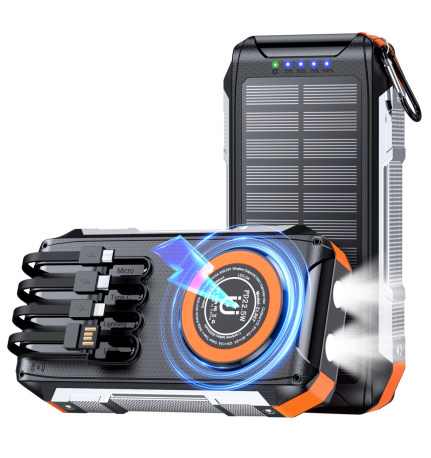
Solar panels integrated into a bank should be treated separately from the stored-energy calculation. Daylight may add energy, but the amount depends on panel area, orientation, sunlight, temperature and charge-control behavior. A solar label does not justify adding an arbitrary number of phone charges. If solar replenishment is important, request an actual input-power rating and model-specific field measurements under described conditions. Otherwise plan around the battery’s stored energy and view solar as a contingency feature.
Compare products without confusing capacity and speed
A 30000mAh bank can store more energy than a smaller model yet still charge a phone slowly if its output modes are limited. Conversely, a high-output port can charge a compatible phone quickly but does not create extra stored energy. Check the port-by-port voltage/current or USB PD profile, the number of ports that can work together, and whether the printed output changes when two devices are attached. USB-IF warns that a USB-C connector alone does not establish USB Power Delivery support; its product and packaging guidance says manufacturers should state supported protocols and performance clearly.
For a concrete comparison on this site, see the 30000mAh solar power bank and the 20000mAh solar power bank listed with 35W. Their different capacity labels and product configurations can help frame a shortlist. Before ordering either, ask for the current model label showing Wh, USB output profiles, available test data and dimensions. This article does not assert measured charge counts for either product.
Do not use the charge estimate as an airline allowance
The hypothetical 30000mAh × 3.7V calculation equals 111Wh. Under the FAA’s US passenger-battery guidance, the commonly referenced 100Wh threshold and the treatment of larger spare batteries require particular care. A real product may have a different printed Wh rating, and airline, country and route rules can be more restrictive. Check the actual label and the applicable airline before travel; do not infer cabin eligibility from the mAh figure, a seller title, or the charge-count range above. This is a purchasing and usage calculation, not an aviation clearance.
A quick buyer checklist
- Record the exact product model and printed Wh, mAh and voltage.
- Find the phone battery Wh for your exact model, or clearly mark an estimate.
- Ask whether usable USB output energy was measured and under what load.
- Check the output protocol and port power separately from stored capacity.
- Plan for phone activity during charging and for several partial top-ups.
- Confirm airline rules separately if the bank will travel by air.
The useful answer to “how many charges?” is a transparent calculation with assumptions you can replace. That lets you compare banks on the energy you can actually use, while acknowledging that no single mAh label can predict every phone, cable or charging session.