It can, if the exact camera supports external power during the activity you plan, the bank and cable provide the required electrical mode, and the usable energy covers the entire session with a margin. “USB-C camera” and “large power bank” do not establish any of those points. This checklist is for an overnight time-lapse, a fixed wildlife camera, or a long stationary recording session using a compatible camera. It is not a promise that any camera or bank will run for a given number of hours.
First, confirm what the camera’s USB port actually does
Some cameras can run from external USB power while shooting. Others charge their battery only when turned off, and some use USB for data without accepting operating power. Even among compatible cameras, the internal battery may still be required and may discharge slowly under a heavy load. The camera’s own help guide is the authority for that model and firmware. For a concrete example, Sony’s ILCE-7RM6 help guide describes USB power while shooting, specifies a USB PD source and cable supporting at least 27W for its stated setup, and requires a sufficiently charged battery installed. It also says a lower-powered source may allow the battery to drain and that operation is not guaranteed with all external supplies. Those details apply to that Sony model, not to cameras generally.
Read the manual for the exact task. A camera might accept external power for playback but not charging during recording. Continuous video, interval shooting, image transfer and standby can have different power behavior. Check whether the camera auto-powers off, whether a menu option enables USB supply, and what happens if the bank disconnects briefly. A camera that can record for one hour on USB may still stop at night because of a clip limit, temperature protection or a recording schedule. Power is only one part of the overnight system.
Separate output watts from stored watt-hours
Output watts describe the maximum rate a compatible port can supply; watt-hours describe the bank’s energy budget. A bank could have enough energy but fail to offer the voltage and current mode the camera requests. Conversely, a very powerful USB-C port on a small bank may meet the camera’s electrical requirement but run out of energy quickly. USB-IF explains the negotiated nature of USB Power Delivery, while its Type-C product guidance makes clear that a USB-C connector alone does not guarantee USB PD. Request the bank’s per-port source profiles and compare them with the camera guide.
| Question | Evidence to find | Why it matters |
|---|---|---|
| Can the camera operate from USB? | Exact model’s manual and menu instructions | Charging while off is different from shooting on external power |
| Which power mode is required? | Required voltage, current or USB PD minimum | A connector can fit while the electrical offer is insufficient |
| Must an internal battery remain installed? | Camera manufacturer’s instruction | Some cameras use the battery to start or supplement USB |
| How much energy is available? | Bank label Wh and measured USB output Wh | Nominal cell capacity is not all delivered to the camera |
| What ends the session? | Auto-off, card capacity, clip, heat and weather limits | Power alone cannot guarantee overnight capture |
Estimate the energy budget with explicit assumptions
Use the bank’s printed Wh value where available. If it lists only mAh, convert using its stated nominal battery voltage: Ah × V = Wh. A hypothetical 20,000mAh pack at 3.7V contains 74Wh at the cells; a hypothetical 30,000mAh pack at the same nominal voltage contains 111Wh. These are examples, not verified specifications for the two products linked below. Output conversion, internal electronics, cable loss and the camera’s own behavior reduce what the camera receives. If an illustrative 80% of cell energy reaches the USB load, those examples become 59.2Wh and 88.8Wh respectively. The actual output fraction must be measured or documented for the bank and load in question.
Now estimate camera demand. If a camera averaged 8W for ten hours, it would require 80Wh at its input under a constant-power model. The illustrative 20,000mAh bank above would fall short; the 30,000mAh example would have only 8.8Wh of calculated margin. A camera averaging 12W for the same ten hours would require 120Wh, exceeding both example budgets. The point is the method, not those invented camera loads: substitute a measured average for your shooting mode. The US Department of Energy’s energy primer supports the Wh = W × hours arithmetic.
| Assumed average camera load | Energy needed for 10 hours | 59.2Wh usable example | 88.8Wh usable example |
|---|---|---|---|
| 4W | 40Wh | Calculated margin 19.2Wh | Calculated margin 48.8Wh |
| 8W | 80Wh | Calculated shortfall 20.8Wh | Calculated margin 8.8Wh |
| 12W | 120Wh | Calculated shortfall 60.8Wh | Calculated shortfall 31.2Wh |
Do not choose a bank that only passes by a fraction of a watt-hour on paper. The camera may draw more power while writing files, using a display, focusing or transmitting. A time-lapse may have bursts of high demand separated by low draw; the bank could even shut down between shots if its minimum-load threshold is triggered. A video camera may run continuously but stop from heat. The safe planning figure comes from a rehearsal of the exact camera settings, lens, storage card, cable and ambient conditions.
Build and test the entire connection
Use the port identified as output on the bank, not a port that only accepts charging input. Record the bank’s single-port PD modes and what changes when another device is attached. If you will charge a phone at the same time, test that combination: a shared-output limit can lower the camera port’s available power. Select a cable that supports the camera’s required power mode and route it with strain relief so a tripod adjustment does not pull it loose. Do not tape over ventilation or bend the USB connector sharply at the camera body.
Run a short daylight test first. Confirm the camera shows its external-power indicator if it has one. Film or shoot for long enough to see whether its internal battery rises, holds or falls. Then run a full-length test before relying on the setup outdoors. Start with the bank fully charged, note the camera battery level, and log start and stop times. Watch for the bank turning itself off during an interval-shooting idle period. If the camera needs its own battery to remain installed, follow the maker’s instructions. Sony’s guide for the example model specifically warns not to remove that battery while USB power is supplied.
Account for the outdoor setting
An overnight setup adds dew, rain, cold, heat, cables and unattended equipment. Keep connectors dry and follow both manufacturers’ operating-temperature instructions. Do not treat a product photo of a splash-resistant case as proof that an open USB port can sit in rain. Place the bank so its weight cannot pull the tripod, and secure cables against wind or curious animals without blocking the camera’s movement. If you use a weather enclosure, check that it does not cause heat buildup during recording. Stop the test if equipment becomes unusually hot, wet inside its protected area or physically damaged.
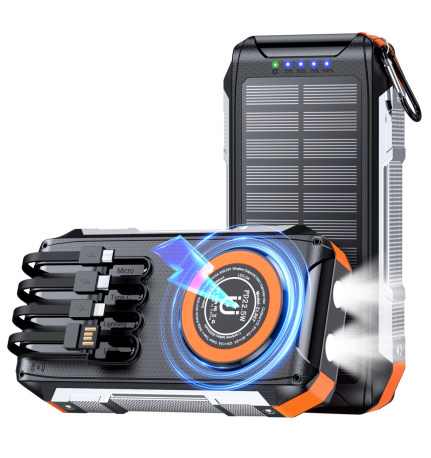
The solar panel on a bank does not replenish it after sunset. Even in daylight, panel charging is a separate input question: panel watts, orientation and the bank’s solar-input limits determine the gain. For overnight planning, count only the energy stored before the session begins. A vehicle or folding panel can prepare the bank earlier in the day, but neither should be assumed to add energy during a dark time-lapse.
Use site listings as candidates, not compatibility proof
For a capacity comparison, the site’s 20,000mAh solar bank marked 35W and 30,000mAh solar bank are two catalog starting points. The displayed mAh and headline wattage do not establish their exact Wh labels, usable USB output energy, PD source profiles or compatibility with your camera. Ask for the current datasheet and a model-specific output test before assigning a run time. An integrated cable in a render does not establish its power rating or fit with a camera’s USB port.
A reliable overnight plan ends with a recorded trial: the camera completes the exact shot sequence, the bank still has a sensible reserve, and the physical connection survives the intended conditions. If the test fails, diagnose which constraint failed—electrical negotiation, total energy, auto-shutoff, camera setting, storage or environment—before buying a larger bank. Increasing mAh alone cannot repair an incompatible power mode or a camera that does not support USB power while shooting.