“Rugged,” “waterproof” and “drop resistant” sound precise on an outdoor power bank listing, but the words do not tell a buyer what was tested, which unit was tested or whether an open charging port was included. A defensible purchase decision begins with the exact model and a claim matched to a report. This guide is a document and sample audit for buyers comparing outdoor banks. It does not give field-care instructions for heat, cold or rain, and it does not claim that either catalog product linked below has an IP or drop rating. A photograph of a thick housing is useful for identifying a design, not for proving environmental performance.
Turn the adjective into a testable statement
Start by copying the seller’s words exactly. “Outdoor style” may be a description of intended use. “IP67 certified,” “survives a two-meter drop” or “waterproof while charging” are objective claims that need much more specific support. The US Federal Trade Commission’s advertising guidance says advertisers need a reasonable basis for objective claims before making them. That US guidance is useful as a claim-review principle, while the applicable legal rules depend on the market. For procurement, the practical question is simpler: what document supports the exact wording a customer will see?
Make one row per claim. Record the product code, enclosure revision and marketing wording in separate columns. Ask whether the statement applies to a closed housing, a closed port cover, a connected cable, an unused accessory or a production unit from the current batch. A test report for a similar-looking bank does not answer those questions. A current product label, drawing and sample photograph help tie the report to the physical unit. If the supplier cannot connect those identifiers, treat the claim as unverified until the mismatch is resolved.
| Listing claim | Minimum useful evidence to request | Common gap |
|---|---|---|
| Specific IP code | Exact code, IEC 60529 test report, model and tested enclosure state | Report belongs to another revision or a closed sample only. |
| “Waterproof” without a code | Defined water exposure, duration, acceptance criterion and test record | Word suggests more than the available splash test supports. |
| “Dustproof” | Defined dust test and the resulting enclosure classification | Rubberized appearance is used instead of an actual result. |
| Drop resistant | Drop height, surface, faces, sample count and post-drop functional results | Only a cosmetic photo or an unspecified demonstration is supplied. |
| “Certified rugged” | Name of the certifier, scheme, identifier and exact model scope | A generic laboratory logo is mistaken for product certification. |
Read the IP code as a classification, not a slogan
The IEC 60529 publication defines degrees of protection provided by electrical enclosures using the IP Code. A seller who claims a particular code should name that standard, the code and the test evidence for the exact product. The first characteristic numeral relates to solid objects and dust; the second relates to water. An X in one position means that position has not been specified in the claimed code; it is not a hidden top score. A water result should not be silently converted into a dust result or vice versa.
Do not read an IP code as permission for every wet activity. The test applies to defined conditions and an enclosure state. Ask how port covers were positioned, whether any cable was connected, and whether the unit was operational during or after the test. A bank can have an enclosure claim with all covers closed and still need dry connectors for charging. Equally, a test of one housing design may cease to describe the product after a supplier changes a gasket, button, port flap or assembly process. The report and the current build must be linked.
Check the test report’s identity chain
A useful report names the laboratory, client, test date, standard and edition, model number, sample description, photographs or drawings, methods and result. Check that the model on the report matches the sales page, product label and order form. If the model family has several variants, ask whether the tested sample was the largest, smallest or otherwise representative of the one being purchased, and how that equivalence was justified. A one-page badge or certificate image may omit the very conditions that limit the claim; request the full relevant test pages or a report extract that preserves the method and sample identity.
Record who supplied the sample to the lab and which hardware revision it represented. A report may truthfully show that one submitted sample passed a test without establishing that every later production unit has the same seals. A buyer may therefore ask for production controls: incoming inspection of gaskets, port-cover fit checks, assembly instructions and a change-control rule for materials that affect ingress. These are procurement questions, not proof that a named factory currently performs them. If the supplier offers a certification mark, verify the mark under the named scheme rather than assuming that any laboratory letterhead is a certification.
Keep drop and ingress claims in separate columns
An IP code concerns protection by an enclosure; it is not a drop rating. A drop can deform a seal or crack a port cover even when a pristine sample previously passed a water test. The IEC 60068-2-31 publication describes rough-handling shock procedures including drop and topple for suitable equipment specimens. It also identifies limits to what those procedures simulate. A claim such as “drop tested” needs its own method, height, orientation, surface and pass criterion. Naming a standard without those details leaves the actual performance claim unclear.
Ask what happened after the drop: did the unit merely look intact, did it still charge a device, did all ports and buttons function, and was enclosure protection retested? Those are different outcomes. A bank that powers on after one fall has not thereby proved that its water seal remains intact. If a supplier markets a combined “rugged waterproof” feature, ask for evidence for both parts and for the sequence if the intended claim is that water protection remains after impact. Do not add that combined claim to a product page from two unrelated reports without understanding their tested samples and conditions.
| Report field | Buyer check | Decision if missing |
|---|---|---|
| Model and revision | Matches the sample, label and planned order | Request a traceability explanation. |
| Standard and edition | Names the actual method used for that claim | Do not substitute a marketing phrase for the method. |
| Sample configuration | Shows covers, cables and accessories as tested | Limit the claim to the known configuration. |
| Exposure or impact setup | Defines water/dust conditions or drop height and surface | Ask for the relevant test pages. |
| Acceptance criteria | States what counted as passing after the test | Do not infer continued charging or sealed ports. |
| Production link | Explains how current units retain the tested design | Check changed parts before using the claim. |
Look for qualifications in the exact sales wording
Suppose the evidence supports splash exposure only with a fully closed cover. A headline that simply says “waterproof power bank” may invite a much broader reading than the report supports. State the tested condition near the claim, in ordinary language, and keep it consistent across the product page, packaging and quote. The FTC’s policy statement on advertising substantiation emphasizes that both explicit and reasonably implied objective claims matter. For a purchasing team, this means reviewing images and captions too: a picture showing the unit charging underwater can imply a use condition even if the small print says closed-port testing only.
A similar check applies to “military grade,” “shockproof” and “all weather.” Ask the seller to define the actual test and scope. If the evidence cannot support the broad phrase, a narrower factual description may be more useful to customers. A well written listing might state a documented enclosure code and the cover condition, then separately describe a defined impact test. It should not present a generic laboratory report as proof of durability in every weather, terrain and charging arrangement. Exactness helps both the seller and the buyer compare products fairly.
Use catalog products as examples of questions, not proof
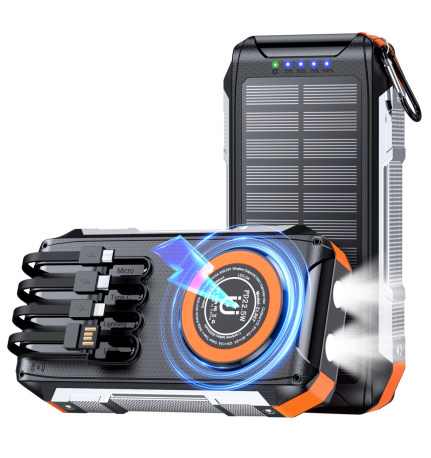
The 30,000mAh solar power bank and 20,000mAh solar power bank are two site catalog pages relevant to an outdoor-power comparison. Their photographs and product names can help identify the form factors a buyer is considering. They do not, by themselves, verify an IP code, an impact result or safe charging with wet ports. Request the current model sheet and exact test evidence before putting any specific rugged claim into a purchase requirement or a customer listing.
If evaluating a batch, attach the claim matrix to the request for quotation. Ask each supplier to mark every claim as documented, qualified or unsupported, and to provide the matching report identifier. When samples arrive, photograph labels and enclosure details, check that the quoted revision matches, and record discrepancies. A simple sample inspection is useful for identity and visible construction; it does not replace a laboratory ingress or drop test. Where a claim is central to the purchase, arrange an appropriate test on the approved production configuration under an agreed method.
Approve only the wording the evidence can carry
The final review is a short chain: exact product, exact claim, exact test, exact configuration and current production link. If any link is missing, qualify the wording or leave the claim out while asking for the missing evidence. That decision is more informative than treating “rugged” as a yes-or-no feature. It also avoids confusing a visual design cue with a measured property. Buyers can still choose an outdoor-looking bank for its layout or size; they simply should not pay for an unverified environmental promise.