A factory can build a portable power bank around a lithium-ion pouch cell or around cylindrical cells, but the package shape is only one part of the finished product. It does not, by itself, determine safety, useful capacity, cycle life, charging speed or cost. Those outcomes depend on the exact cell design, chemistry, protection circuit, enclosure, thermal path, manufacturing controls and test conditions. For a custom power-bank order, the productive question is which cell and pack design can be documented and tested against the same product brief. This guide turns the pouch-versus-cylinder discussion into a comparable request for evidence.
Separate the cell package from the battery specification
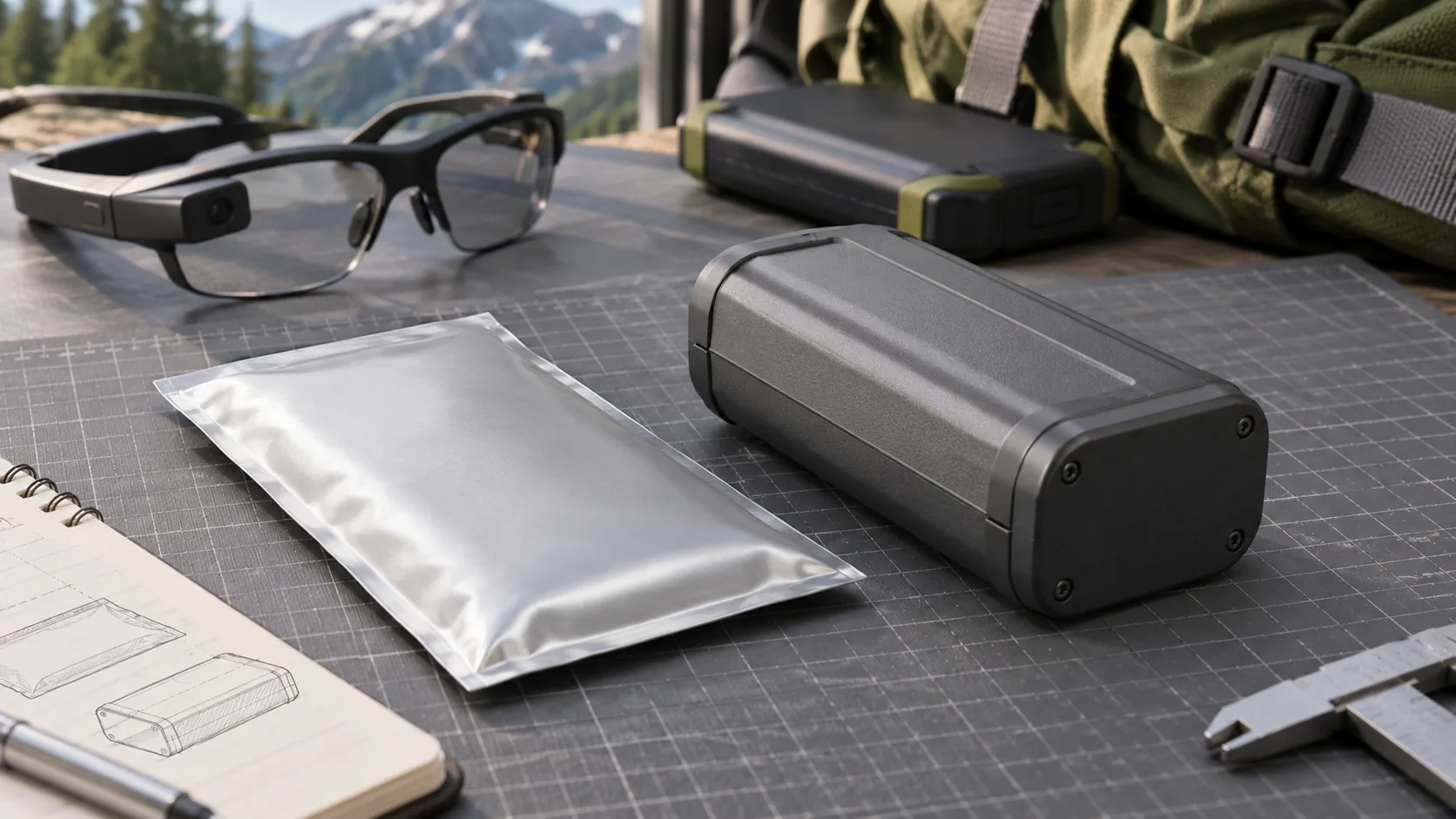
“Pouch” describes a cell sealed in a flexible laminated package. “Cylindrical” describes a cell in a round metal can. Neither word states the cathode chemistry, nominal voltage, usable energy, quality grade or protective electronics. The US Department of Energy’s battery-cell design presentation illustrates both forms and their internal components. Its drawings help explain the physical distinction; they are not a ranking of consumer power-bank performance. Ask suppliers to name the actual cell manufacturer and model, chemistry, rated capacity and energy, dimensions, production revision and operating limits for each proposed option.
A label such as “20,000mAh” describes a pack-level marketing quantity only when its voltage basis and configuration are clear. Two cells with similar printed mAh values can have different watt-hours if their nominal voltages differ. A finished USB bank also spends energy in voltage conversion and controls. Therefore, compare rated pack Wh, measured delivered USB Wh under one defined load, and the voltage/current profiles of the finished bank. Do not choose a cell format by comparing mAh labels from different electrical bases. A quote that omits Wh and the exact pack wiring leaves too much room for misunderstanding.
| Field | Request from each supplier | Why it matters |
|---|---|---|
| Cell identity | Manufacturer, model and revision | Links claims and documents to an actual design |
| Cell specification | Chemistry, nominal voltage, Ah and Wh | Makes energy comparison possible |
| Pack design | Cell count, series/parallel layout and protection board | Explains electrical and physical differences |
| Mechanical design | Cell restraint, spacing, insulation and enclosure drawing | Shows how the package is supported |
| Test basis | Load, temperature, sample count and measured output Wh | Prevents unequal performance comparisons |
| Documents | Model-linked test summaries and change record | Supports traceability after sample approval |
Compare pack geometry, not slogans about thinness or ruggedness
A pouch can fit a broad, flat cavity; cylindrical cells may suit an enclosure designed around one or more round cans. Those are design possibilities, not guarantees that one finished bank will be slimmer, lighter or tougher. The actual result depends on how many cells are needed, their capacity, protective layers, circuit board, ports, case walls, thermal allowance and assembly method. Request a dimensioned cross-section and the assembled sample’s measured size and mass. If the bank also contains a lamp, wireless coil, integrated cable or solar panel, those parts may dominate the package geometry.
Cell restraint matters in both designs. A flexible pouch should not be left to carry an enclosure load or be squeezed by a sharp edge. A cylindrical arrangement also needs secure location, insulation and reliable electrical connections. These are engineering review points, not a claim that either format is inherently safe or unsafe. Ask for a pack drawing showing how the cells are fixed, how leads are routed, and what prevents abrasion or unintended electrical contact. Compare the drawing with a physical sample, because a render can conceal the important internal details.
Keep thermal and charging claims model-specific
A supplier may say that one format “runs cooler” or “charges faster.” Ask for the same test on finished banks with the same rated energy and output load, then inspect where temperature was measured and how long the test lasted. Cell chemistry, internal resistance, electrical connections and heat transfer through the case can all change the result. A fast-charge headline at the USB port is also separate from the cell’s allowable charging conditions. The bank’s controller may limit input or output to protect the pack. Without a matched test, a format-level performance ranking is unsupported.
Request safety and transport evidence for the exact design
For lithium batteries offered for transport, the US Pipeline and Hazardous Materials Safety Administration explains the UN 38.3 test-summary requirement and links guidance on the fields a summary should contain. Ask for the applicable cell and battery design identities, model numbers, test report references and manufacturer details. A document for a similar but different cell is not enough. Changing from pouch to cylindrical cells changes the pack design and may require a new review of which tests and documents apply. Have a qualified transport specialist confirm the final shipment requirements rather than treating a PDF as a universal shipping approval.
Transport evidence is only one part of the purchasing record. Request the cell datasheet, pack protection-circuit description, charging and discharging limits, assembly inspection plan and relevant finished-product safety evidence for the destination market. Document how the factory handles a cell supplier substitution or revision change. If the sales team cannot connect the test summary and datasheet to the exact approved sample, pause the comparison. The question is not whether a factory has a certificate somewhere; it is whether evidence matches the specific design being bought.
| Check | Pouch proposal | Cylindrical proposal |
|---|---|---|
| Identity | Record exact cells and pack revision | Record exact cells and pack revision |
| Energy | Confirm labeled Wh and measured USB Wh | Use the same load and meter |
| Ports | Record input and output modes | Test the same adapter, cable and device |
| Temperature | Log ambient and case points during load | Use identical duration and locations |
| Mechanical | Inspect restraint and edge clearance | Inspect retention and insulation |
| Traceability | Match cell and battery documents to sample | Match cell and battery documents to sample |
| Production | Record approved revision and substitutions | Record approved revision and substitutions |
Use an RFQ that permits a fair comparison
Send both suppliers the same target finished-product dimensions, rated Wh, intended devices, USB input and output profiles, ports, operating environment, label requirements, destination markets and order volume. State which constraints are mandatory. If the package must fit an existing enclosure, include the internal keep-out zones and connector positions. If the case can change, allow each supplier to propose a mechanical layout and explain trade-offs. Request an itemized quote for cell, enclosure, tooling, test work and packaging so a low unit price does not hide a different scope.
Then compare approved samples on the same written procedure. Measure output energy at a defined USB voltage and load, note any automatic cutoff, and record charging behavior with a specified adapter and cable. Include dimensions, mass, fit of plugs and visible assembly quality. Do not turn one sample into a claim about every unit in mass production. Agree on a production inspection plan, acceptance criteria and change-control process. A repeatable sample test provides evidence for the actual finished bank; a generic statement about pouch or cylindrical cells does not.
The site’s SH-601 20,000mAh bank lists a lithium-polymer cell type, while the 30,000mAh solar bank is a second enclosure example. These pages show product form factors and marketing specifications. They are not evidence of a cell-format comparison, a measured thermal result or an approved substitution. Ask for exact cell and pack documents before using either as a manufacturing benchmark.
Decide from the finished product and its evidence
The strongest proposal is the one that meets the buyer’s defined geometry, energy, port and environmental requirements with traceable cells, a reviewable pack design, matched test results and a controlled production revision. Either package style may be appropriate for a particular brief. Neither should be described as categorically safer, longer lived or more powerful from shape alone. If the quotes differ, identify exactly which constraint, document or test explains the difference and request a revised comparison if necessary.
Before a purchase order, freeze the cell model and pack revision in the specification, retain the approved sample, and state what changes require written approval. That makes the pouch-versus-cylinder decision a concrete engineering and sourcing choice. It also gives the buyer a path to investigate later quality questions without relying on an unverifiable slogan about the “best” kind of lithium cell.