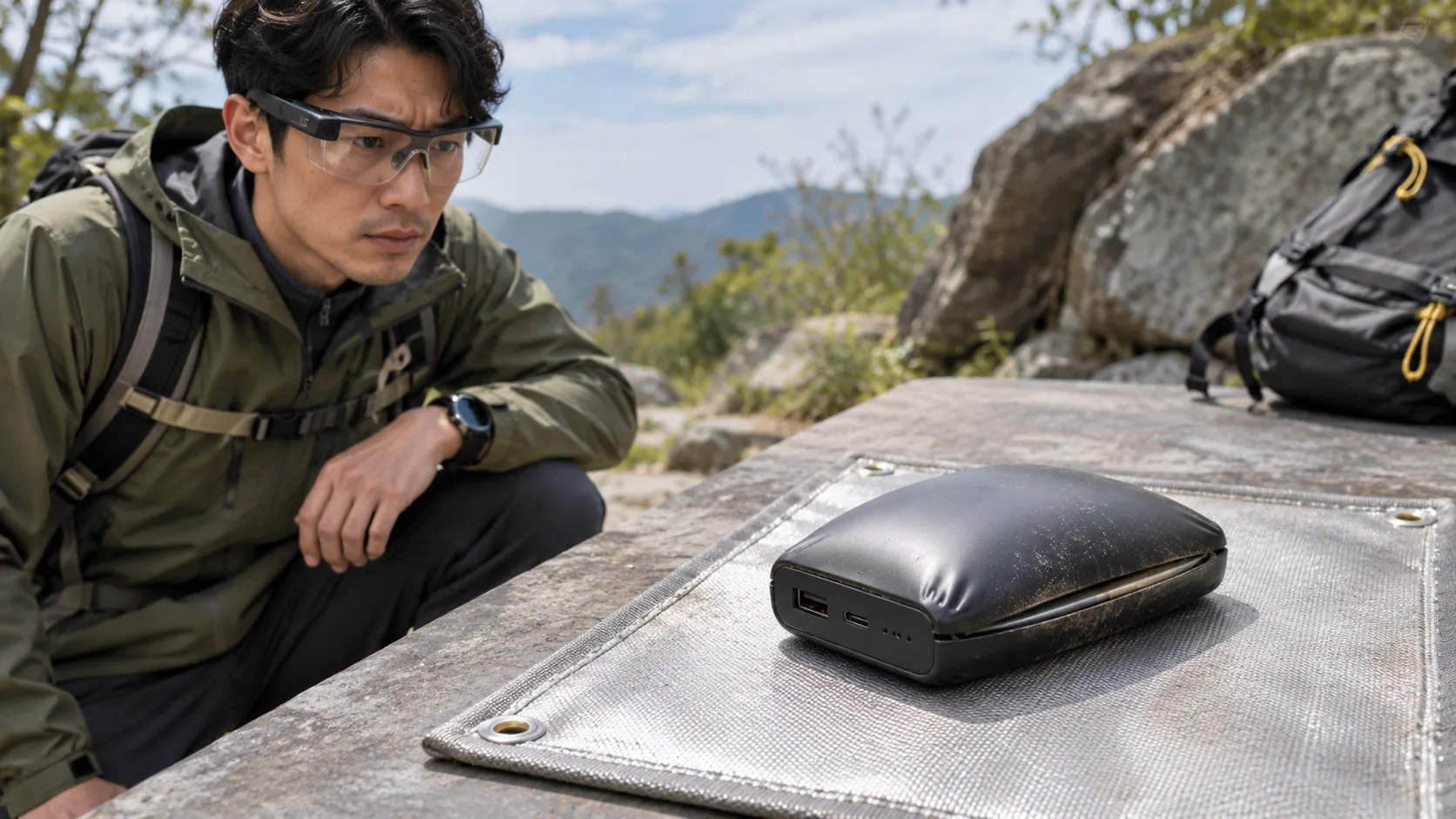
A power bank with a bulging case, a split seam, a puncture, unusual heat, leaking, hissing or a chemical odor needs a different response from a bank that merely charges slowly. Stop using it. Do not run one more test cycle to see whether it still works. Lithium-ion battery damage can create a fire hazard, and the risk cannot be judged from the remaining-charge lights alone. This guide separates urgent warning signs from a stable, damaged unit that needs a disposal plan. It is general consumer guidance; the product maker, local fire service and local waste authority should direct the response to a specific incident.
Recognize a stop-use sign without diagnosing the cells
The US Fire Administration’s battery fire safety page says to stop using lithium-ion batteries if you notice an odor, color change, excessive heat, shape change, leaking or odd noises. The US Environmental Protection Agency’s lithium-ion FAQ specifically identifies swelling as damage and a potential fire hazard. You do not have to prove which cell failed before acting. A housing that no longer closes flush, a case that rocks because its face has bulged, or a port pushed out of alignment deserves the same stop-use decision as an obvious swollen battery.
Look without squeezing or opening the enclosure. A scratch in the outer finish is different from a crack exposing internals, but a dropped unit can have internal damage that is not visible. If it has been crushed, pierced, immersed, overheated or involved in a product recall, consult the maker even if it powers on. Do not use a capacity test, a charger or a phone as a diagnostic tool for suspected physical damage. The small reward of learning that it still produces USB power does not resolve the battery’s condition.
| What you observe | Immediate action | Next contact |
|---|---|---|
| Bulging, split seam or distorted case without active smoke | Stop charging and using; avoid pressing on the case | Manufacturer and local hazardous-waste or battery collection service |
| Leak, strange odor, discoloration or unexpected heat | Stop use; keep people away from the device and combustibles if safe to do so | Manufacturer; local fire service if risk is escalating |
| Smoke, hissing, sparks or flames | Leave the area and follow local emergency instructions | Emergency services |
| Known recall affecting the exact model | Follow the official recall notice and stop-use instructions | Manufacturer or recall authority |
Disconnect only when it is safe
If the bank is connected to a phone or wall charger and is stable enough to approach, stop the charging session and disconnect without touching a hot, leaking or damaged part. If it is smoking, hissing or rapidly heating, prioritize leaving the area and calling emergency services rather than trying to unplug, carry or contain it. Do not place it in water, put it in a freezer, puncture the housing or attempt to “discharge it to zero.” These improvisations can increase risk or expose you to hazardous material. Follow the emergency responders’ directions for an active event.
The US Fire Administration describes lithium-ion fire failures as fast moving and warns that burning batteries can release harmful emissions. That is why an active incident is not a routine recycling task. Move people away from the area and use the local emergency number. For a stable but swollen unit, the EPA advises contacting the manufacturer, retailer or local waste program for management directions and keeping it in a safe location away from flammable materials while the disposal route is identified. Use that guidance rather than assuming the same handling works for every battery size and condition.
Do not reopen or repair a sealed power bank
Some power banks hide multiple cells, protection circuitry and conductive parts behind a glued or screwed case. Opening the housing to “check the swelling” adds puncture and short-circuit risks and may defeat the maker’s safety controls. A swollen battery does not become suitable for reuse after the exterior is pressed flat or the charge indicator returns to normal. A cable, wall adapter or firmware reset also cannot validate the internal cell. Give the service provider the model, purchase information and clear photos taken from a safe distance; do not take a close-up that requires handling an unstable unit.
Keep a stable damaged unit separate while arranging disposal
EPA guidance says lithium-ion batteries and devices containing them should not go into household trash or ordinary curbside recycling. They can be crushed in collection equipment and cause fires. Its FAQ recommends separate battery recycling or household hazardous-waste collection, and it distinguishes a swollen battery as one requiring additional care. Call the facility before taking it there. Ask specifically whether it accepts damaged or swollen lithium-ion power banks, what packaging it requires and whether an appointment or special drop-off route is needed. A store that accepts ordinary spent cells may refuse damaged packs.
For a stable unit awaiting instructions, keep it away from flammable items and from children or pets. The EPA’s damaged-battery collection guidance discusses isolation with nonflammable fill for collection programs, but that document is written for collection and transport operations. Consumers should follow the local program’s and maker’s instructions for their exact case rather than independently improvising a shipping package. If the bank heats again, vents or changes rapidly, treat it as an active incident and contact emergency services.
| Detail | Why it helps | How to collect it safely |
|---|---|---|
| Brand and model | Identifies battery chemistry and possible recall | Read packaging, receipt or a label visible without turning the device |
| Damage sign | Determines whether normal collection is inappropriate | Describe swelling, leak, heat, puncture or smoke plainly |
| Present condition | Separates stable storage from an urgent event | Report whether it is cool, warming or actively venting |
| Battery rating if visible | Helps the facility plan handling | Use a label photo already available; do not peel or open the case |
| Location | Lets the authority direct you to a suitable collection point | Provide city or district, not an invented shipping plan |
Do not put a damaged bank in travel luggage
A power bank is a spare lithium battery for airline purposes. The Federal Aviation Administration’s PackSafe guidance says damaged or recalled batteries and devices likely to create sparks or dangerous heat must not be carried aboard an aircraft unless made safe under the applicable rules. Do not place a swollen unit in checked luggage as a workaround. If you discover it while preparing for a trip, leave it out of travel and contact the maker or a qualified local collection program. Airline and destination rules may add conditions; the critical point is that a damaged bank is not an ordinary spare charger.
Shipping a damaged lithium battery is also not the same as returning an intact consumer product. Do not mail it with routine postage or put it in a seller’s prepaid box without explicit damaged-battery instructions from an authorized handler. The EPA’s damaged-battery collection guidance distinguishes special collection and shipping routes. Ask the retailer or manufacturer for a compliant return process if a warranty or recall applies. Do not assume a normal electronics return label is suitable.
Check the exact model before choosing a replacement
After the damaged unit is safely out of service, choose a replacement using current product information, not a promise that any new bank is risk-free. Compare the rated Wh, intended USB output, protection instructions and warranty route for your use. For example, the SH-601 20,000mAh power bank and 20,000mAh 35W solar power bank are two catalog options to investigate. Their listings are not evidence that either is suitable for handling a damaged battery, and this article makes no claim about their comparative safety or measured life.
If the failed unit is subject to a recall, follow the recall notice’s remedy and handling steps before buying or disposing of anything. If it is a product you use for work, isolate the affected stock and document model numbers so an organization can act consistently. A photograph of one swollen unit does not prove that every unit of the model has failed; equally, one intact unit does not clear a known defect. The manufacturer’s official notice and relevant safety authority are the right sources for product-specific action.
A short decision path
First, stop using a bank that has changed shape, leaked, overheated or made unusual sounds. Second, if there is smoke, hissing or rapidly increasing heat, move away and call emergency services. Third, for a stable damaged unit, keep it separate from combustibles and ask the maker and local waste authority how to dispose of it. Fourth, do not put it in trash, ordinary recycling, routine shipping or travel luggage. Those steps avoid turning a suspect battery into a test project and let the right service handle its next movement.