Schnelle Antwort: A power bank can be recharged away from a wall outlet with a compatible folding solar panel, a vehicle USB adapter or, on a specifically designed model, a hand crank. The amount of energy available depends on panel area, sunlight, electrical losses and the pack’s input rating. A tiny panel molded into a battery case should be treated as a supplemental source unless the maker publishes credible measured output. For a trip or emergency kit, plan around watt-hours and a reserve rather than a promise printed in mAh.
In dieser Anleitung geht es um Energie wieder in den Akkupack einsetzenein Es ergänzt unsere Leistungshandbuch für die Solarenergiebank, which explains solar output in more detail. The estimates below are illustrative calculations with stated assumptions, not field tests of our products or a guarantee of emergency phone service.
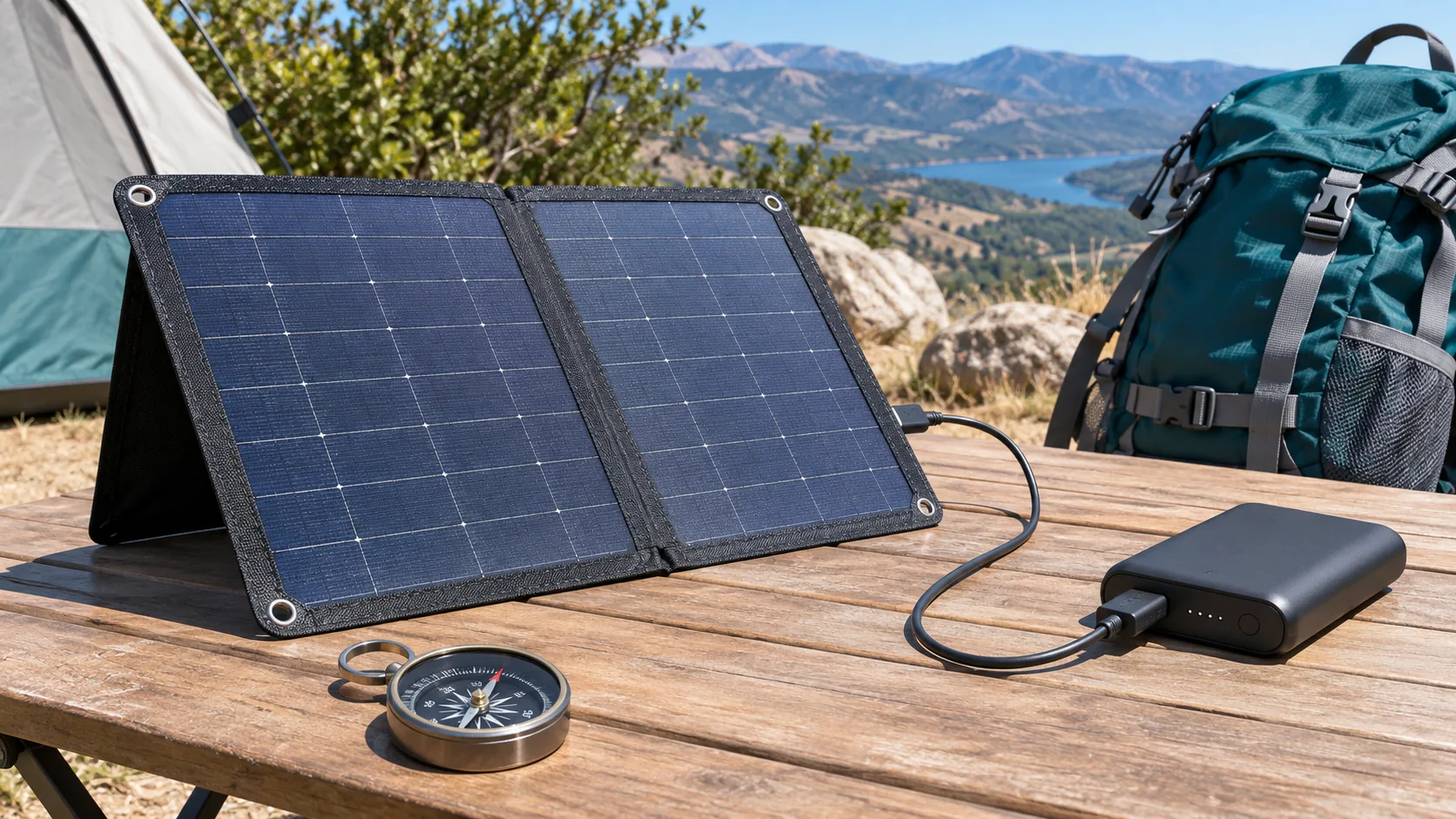
Start with the energy you need, not the largest mAh number
Battery capacity is often printed in mAh at a cell’s nominal voltage. To plan across solar panels and USB devices, convert to watt-hours: Wh = Ah × nominal V. For example, a hypothetical 10,000 mAh pack at 3.7 V contains 10 Ah × 3.7 V = 37 Wh at cell level. A 20,000 mAh pack under the same assumption contains 74 Wh. The energy delivered through a USB output will be lower because conversion and charging use energy. Likewise, the energy drawn from a solar panel or vehicle source to refill it will be higher than the cell-level Wh. Use the model’s label when available instead of assuming every pack uses 3.7 V.
| Planungsfrage | Was ist zu prüfen? | Warum ist das wichtig? |
|---|---|---|
| Wie viel Energie wird gespeichert? | Wh or mAh plus nominal V on the pack label | Ermöglicht Vergleich mit Panel-Ausgabe und Gerätebedarf |
| Wie schnell kann es Energie akzeptieren? | USB-C or other input voltage/current and protocol | Ein leistungsstarkes Panel kann die Eingabegrenze des Packs nicht überschreiten |
| Wie viel werden Ihre Geräte verbrauchen? | Device battery Wh or measured daily use | Prevents planning around a nominal capacity alone |
| Wie lange könnte die Sonne nicht verfügbar sein? | Wetter, Schatten, Saison, Orientierung und Reservetage | Bestimmt, ob der Plan eine andere Energiequelle benötigt |
Solar: Panel-Bewertung versus gelieferte Energie
Das US-Energieministerium erklärt, dass die Nennleistung eines Photovoltaikmoduls unter Standardtestbedingungen gemessen wird: 1.000 W / m² Beleuchtung und 25 ° C Zelltemperatur. Das tatsächliche Sonnenlicht, die Plattentemperatur, der Winkel und der Schatten variieren. Siehe die DOE-Leistungsübersicht und deren Solarstrahlungsprimer. Das 20-W-Typenschild eines Klapppanels bedeutet daher nicht, dass es 20 W für jede Stunde draußen liefert.
als transparent Planungsbeispiel, suppose a 20 W panel delivers an average 10 W into a compatible charging circuit for four useful hours. That is 40 Wh at that point in the system, before losses and any interruptions. It might be enough to materially replenish a 37 Wh cell-level pack, but it is not evidence of a full recharge because both conversion loss and the final charge stage matter. If clouds halve the effective average, the input becomes about 20 Wh. These numbers describe assumptions you can replace with local measurements; they are not test results for a particular panel.
| Veranschaulichende Bedingung | angenommene durchschnittliche Eingabe | Vier-Stunden-Energie vor späteren Verlusten | Praktische Implikation |
|---|---|---|---|
| Gute Sonne und günstige Orientierung | 10 W | 40 Wh | Potenziell nützlich für eine kleine Packung |
| Teilwolke oder schlechter Winkel | 5 W | 20 Wh | Erwarten Sie eine teilweise Nachfüllung |
| Schwerer Schatten | 1 w | 4 Wh | Do not count on this as the main source |
The panel’s actual output can drop sharply when it is partly covered. Place it according to the manufacturer’s instructions, keep electrical connections dry and avoid leaving a lithium pack where the sun can overheat it. If using a panel with an integrated battery, distinguish the panel’s measured output from the battery’s stored capacity. A 30,000 mAh pack such as the 30,000 mAh solar power bank Kann mehr Energie speichern, aber das bedeutet nicht, dass ein kleines integriertes Panel es an einem Tag auffüllen kann.
Handkurbel: Nützliches Backup, begrenzte Energiequelle
A hand crank can provide power without sun or a vehicle, but its output is limited by mechanical effort, generator efficiency and the pack’s electronics. Do not assume a rate from product photography or a generic “minutes of crank = minutes of phone use” slogan. Ask for a measured curve showing generator output, crank speed, input energy stored and test conditions for the exact model.
For scale, if a hypothetical crank supplies an average 2 W of electrical power for 15 minutes, that represents 0.5 Wh before storage losses. Compare that with a hypothetical 37 Wh cell-level pack: it is a small fraction of a full recharge. The calculation illustrates why a crank is best treated as a short-term contingency, not a primary source for a multi-day trip. The 20,000 mAh hand-crank model ist ein Ausgangspunkt, um nach der tatsächlich gemessenen Kurbelleistung und dem Ladepfad zu fragen; In diesem Artikel wird keine modellspezifische Laufzeit angegeben.
Fahrzeug- und Durchgangsladung
A car’s 12 V outlet can be convenient when a vehicle is available, but the USB adapter plugged into that outlet determines available modes. Compare its per-port output with the pack’s input label, and follow the vehicle and adapter instructions. Secure loose cables so they do not interfere with controls. Never rely on an unattended running engine or a vehicle battery for emergency energy without considering fuel, ventilation and starting reserve.
“Pass-through” means the power bank receives energy while also supplying another device. Some products support it; others do not, or limit it to certain ports. It may generate extra heat and can make charge-state estimates confusing. Verify support in the exact product manual. If an emergency phone must stay powered, connect it directly to the best available source when safe and compatible; do not assume a daisy chain has no loss or interruption.
| Verfahren | Hauptvorteil | Planungsgrenze | Beste Verwendung |
|---|---|---|---|
| Klappbares Solarpanel | Erneuerbarer Input bei Tageslicht | Stark abhängig von Licht und Orientierung | Mehrtagesausflug mit Platz für Panel-Bereich |
| Integriertes Mini-Panel | Immer an der Packung befestigt | normalerweise durch kleine Flächen eingeschränkt | Zusätzliche Aufladung, wenn die gemessene Leistung glaubwürdig ist |
| Handkurbel | Funktioniert ohne Sonne | Niedrige Energie für nachhaltige menschliche Anstrengung | Begrenzte Eventualität aufladen |
| Fahrzeug-USB-Adapter | vorhersehbare Quelle, während ein Fahrzeug in Betrieb ist | Benötigt kompatible Adapter und Fahrzeugzugang | Fahren Sie, wo ein Fahrzeug bereits verfügbar ist |
Erstellen Sie einen Off-Grid-Plan, der einen schlechten Tag überlebt
- Listen Sie die Geräte auf, die Sie ausführen müssen, und trennen Sie die wesentliche Kommunikation von der optionalen Unterhaltung.
- Estimate daily energy demand in Wh using device labels or a measurement, then add a reserve for poor weather or heavy use.
- Wählen Sie ein Panel mit genügend Fläche und einer verifizierten Ausgangsverbindung; Überprüfen Sie die Eingabegrenze des Packs.
- Tragen Sie ein geeignetes Kabel und schützen Sie die Stecker vor Feuchtigkeit und Belastung.
- Testen Sie das gesamte Setup vor der Fahrt: Panel, Regler, falls verwendet, Powerbank, Kabel und Telefon.
- Keep a second charging path, such as a vehicle adapter or extra precharged pack, where safety needs justify one.
For emergency planning, avoid treating one solar power bank as the only way to call for help. If the battery is damaged, swollen, leaking or unusually hot, stop using it and follow the guidance in our power bank safety article.
Fragen, die Sie vor einem OEM-Kauf stellen sollten
Request model-specific solar wattage at the panel’s test conditions, measured output under stated real light, battery Wh, USB input profiles and a diagram of the charging path. Ask whether pass-through is supported and under what thermal limits. For a crank model, request a repeatable test with crank speed, duration and usable energy stored. Compare samples with the final bill of materials and insist that any public runtime claim quote its test conditions. Those questions are more useful than unverified statements such as “fully charges in the sun.”
Häufige Fragen
Kann ein winziges Solarmodul eine große Powerbank vollständig aufladen?
It depends on measured panel energy over time, weather and the pack’s Wh. Small panel area normally limits output. Do not infer a one-day recharge from the battery’s mAh label.
Reicht eine Handkurbel für das normale tägliche Aufladen aus?
Not usually a comfortable primary plan. Use measured output and your device’s Wh demand to decide, and reserve the crank for limited contingency use if the model supports it.
Kann ich eine Packung aus einer anderen Packung aufladen?
Einige kompatible Geräte können auf diese Weise angeschlossen werden, es gibt jedoch Konvertierungsverluste und mögliche Protokoll- oder Durchgangsgrenzen. Überprüfen Sie beide Handbücher und vermeiden Sie Schleifen oder unbeaufsichtigte Setups.
Quellen und Grenzen
Primärquellen: US-DOE zu PV-Bewertungsbedingungen und Feldvariabilität und Grundlagen der US-amerikanischen DOE-Solarressourcenein Alle oben genannten Watt- und Laufzeitbeispiele sind mit Annahmen versehen, nicht die Behauptungen, unsere Produkte zu testen.