Snel antwoord: A power bank can be recharged away from a wall outlet with a compatible folding solar panel, a vehicle USB adapter or, on a specifically designed model, a hand crank. The amount of energy available depends on panel area, sunlight, electrical losses and the pack’s input rating. A tiny panel molded into a battery case should be treated as a supplemental source unless the maker publishes credible measured output. For a trip or emergency kit, plan around watt-hours and a reserve rather than a promise printed in mAh.
Deze gids gaat over Energie terug in het batterijpakket zetten. het vormt een aanvulling op onze Prestatiegids voor zonne-energiebank, which explains solar output in more detail. The estimates below are illustrative calculations with stated assumptions, not field tests of our products or a guarantee of emergency phone service.
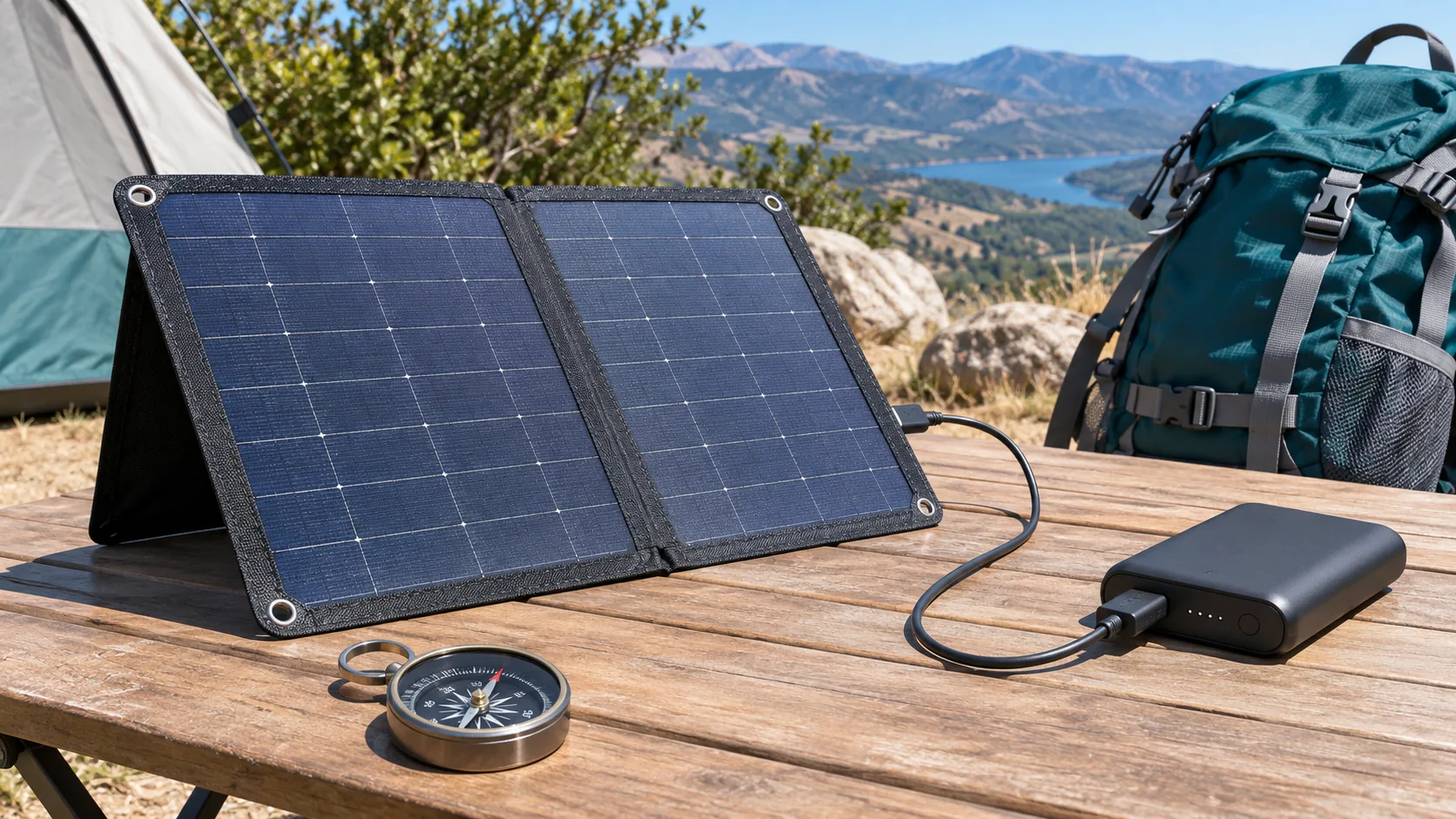
Start with the energy you need, not the largest mAh number
Battery capacity is often printed in mAh at a cell’s nominal voltage. To plan across solar panels and USB devices, convert to watt-hours: Wh = Ah × nominal V. For example, a hypothetical 10,000 mAh pack at 3.7 V contains 10 Ah × 3.7 V = 37 Wh at cell level. A 20,000 mAh pack under the same assumption contains 74 Wh. The energy delivered through a USB output will be lower because conversion and charging use energy. Likewise, the energy drawn from a solar panel or vehicle source to refill it will be higher than the cell-level Wh. Use the model’s label when available instead of assuming every pack uses 3.7 V.
| Planningsvraag | Wat te controleren? | Waarom het ertoe doet |
|---|---|---|
| Hoeveel energie wordt er opgeslagen? | Wh or mAh plus nominal V on the pack label | Maakt vergelijking met paneeluitgang en apparaatbehoefte mogelijk |
| Hoe snel kan het energie accepteren? | USB-C or other input voltage/current and protocol | Een krachtig paneel mag de invoerlimiet van het pakket niet overschrijden |
| Hoeveel zullen uw apparaten verbruiken? | Device battery Wh or measured daily use | Prevents planning around a nominal capacity alone |
| Hoe lang kan de zon niet beschikbaar zijn? | Weer, schaduw, seizoen, oriëntatie en reservedagen | Bepaalt of het plan een andere energiebron nodig heeft |
Solar: paneelclassificatie versus geleverde energie
Het Amerikaanse ministerie van Energie legt uit dat de nominale output van een fotovoltaïsche module wordt gemeten onder standaard testomstandigheden: 1.000 W/m² verlichting en 25°C celtemperatuur. Werkelijke zon, paneeltemperatuur, hoek en schaduw variëren. Zie het DOE-prestatieoverzicht en zijn zonnestralingsprimer. Het 20 W naambord van een vouwpaneel betekent daarom niet dat het 20 W voor elk uur buiten levert.
Als transparant Voorbeeld van een planning, suppose a 20 W panel delivers an average 10 W into a compatible charging circuit for four useful hours. That is 40 Wh at that point in the system, before losses and any interruptions. It might be enough to materially replenish a 37 Wh cell-level pack, but it is not evidence of a full recharge because both conversion loss and the final charge stage matter. If clouds halve the effective average, the input becomes about 20 Wh. These numbers describe assumptions you can replace with local measurements; they are not test results for a particular panel.
| Illustratieve toestand | veronderstelde gemiddelde invoer | Vier uur energie voor latere verliezen | Praktische implicatie |
|---|---|---|---|
| Goede zon en gunstige oriëntatie | 10 W | 40 Wh | Mogelijk handig voor een klein pakket |
| Gedeeltelijke wolk of slechte hoek | 5 W | 20 Wh | Verwacht een gedeeltelijke vulling |
| Zware schaduw | 1 met | 4 Wh | Do not count on this as the main source |
The panel’s actual output can drop sharply when it is partly covered. Place it according to the manufacturer’s instructions, keep electrical connections dry and avoid leaving a lithium pack where the sun can overheat it. If using a panel with an integrated battery, distinguish the panel’s measured output from the battery’s stored capacity. A 30,000 mAh pack such as the 30,000 mAh solar power bank Kan meer energie opslaan, maar dat betekent niet dat een klein geïntegreerd paneel het in één dag kan bijvullen.
Handslinger: handige back-up, beperkte energiebron
A hand crank can provide power without sun or a vehicle, but its output is limited by mechanical effort, generator efficiency and the pack’s electronics. Do not assume a rate from product photography or a generic “minutes of crank = minutes of phone use” slogan. Ask for a measured curve showing generator output, crank speed, input energy stored and test conditions for the exact model.
For scale, if a hypothetical crank supplies an average 2 W of electrical power for 15 minutes, that represents 0.5 Wh before storage losses. Compare that with a hypothetical 37 Wh cell-level pack: it is a small fraction of a full recharge. The calculation illustrates why a crank is best treated as a short-term contingency, not a primary source for a multi-day trip. The 20,000 mAh hand-crank model is een startpunt om te vragen naar het werkelijke gemeten crankuitgangs- en laadpad; Dit artikel bevestigt geen modelspecifieke runtime.
Voertuig opladen en doorvoer opladen
A car’s 12 V outlet can be convenient when a vehicle is available, but the USB adapter plugged into that outlet determines available modes. Compare its per-port output with the pack’s input label, and follow the vehicle and adapter instructions. Secure loose cables so they do not interfere with controls. Never rely on an unattended running engine or a vehicle battery for emergency energy without considering fuel, ventilation and starting reserve.
“Pass-through” means the power bank receives energy while also supplying another device. Some products support it; others do not, or limit it to certain ports. It may generate extra heat and can make charge-state estimates confusing. Verify support in the exact product manual. If an emergency phone must stay powered, connect it directly to the best available source when safe and compatible; do not assume a daisy chain has no loss or interruption.
| Methode | Groot voordeel | Planningslimiet | beste gebruik |
|---|---|---|---|
| Vouwen zonnepaneel | Hernieuwbare input bij daglicht | sterk afhankelijk van licht en oriëntatie | Meerdaagse reis met ruimte voor paneelruimte |
| Geïntegreerd minipaneel | altijd aan het pakket bevestigd | Meestal beperkt door een klein gebied | Aanvullende herwaardering als gemeten output geloofwaardig is |
| handslinger | Werkt zonder zon | Lage energie voor aanhoudende menselijke inspanning | Beperkte onvoorziene opladen |
| Voertuig USB-adapter | voorspelbare bron terwijl een voertuig in bedrijf is | heeft compatibele adapter en voertuigtoegang nodig | reizen waar een voertuig al beschikbaar is |
Bouw een off-grid plan dat een slechte dag overleeft
- Maak een lijst van de apparaten die u moet uitvoeren en scheid essentiële communicatie van optioneel entertainment.
- Estimate daily energy demand in Wh using device labels or a measurement, then add a reserve for poor weather or heavy use.
- Kies een paneel met voldoende oppervlakte en een geverifieerde uitgangsverbinding; Controleer de invoerlimiet van het pakket.
- Draag een geschikte kabel en bescherm connectoren tegen vocht en overbelasting.
- Test de hele opstelling vóór de rit: paneel, regelaar indien gebruikt, powerbank, kabel en telefoon.
- Keep a second charging path, such as a vehicle adapter or extra precharged pack, where safety needs justify one.
For emergency planning, avoid treating one solar power bank as the only way to call for help. If the battery is damaged, swollen, leaking or unusually hot, stop using it and follow the guidance in our power bank safety article.
Vragen die u moet stellen voor een OEM-aankoop
Request model-specific solar wattage at the panel’s test conditions, measured output under stated real light, battery Wh, USB input profiles and a diagram of the charging path. Ask whether pass-through is supported and under what thermal limits. For a crank model, request a repeatable test with crank speed, duration and usable energy stored. Compare samples with the final bill of materials and insist that any public runtime claim quote its test conditions. Those questions are more useful than unverified statements such as “fully charges in the sun.”
Veel gestelde vragen
Kan een klein zonnepaneel een grote powerbank volledig opladen?
It depends on measured panel energy over time, weather and the pack’s Wh. Small panel area normally limits output. Do not infer a one-day recharge from the battery’s mAh label.
Is een handslinger genoeg voor normaal dagelijks opladen?
Not usually a comfortable primary plan. Use measured output and your device’s Wh demand to decide, and reserve the crank for limited contingency use if the model supports it.
Kan ik een pakket uit een ander pakket opladen?
Sommige compatibele apparaten kunnen op deze manier worden aangesloten, maar er zijn conversieverliezen en mogelijke protocol- of pass-through-limieten. Controleer beide handleidingen en vermijd lussen of onbeheerde opstellingen.
Bronnen en limieten
Primaire bronnen: VS. DOE over PV-beoordelingsvoorwaarden en veldvariabiliteit en U.S. DOE Solar Resource Basics. Alle wattage- en runtime-voorbeelden hierboven zijn gelabelde aannames, geen claims van het testen van onze producten.