Quick answer: A power bank can be recharged away from a wall outlet with a compatible folding solar panel, a vehicle USB adapter or, on a specifically designed model, a hand crank. The amount of energy available depends on panel area, sunlight, electrical losses and the pack’s input rating. A tiny panel molded into a battery case should be treated as a supplemental source unless the maker publishes credible measured output. For a trip or emergency kit, plan around watt-hours and a reserve rather than a promise printed in mAh.
This guide is about putting energy back into the battery pack. It complements our solar power bank performance guide, which explains solar output in more detail. The estimates below are illustrative calculations with stated assumptions, not field tests of our products or a guarantee of emergency phone service.
Start with the energy you need, not the largest mAh number
Battery capacity is often printed in mAh at a cell’s nominal voltage. To plan across solar panels and USB devices, convert to watt-hours: Wh = Ah × nominal V. For example, a hypothetical 10,000 mAh pack at 3.7 V contains 10 Ah × 3.7 V = 37 Wh at cell level. A 20,000 mAh pack under the same assumption contains 74 Wh. The energy delivered through a USB output will be lower because conversion and charging use energy. Likewise, the energy drawn from a solar panel or vehicle source to refill it will be higher than the cell-level Wh. Use the model’s label when available instead of assuming every pack uses 3.7 V.
| Planning question | What to check | Why it matters |
|---|---|---|
| How much energy is stored? | Wh or mAh plus nominal V on the pack label | Allows comparison with panel output and device need |
| How quickly can it accept energy? | USB-C or other input voltage/current and protocol | A powerful panel cannot exceed the pack’s input limit |
| How much will your devices consume? | Device battery Wh or measured daily use | Prevents planning around a nominal capacity alone |
| How long might sun be unavailable? | Weather, shade, season, orientation and reserve days | Determines whether the plan needs another energy source |
Solar: panel rating versus delivered energy
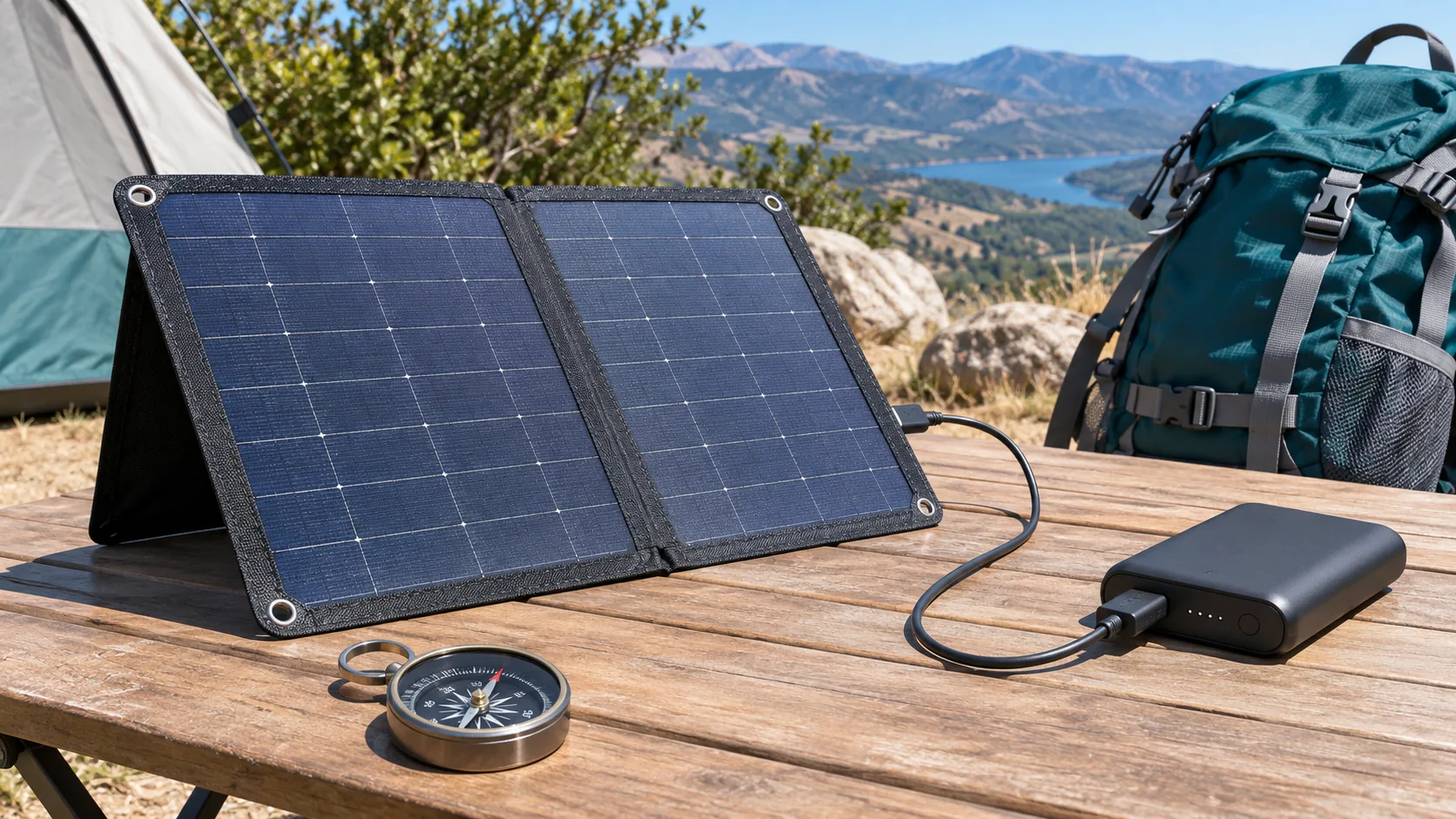
The U.S. Department of Energy explains that a photovoltaic module’s rated output is measured under standard test conditions: 1,000 W/m² illumination and 25°C cell temperature. Actual sunlight, panel temperature, angle and shade vary. See the DOE performance overview and its solar radiation primer. A folding panel’s 20 W nameplate therefore does not mean it supplies 20 W for every hour outside.
As a transparent planning example, suppose a 20 W panel delivers an average 10 W into a compatible charging circuit for four useful hours. That is 40 Wh at that point in the system, before losses and any interruptions. It might be enough to materially replenish a 37 Wh cell-level pack, but it is not evidence of a full recharge because both conversion loss and the final charge stage matter. If clouds halve the effective average, the input becomes about 20 Wh. These numbers describe assumptions you can replace with local measurements; they are not test results for a particular panel.
| Illustrative condition | Assumed average input | Four-hour energy before later losses | Practical implication |
|---|---|---|---|
| Good sun and favorable orientation | 10 W | 40 Wh | Potentially useful for a small pack |
| Partial cloud or poor angle | 5 W | 20 Wh | Expect a partial refill |
| Heavy shade | 1 W | 4 Wh | Do not count on this as the main source |
The panel’s actual output can drop sharply when it is partly covered. Place it according to the manufacturer’s instructions, keep electrical connections dry and avoid leaving a lithium pack where the sun can overheat it. If using a panel with an integrated battery, distinguish the panel’s measured output from the battery’s stored capacity. A 30,000 mAh pack such as the 30,000 mAh solar power bank may store more energy, but that does not imply a small integrated panel can refill it in one day.
Hand crank: useful backup, limited energy source
A hand crank can provide power without sun or a vehicle, but its output is limited by mechanical effort, generator efficiency and the pack’s electronics. Do not assume a rate from product photography or a generic “minutes of crank = minutes of phone use” slogan. Ask for a measured curve showing generator output, crank speed, input energy stored and test conditions for the exact model.
For scale, if a hypothetical crank supplies an average 2 W of electrical power for 15 minutes, that represents 0.5 Wh before storage losses. Compare that with a hypothetical 37 Wh cell-level pack: it is a small fraction of a full recharge. The calculation illustrates why a crank is best treated as a short-term contingency, not a primary source for a multi-day trip. The 20,000 mAh hand-crank model is a starting point for asking about its actual measured crank output and charge path; this article does not assert a model-specific runtime.
Vehicle charging and pass-through charging
A car’s 12 V outlet can be convenient when a vehicle is available, but the USB adapter plugged into that outlet determines available modes. Compare its per-port output with the pack’s input label, and follow the vehicle and adapter instructions. Secure loose cables so they do not interfere with controls. Never rely on an unattended running engine or a vehicle battery for emergency energy without considering fuel, ventilation and starting reserve.
“Pass-through” means the power bank receives energy while also supplying another device. Some products support it; others do not, or limit it to certain ports. It may generate extra heat and can make charge-state estimates confusing. Verify support in the exact product manual. If an emergency phone must stay powered, connect it directly to the best available source when safe and compatible; do not assume a daisy chain has no loss or interruption.
| Method | Main advantage | Planning limit | Best use |
|---|---|---|---|
| Folding solar panel | Renewable input in daylight | Strongly dependent on light and orientation | Multi-day trip with room for panel area |
| Integrated mini panel | Always attached to the pack | Usually constrained by small area | Supplemental top-up if measured output is credible |
| Hand crank | Works without sun | Low energy for sustained human effort | Limited contingency charging |
| Vehicle USB adapter | Predictable source while a vehicle is operating | Needs compatible adapter and vehicle access | Travel where a vehicle is already available |
Build an off-grid plan that survives a bad day
- List the devices you must run and separate essential communication from optional entertainment.
- Estimate daily energy demand in Wh using device labels or a measurement, then add a reserve for poor weather or heavy use.
- Choose a panel with enough area and a verified output connection; check the pack’s input limit.
- Carry an appropriate cable and protect connectors against moisture and strain.
- Test the entire setup before the trip: panel, regulator if used, power bank, cable and phone.
- Keep a second charging path, such as a vehicle adapter or extra precharged pack, where safety needs justify one.
For emergency planning, avoid treating one solar power bank as the only way to call for help. If the battery is damaged, swollen, leaking or unusually hot, stop using it and follow the guidance in our power bank safety article.
Questions to ask before an OEM purchase
Request model-specific solar wattage at the panel’s test conditions, measured output under stated real light, battery Wh, USB input profiles and a diagram of the charging path. Ask whether pass-through is supported and under what thermal limits. For a crank model, request a repeatable test with crank speed, duration and usable energy stored. Compare samples with the final bill of materials and insist that any public runtime claim quote its test conditions. Those questions are more useful than unverified statements such as “fully charges in the sun.”
Frequently asked questions
Can a tiny solar panel fully charge a large power bank?
It depends on measured panel energy over time, weather and the pack’s Wh. Small panel area normally limits output. Do not infer a one-day recharge from the battery’s mAh label.
Is a hand crank enough for normal daily charging?
Not usually a comfortable primary plan. Use measured output and your device’s Wh demand to decide, and reserve the crank for limited contingency use if the model supports it.
Can I recharge a pack from another pack?
Some compatible devices can be connected this way, but there are conversion losses and possible protocol or pass-through limits. Check both manuals and avoid loops or unattended setups.
Sources and limits
Primary sources: U.S. DOE on PV rating conditions and field variability and U.S. DOE solar resource basics. All wattage and runtime examples above are labeled assumptions, not claims of testing our products.