Risposta rapida: A power bank can be recharged away from a wall outlet with a compatible folding solar panel, a vehicle USB adapter or, on a specifically designed model, a hand crank. The amount of energy available depends on panel area, sunlight, electrical losses and the pack’s input rating. A tiny panel molded into a battery case should be treated as a supplemental source unless the maker publishes credible measured output. For a trip or emergency kit, plan around watt-hours and a reserve rather than a promise printed in mAh.
Questa guida riguarda Rimettere l'energia nel pacco batteria. completa il nostro Guida alle prestazioni della banca di energia solare, which explains solar output in more detail. The estimates below are illustrative calculations with stated assumptions, not field tests of our products or a guarantee of emergency phone service.
Start with the energy you need, not the largest mAh number
Battery capacity is often printed in mAh at a cell’s nominal voltage. To plan across solar panels and USB devices, convert to watt-hours: Wh = Ah × nominal V. For example, a hypothetical 10,000 mAh pack at 3.7 V contains 10 Ah × 3.7 V = 37 Wh at cell level. A 20,000 mAh pack under the same assumption contains 74 Wh. The energy delivered through a USB output will be lower because conversion and charging use energy. Likewise, the energy drawn from a solar panel or vehicle source to refill it will be higher than the cell-level Wh. Use the model’s label when available instead of assuming every pack uses 3.7 V.
| Domanda di pianificazione | cosa controllare | Perché è importante |
|---|---|---|
| Quanta energia viene immagazzinata? | Wh or mAh plus nominal V on the pack label | Consente il confronto con l'output del pannello e la necessità del dispositivo |
| Quanto velocemente può accettare l'energia? | USB-C or other input voltage/current and protocol | Un pannello potente non può superare il limite di input del pacchetto |
| Quanto consumeranno i tuoi dispositivi? | Device battery Wh or measured daily use | Prevents planning around a nominal capacity alone |
| Per quanto tempo il sole potrebbe non essere disponibile? | Tempo, ombra, stagione, orientamento e giorni di riserva | Determina se il piano ha bisogno di un'altra fonte di energia |
Solare: valutazione del pannello rispetto all'energia consegnata
Il Dipartimento dell'Energia degli Stati Uniti spiega che l'uscita nominale di un modulo fotovoltaico viene misurata in condizioni di prova standard: 1.000 W/m² di illuminazione e 25°C di temperatura. La luce solare effettiva, la temperatura del pannello, l'angolo e l'ombra variano. Vedere la Panoramica sulle prestazioni del DOE e il suo primer per radiazioni solari. La targhetta da 20 W di un pannello pieghevole quindi non significa che fornisce 20 W per ogni ora all'esterno.
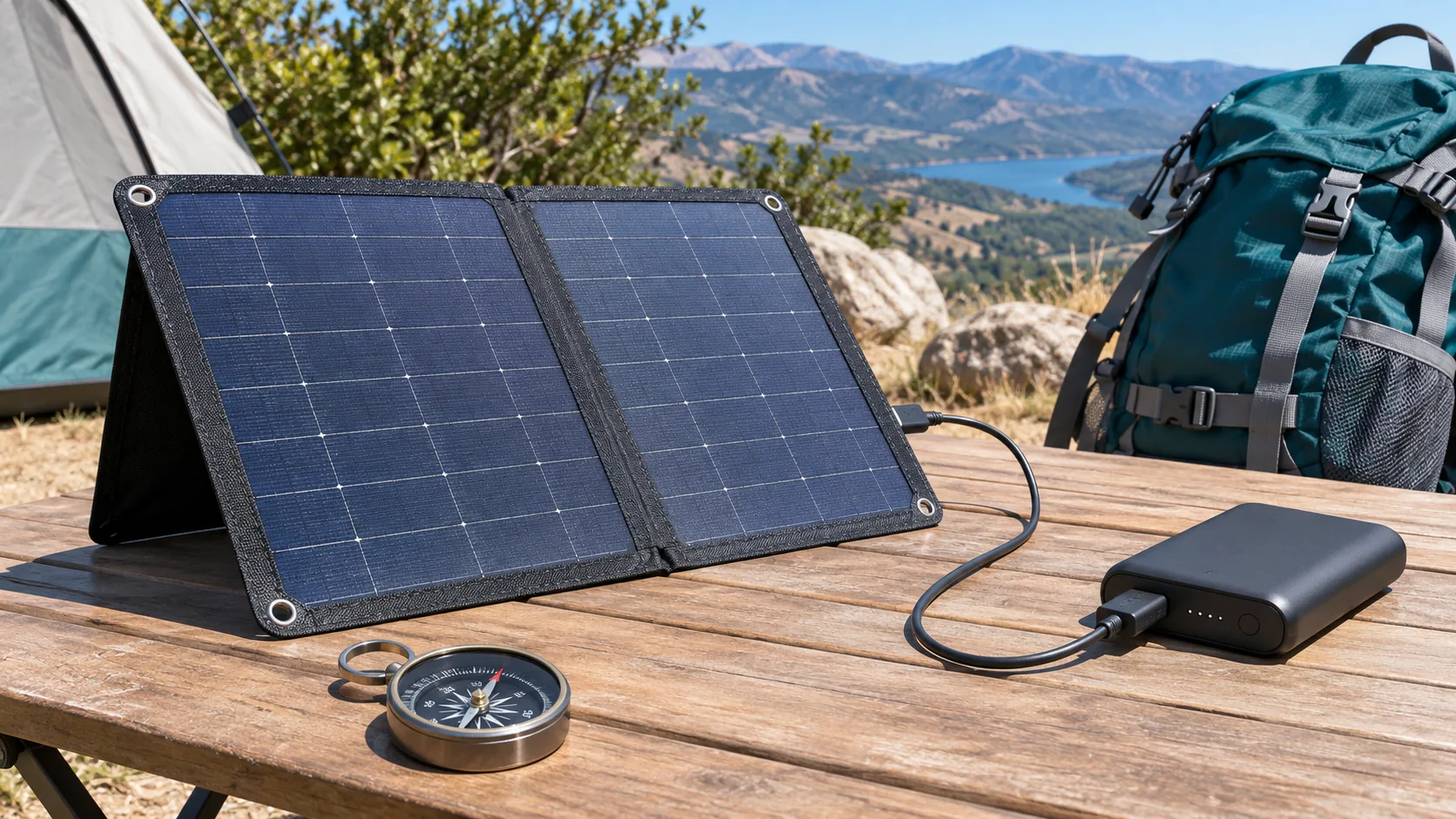
come trasparente Esempio di pianificazione, suppose a 20 W panel delivers an average 10 W into a compatible charging circuit for four useful hours. That is 40 Wh at that point in the system, before losses and any interruptions. It might be enough to materially replenish a 37 Wh cell-level pack, but it is not evidence of a full recharge because both conversion loss and the final charge stage matter. If clouds halve the effective average, the input becomes about 20 Wh. These numbers describe assumptions you can replace with local measurements; they are not test results for a particular panel.
| Condizione illustrativa | presunto input medio | Energia di quattro ore prima delle perdite successive | Implicazione pratica |
|---|---|---|---|
| Buon sole e orientamento favorevole | 10 W | 40 Wh | potenzialmente utile per un piccolo pacchetto |
| Nuvola parziale o angolo scarso | 5 W | 20 Wh | Aspettati una ricarica parziale |
| Ombra pesante | 1 W | 4 Wh | Do not count on this as the main source |
The panel’s actual output can drop sharply when it is partly covered. Place it according to the manufacturer’s instructions, keep electrical connections dry and avoid leaving a lithium pack where the sun can overheat it. If using a panel with an integrated battery, distinguish the panel’s measured output from the battery’s stored capacity. A 30,000 mAh pack such as the 30,000 mAh solar power bank Può immagazzinare più energia, ma ciò non implica che un piccolo pannello integrato possa riempirlo in un giorno.
Manovella: utile riserva, fonte di energia limitata
A hand crank can provide power without sun or a vehicle, but its output is limited by mechanical effort, generator efficiency and the pack’s electronics. Do not assume a rate from product photography or a generic “minutes of crank = minutes of phone use” slogan. Ask for a measured curve showing generator output, crank speed, input energy stored and test conditions for the exact model.
For scale, if a hypothetical crank supplies an average 2 W of electrical power for 15 minutes, that represents 0.5 Wh before storage losses. Compare that with a hypothetical 37 Wh cell-level pack: it is a small fraction of a full recharge. The calculation illustrates why a crank is best treated as a short-term contingency, not a primary source for a multi-day trip. The 20,000 mAh hand-crank model è un punto di partenza per chiedere informazioni sulla sua effettiva uscita della manovella misurata e sul percorso di carica; Questo articolo non afferma un runtime specifico del modello.
Ricarica del veicolo e ricarica pass-through
A car’s 12 V outlet can be convenient when a vehicle is available, but the USB adapter plugged into that outlet determines available modes. Compare its per-port output with the pack’s input label, and follow the vehicle and adapter instructions. Secure loose cables so they do not interfere with controls. Never rely on an unattended running engine or a vehicle battery for emergency energy without considering fuel, ventilation and starting reserve.
“Pass-through” means the power bank receives energy while also supplying another device. Some products support it; others do not, or limit it to certain ports. It may generate extra heat and can make charge-state estimates confusing. Verify support in the exact product manual. If an emergency phone must stay powered, connect it directly to the best available source when safe and compatible; do not assume a daisy chain has no loss or interruption.
| Metodo | Vantaggio principale | Limite di pianificazione | Miglior uso |
|---|---|---|---|
| Pannello solare pieghevole | Input rinnovabile alla luce del giorno | fortemente dipendente dalla luce e dall'orientamento | Gita di più giorni con spazio per area pannello |
| Mini pannello integrato | Sempre attaccato al pacco | Di solito vincolato da una piccola area | Ricarica supplementare se l'output misurato è credibile |
| manovella | funziona senza sole | Bassa energia per uno sforzo umano sostenuto | Ricarica di contingenza limitata |
| Adattatore USB per veicoli | fonte prevedibile mentre un veicolo è in funzione | Ha bisogno di adattatore compatibile e accesso al veicolo | viaggio dove un veicolo è già disponibile |
Costruisci un piano off-grid che sopravviva a una brutta giornata
- Elenca i dispositivi che devi eseguire e separare la comunicazione essenziale dall'intrattenimento opzionale.
- Estimate daily energy demand in Wh using device labels or a measurement, then add a reserve for poor weather or heavy use.
- Scegli un pannello con un'area sufficiente e una connessione di uscita verificata; Controllare il limite di input del pacchetto.
- Portare un cavo appropriato e proteggere i connettori contro l'umidità e la tensione.
- Testare l'intera configurazione prima del viaggio: pannello, regolatore se utilizzato, power bank, cavo e telefono.
- Keep a second charging path, such as a vehicle adapter or extra precharged pack, where safety needs justify one.
For emergency planning, avoid treating one solar power bank as the only way to call for help. If the battery is damaged, swollen, leaking or unusually hot, stop using it and follow the guidance in our power bank safety article.
Domande da porre prima dell'acquisto di un OEM
Request model-specific solar wattage at the panel’s test conditions, measured output under stated real light, battery Wh, USB input profiles and a diagram of the charging path. Ask whether pass-through is supported and under what thermal limits. For a crank model, request a repeatable test with crank speed, duration and usable energy stored. Compare samples with the final bill of materials and insist that any public runtime claim quote its test conditions. Those questions are more useful than unverified statements such as “fully charges in the sun.”
Domande frequenti
Un minuscolo pannello solare può caricare completamente una grande banca di potenza?
It depends on measured panel energy over time, weather and the pack’s Wh. Small panel area normally limits output. Do not infer a one-day recharge from the battery’s mAh label.
Una manovella è sufficiente per la normale ricarica quotidiana?
Not usually a comfortable primary plan. Use measured output and your device’s Wh demand to decide, and reserve the crank for limited contingency use if the model supports it.
Posso ricaricare un pacchetto da un altro pacchetto?
Alcuni dispositivi compatibili possono essere collegati in questo modo, ma ci sono perdite di conversione e possibili limiti di protocollo o pass-through. Controllare entrambi i manuali ed evitare loop o configurazioni incustodite.
Fonti e limiti
Fonti primarie: U.S. DOE sulle condizioni di valutazione PV e sulla variabilità del campo e U.S. Nozioni di base sulle risorse solari del DOE. Tutti gli esempi di potenza e runtime di cui sopra sono ipotesi etichettate, non affermazioni di testare i nostri prodotti.