Respuesta rápida: A power bank can be recharged away from a wall outlet with a compatible folding solar panel, a vehicle USB adapter or, on a specifically designed model, a hand crank. The amount of energy available depends on panel area, sunlight, electrical losses and the pack’s input rating. A tiny panel molded into a battery case should be treated as a supplemental source unless the maker publishes credible measured output. For a trip or emergency kit, plan around watt-hours and a reserve rather than a promise printed in mAh.
Esta guía se trata de Volver a poner energía en el paquete de baterías. Complementa nuestro Guía de rendimiento del banco de energía solar, which explains solar output in more detail. The estimates below are illustrative calculations with stated assumptions, not field tests of our products or a guarantee of emergency phone service.
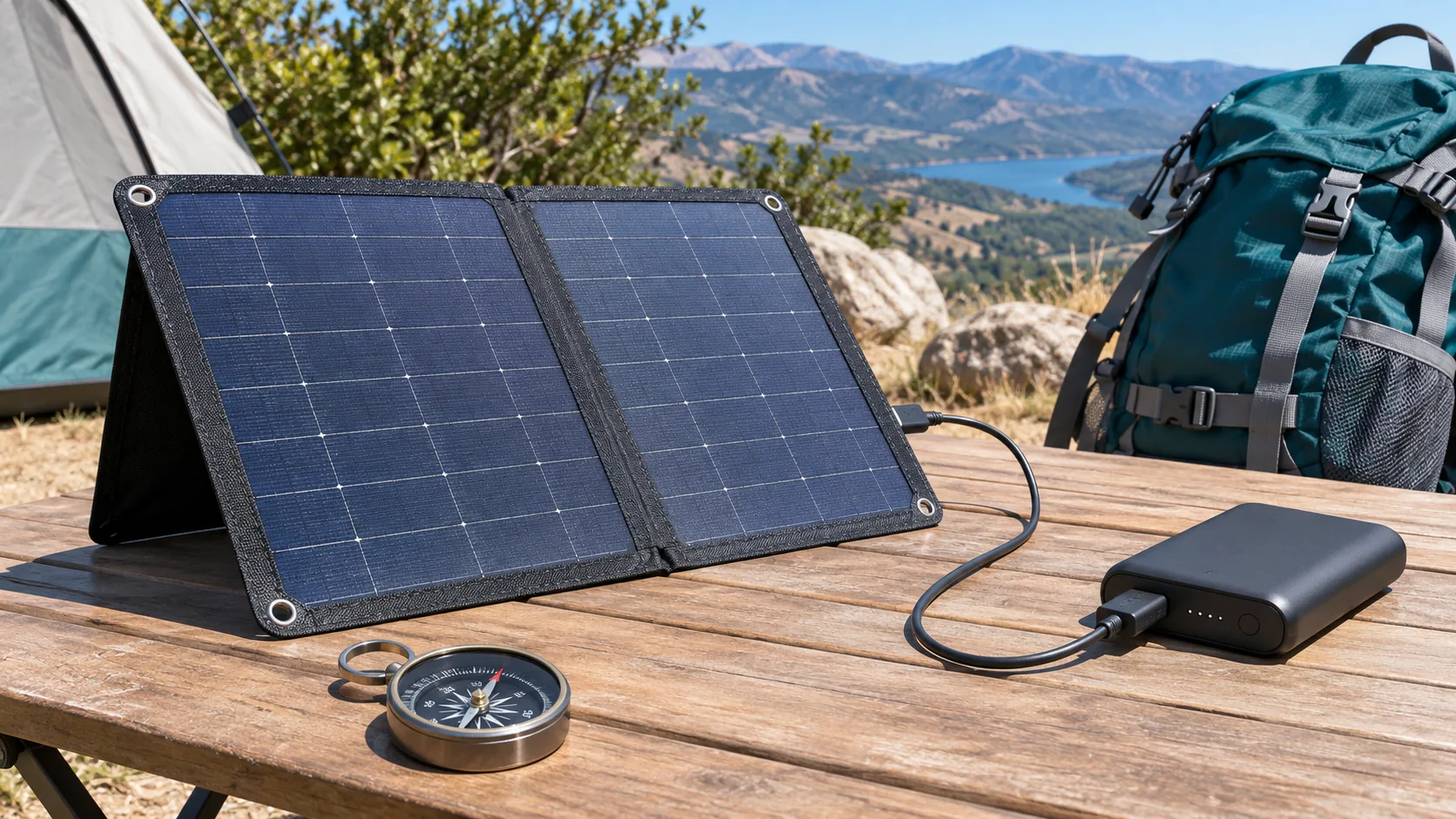
Start with the energy you need, not the largest mAh number
Battery capacity is often printed in mAh at a cell’s nominal voltage. To plan across solar panels and USB devices, convert to watt-hours: Wh = Ah × nominal V. For example, a hypothetical 10,000 mAh pack at 3.7 V contains 10 Ah × 3.7 V = 37 Wh at cell level. A 20,000 mAh pack under the same assumption contains 74 Wh. The energy delivered through a USB output will be lower because conversion and charging use energy. Likewise, the energy drawn from a solar panel or vehicle source to refill it will be higher than the cell-level Wh. Use the model’s label when available instead of assuming every pack uses 3.7 V.
| pregunta de planificación | que comprobar | Por qué importa |
|---|---|---|
| ¿Cuánta energía se almacena? | Wh or mAh plus nominal V on the pack label | Permite la comparación con la salida del panel y la necesidad del dispositivo |
| ¿Qué tan rápido puede aceptar energía? | USB-C or other input voltage/current and protocol | Un panel potente no puede exceder el límite de entrada del paquete |
| ¿Cuánto consumirán sus dispositivos? | Device battery Wh or measured daily use | Prevents planning around a nominal capacity alone |
| ¿Cuánto tiempo podría no estar disponible el sol? | Días, Sombra, Temporada, Orientación y Días de Reserva | Determina si el plan necesita otra fuente de energía |
Solar: Clasificación del panel frente a la energía entregada
El Departamento de Energía de EE. UU. explica que la salida nominal de un módulo fotovoltaico se mide en condiciones de prueba estándar: 1.000 W/m² de iluminación y temperatura de celda de 25°C. La luz solar real, la temperatura del panel, el ángulo y la sombra varían. ver el Descripción general del rendimiento del DOE y su Imprimación de radiación solar. Por lo tanto, la placa de identificación de 20 W de un panel plegable no significa que suministre 20 W por cada hora al aire libre.
como transparente Ejemplo de planificación, suppose a 20 W panel delivers an average 10 W into a compatible charging circuit for four useful hours. That is 40 Wh at that point in the system, before losses and any interruptions. It might be enough to materially replenish a 37 Wh cell-level pack, but it is not evidence of a full recharge because both conversion loss and the final charge stage matter. If clouds halve the effective average, the input becomes about 20 Wh. These numbers describe assumptions you can replace with local measurements; they are not test results for a particular panel.
| condición ilustrativa | Entrada promedio asumida | Energía de cuatro horas antes de pérdidas posteriores | Implicación práctica |
|---|---|---|---|
| Buen sol y orientación favorable | 10 W | 40 Wh | potencialmente útil para un paquete pequeño |
| Nube parcial o ángulo pobre | 5 W | 20 Wh | Espere una recarga parcial |
| Sombra pesada | 1 w | 4 Wh | Do not count on this as the main source |
The panel’s actual output can drop sharply when it is partly covered. Place it according to the manufacturer’s instructions, keep electrical connections dry and avoid leaving a lithium pack where the sun can overheat it. If using a panel with an integrated battery, distinguish the panel’s measured output from the battery’s stored capacity. A 30,000 mAh pack such as the 30,000 mAh solar power bank Puede almacenar más energía, pero eso no implica que un pequeño panel integrado pueda rellenarlo en un día.
Manivela manual: respaldo útil, fuente de energía limitada
A hand crank can provide power without sun or a vehicle, but its output is limited by mechanical effort, generator efficiency and the pack’s electronics. Do not assume a rate from product photography or a generic “minutes of crank = minutes of phone use” slogan. Ask for a measured curve showing generator output, crank speed, input energy stored and test conditions for the exact model.
For scale, if a hypothetical crank supplies an average 2 W of electrical power for 15 minutes, that represents 0.5 Wh before storage losses. Compare that with a hypothetical 37 Wh cell-level pack: it is a small fraction of a full recharge. The calculation illustrates why a crank is best treated as a short-term contingency, not a primary source for a multi-day trip. The 20,000 mAh hand-crank model es un punto de partida para preguntar sobre su salida de manivela medida real y la ruta de carga; Este artículo no afirma un tiempo de ejecución específico del modelo.
Carga del vehículo y carga de paso
A car’s 12 V outlet can be convenient when a vehicle is available, but the USB adapter plugged into that outlet determines available modes. Compare its per-port output with the pack’s input label, and follow the vehicle and adapter instructions. Secure loose cables so they do not interfere with controls. Never rely on an unattended running engine or a vehicle battery for emergency energy without considering fuel, ventilation and starting reserve.
“Pass-through” means the power bank receives energy while also supplying another device. Some products support it; others do not, or limit it to certain ports. It may generate extra heat and can make charge-state estimates confusing. Verify support in the exact product manual. If an emergency phone must stay powered, connect it directly to the best available source when safe and compatible; do not assume a daisy chain has no loss or interruption.
| Método | Ventaja principal | Límite de planificación | Mejor uso |
|---|---|---|---|
| Panel solar plegable | Insumo renovable a la luz del día | Depende fuertemente de la luz y la orientación | Viaje de varios días con espacio para el área del panel |
| Mini panel integrado | siempre unido al paquete | Por lo general, está restringido por un área pequeña | Recarga suplementaria si la producción medida es creíble |
| manivela | Funciona sin sol | Baja energía para el esfuerzo humano sostenido | Carga de contingencia limitada |
| Adaptador USB para vehículos | Fuente predecible mientras un vehículo está en funcionamiento | Necesita adaptador compatible y acceso al vehículo | viajar donde un vehículo ya está disponible |
Construya un plan fuera de la red que sobreviva a un mal día
- Enumere los dispositivos que debe ejecutar y separe la comunicación esencial del entretenimiento opcional.
- Estimate daily energy demand in Wh using device labels or a measurement, then add a reserve for poor weather or heavy use.
- Elija un panel con suficiente área y una conexión de salida verificada; Compruebe el límite de entrada del paquete.
- Lleve un cable apropiado y proteja los conectores contra la humedad y la tensión.
- Pruebe toda la configuración antes del viaje: panel, regulador si se usa, banco de energía, cable y teléfono.
- Keep a second charging path, such as a vehicle adapter or extra precharged pack, where safety needs justify one.
For emergency planning, avoid treating one solar power bank as the only way to call for help. If the battery is damaged, swollen, leaking or unusually hot, stop using it and follow the guidance in our power bank safety article.
Preguntas para hacer antes de una compra OEM
Request model-specific solar wattage at the panel’s test conditions, measured output under stated real light, battery Wh, USB input profiles and a diagram of the charging path. Ask whether pass-through is supported and under what thermal limits. For a crank model, request a repeatable test with crank speed, duration and usable energy stored. Compare samples with the final bill of materials and insist that any public runtime claim quote its test conditions. Those questions are more useful than unverified statements such as “fully charges in the sun.”
Preguntas frecuentes
¿Puede un pequeño panel solar cargar completamente un gran banco de energía?
It depends on measured panel energy over time, weather and the pack’s Wh. Small panel area normally limits output. Do not infer a one-day recharge from the battery’s mAh label.
¿Es suficiente una manivela para una carga diaria normal?
Not usually a comfortable primary plan. Use measured output and your device’s Wh demand to decide, and reserve the crank for limited contingency use if the model supports it.
¿Puedo recargar un paquete de otro paquete?
Algunos dispositivos compatibles se pueden conectar de esta manera, pero hay pérdidas de conversión y posibles límites de protocolo o de transferencia. Revise ambos manuales y evite bucles o configuraciones desatendidas.
Fuentes y límites
Fuentes primarias: EE.UU. DOE en las condiciones de clasificación PV y la variabilidad de campo y U.S. Fundamentos de los recursos solares del DOE. Todos los ejemplos de potencia y tiempo de ejecución anteriores son supuestos etiquetados, no afirmaciones de probar nuestros productos.