Réponse rapide : A power bank can be recharged away from a wall outlet with a compatible folding solar panel, a vehicle USB adapter or, on a specifically designed model, a hand crank. The amount of energy available depends on panel area, sunlight, electrical losses and the pack’s input rating. A tiny panel molded into a battery case should be treated as a supplemental source unless the maker publishes credible measured output. For a trip or emergency kit, plan around watt-hours and a reserve rather than a promise printed in mAh.
Ce guide concerne Remettre de l'énergie dans la batterie. Il complète notre Guide des performances de la banque d'énergie solaire, which explains solar output in more detail. The estimates below are illustrative calculations with stated assumptions, not field tests of our products or a guarantee of emergency phone service.
Start with the energy you need, not the largest mAh number
Battery capacity is often printed in mAh at a cell’s nominal voltage. To plan across solar panels and USB devices, convert to watt-hours: Wh = Ah × nominal V. For example, a hypothetical 10,000 mAh pack at 3.7 V contains 10 Ah × 3.7 V = 37 Wh at cell level. A 20,000 mAh pack under the same assumption contains 74 Wh. The energy delivered through a USB output will be lower because conversion and charging use energy. Likewise, the energy drawn from a solar panel or vehicle source to refill it will be higher than the cell-level Wh. Use the model’s label when available instead of assuming every pack uses 3.7 V.
| question de planification | Quoi vérifier | Pourquoi c'est important |
|---|---|---|
| Quelle quantité d'énergie est stockée ? | Wh or mAh plus nominal V on the pack label | Permet la comparaison avec la sortie du panneau et le besoin d'appareil |
| À quelle vitesse peut-il accepter l'énergie ? | USB-C or other input voltage/current and protocol | Un panneau puissant ne peut pas dépasser la limite d'entrée du pack |
| Combien vos appareils consommeront-ils ? | Device battery Wh or measured daily use | Prevents planning around a nominal capacity alone |
| Combien de temps le soleil peut-il être indisponible ? | Météo, ombre, saison, orientation et jours de réservation | Détermine si le plan a besoin d'une autre source d'énergie |
Solaire : cote de panneau par rapport à l'énergie livrée
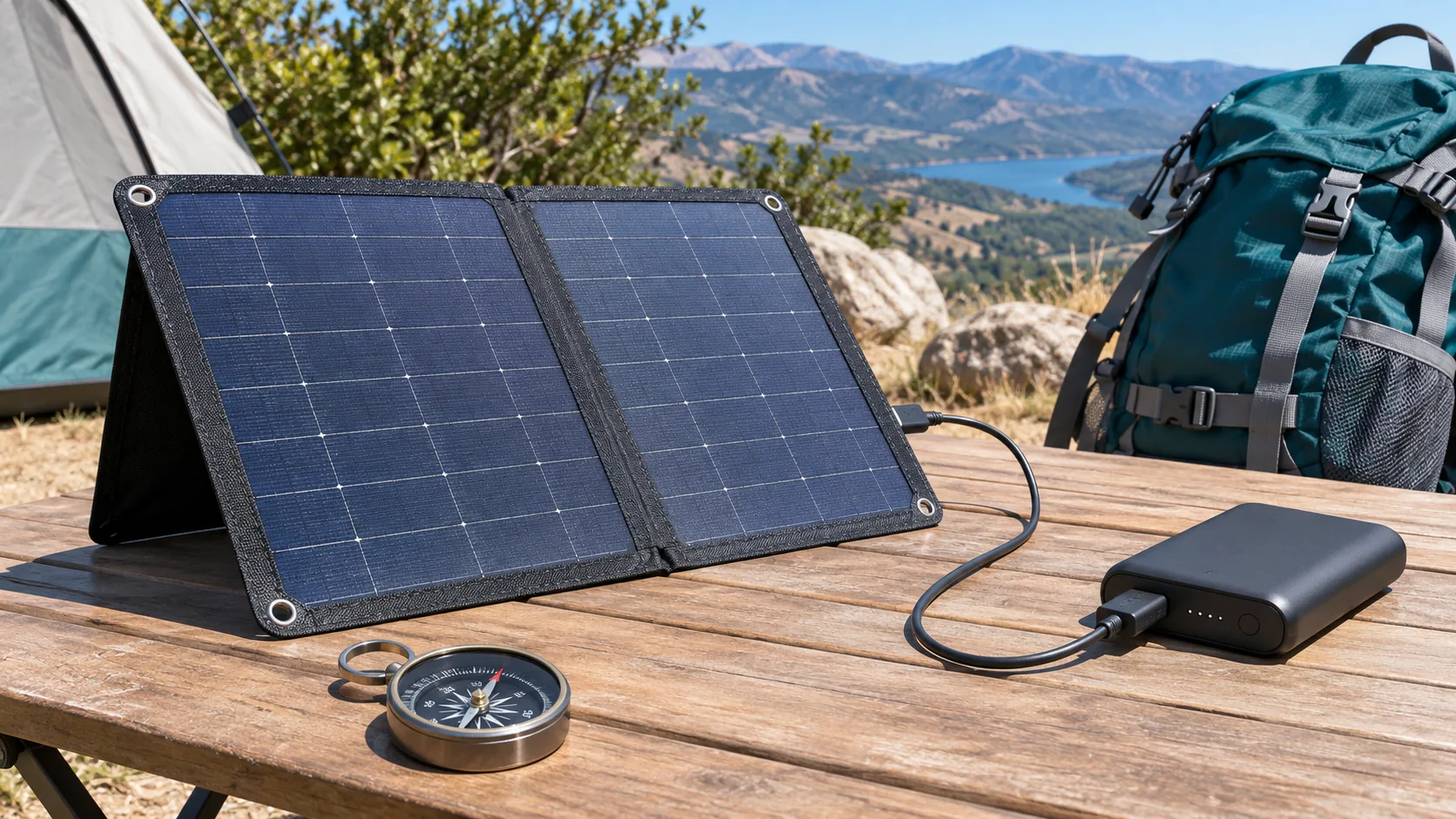
Le département américain de l'énergie explique que la sortie nominale d'un module photovoltaïque est mesurée dans des conditions de test standard : 1 000 W/m² et une température de cellule à 25 °C. La lumière du soleil, la température du panneau, l'angle et l'ombre varient. Consultez la Aperçu des performances du DOE et son Amorce de rayonnement solaire. La plaque signalétique d'un panneau pliant de 20 w ne signifie donc pas qu'elle fournit 20 W par heure à l'extérieur.
Comme un transparent Exemple de planification, suppose a 20 W panel delivers an average 10 W into a compatible charging circuit for four useful hours. That is 40 Wh at that point in the system, before losses and any interruptions. It might be enough to materially replenish a 37 Wh cell-level pack, but it is not evidence of a full recharge because both conversion loss and the final charge stage matter. If clouds halve the effective average, the input becomes about 20 Wh. These numbers describe assumptions you can replace with local measurements; they are not test results for a particular panel.
| état d'illustration | Entrée moyenne supposée | Énergie de quatre heures avant pertes ultérieures | implication pratique |
|---|---|---|---|
| Bon soleil et orientation favorable | 10 W | 40 Wh | Potentiellement utile pour un petit pack |
| Nuage partiel ou angle médiocre | 5 W | 20 Wh | Attendez-vous à une recharge partielle |
| ombre lourde | 1 w | 4 Wh | Do not count on this as the main source |
The panel’s actual output can drop sharply when it is partly covered. Place it according to the manufacturer’s instructions, keep electrical connections dry and avoid leaving a lithium pack where the sun can overheat it. If using a panel with an integrated battery, distinguish the panel’s measured output from the battery’s stored capacity. A 30,000 mAh pack such as the 30,000 mAh solar power bank Peut stocker plus d'énergie, mais cela n'implique pas qu'un petit panneau intégré puisse le recharger en une journée.
Manivelle : sauvegarde utile, source d'énergie limitée
A hand crank can provide power without sun or a vehicle, but its output is limited by mechanical effort, generator efficiency and the pack’s electronics. Do not assume a rate from product photography or a generic “minutes of crank = minutes of phone use” slogan. Ask for a measured curve showing generator output, crank speed, input energy stored and test conditions for the exact model.
For scale, if a hypothetical crank supplies an average 2 W of electrical power for 15 minutes, that represents 0.5 Wh before storage losses. Compare that with a hypothetical 37 Wh cell-level pack: it is a small fraction of a full recharge. The calculation illustrates why a crank is best treated as a short-term contingency, not a primary source for a multi-day trip. The 20,000 mAh hand-crank model est un point de départ pour poser des questions sur sa sortie de manivelle et sa trajectoire de charge réelles mesurées ; Cet article n'affirme pas d'exécution spécifique au modèle.
Chargement du véhicule et charge de passage
A car’s 12 V outlet can be convenient when a vehicle is available, but the USB adapter plugged into that outlet determines available modes. Compare its per-port output with the pack’s input label, and follow the vehicle and adapter instructions. Secure loose cables so they do not interfere with controls. Never rely on an unattended running engine or a vehicle battery for emergency energy without considering fuel, ventilation and starting reserve.
“Pass-through” means the power bank receives energy while also supplying another device. Some products support it; others do not, or limit it to certain ports. It may generate extra heat and can make charge-state estimates confusing. Verify support in the exact product manual. If an emergency phone must stay powered, connect it directly to the best available source when safe and compatible; do not assume a daisy chain has no loss or interruption.
| Méthode | principal avantage | Limite de planification | Meilleure utilisation |
|---|---|---|---|
| Panneau solaire pliant | Input renouvelable en plein jour | fortement dépendant de la lumière et de l'orientation | Voyage de plusieurs jours avec place pour la zone de panneau |
| Mini panneau intégré | Toujours attaché au pack | généralement contraint par une petite zone | Recharge supplémentaire si la sortie mesurée est crédible |
| manivelle | Fonctionne sans soleil | Faible énergie pour un effort humain soutenu | Charge d'urgence limitée |
| Adaptateur USB pour véhicule | Source prévisible pendant qu'un véhicule fonctionne | Nécessite un accès compatible avec un adaptateur | voyager là où un véhicule est déjà disponible |
Construisez un plan hors réseau qui survit à une mauvaise journée
- Énumérez les appareils que vous devez exécuter et séparer la communication essentielle des divertissements optionnels.
- Estimate daily energy demand in Wh using device labels or a measurement, then add a reserve for poor weather or heavy use.
- Choisissez un panneau avec suffisamment de surface et une connexion de sortie vérifiée ; Vérifiez la limite d'entrée du pack.
- Portez un câble approprié et protégez les connecteurs contre l'humidité et la tension.
- Testez l'ensemble de la configuration avant le voyage : panneau, régulateur si utilisé, banque d'alimentation, câble et téléphone.
- Keep a second charging path, such as a vehicle adapter or extra precharged pack, where safety needs justify one.
For emergency planning, avoid treating one solar power bank as the only way to call for help. If the battery is damaged, swollen, leaking or unusually hot, stop using it and follow the guidance in our power bank safety article.
Questions à poser avant un achat OEM
Request model-specific solar wattage at the panel’s test conditions, measured output under stated real light, battery Wh, USB input profiles and a diagram of the charging path. Ask whether pass-through is supported and under what thermal limits. For a crank model, request a repeatable test with crank speed, duration and usable energy stored. Compare samples with the final bill of materials and insist that any public runtime claim quote its test conditions. Those questions are more useful than unverified statements such as “fully charges in the sun.”
Foire aux questions
Un petit panneau solaire peut-il recharger complètement une grande banque d'alimentation ?
It depends on measured panel energy over time, weather and the pack’s Wh. Small panel area normally limits output. Do not infer a one-day recharge from the battery’s mAh label.
Une manivelle est-elle suffisante pour une charge quotidienne normale ?
Not usually a comfortable primary plan. Use measured output and your device’s Wh demand to decide, and reserve the crank for limited contingency use if the model supports it.
Puis-je recharger un pack d'un autre pack ?
Certains appareils compatibles peuvent être connectés de cette manière, mais il existe des pertes de conversion et des limites de protocole ou de passage. Vérifiez les deux manuels et évitez les boucles ou les configurations sans surveillance.
Sources et limites
Sources principales : DOE américain sur les conditions de notation PV et la variabilité du champ et Les bases des ressources solaires du DOE aux États-Unis. Tous les exemples de puissance et d'exécution ci-dessus sont des hypothèses étiquetées, et non des affirmations pour tester nos produits.