त्वरित उत्तर: A power bank can be recharged away from a wall outlet with a compatible folding solar panel, a vehicle USB adapter or, on a specifically designed model, a hand crank. The amount of energy available depends on panel area, sunlight, electrical losses and the pack’s input rating. A tiny panel molded into a battery case should be treated as a supplemental source unless the maker publishes credible measured output. For a trip or emergency kit, plan around watt-hours and a reserve rather than a promise printed in mAh.
यह गाइड के बारे में है बैटरी पैक में ऊर्जा वापस लाना। यह हमारा पूरक है सौर ऊर्जा बैंक प्रदर्शन गाइड, which explains solar output in more detail. The estimates below are illustrative calculations with stated assumptions, not field tests of our products or a guarantee of emergency phone service.
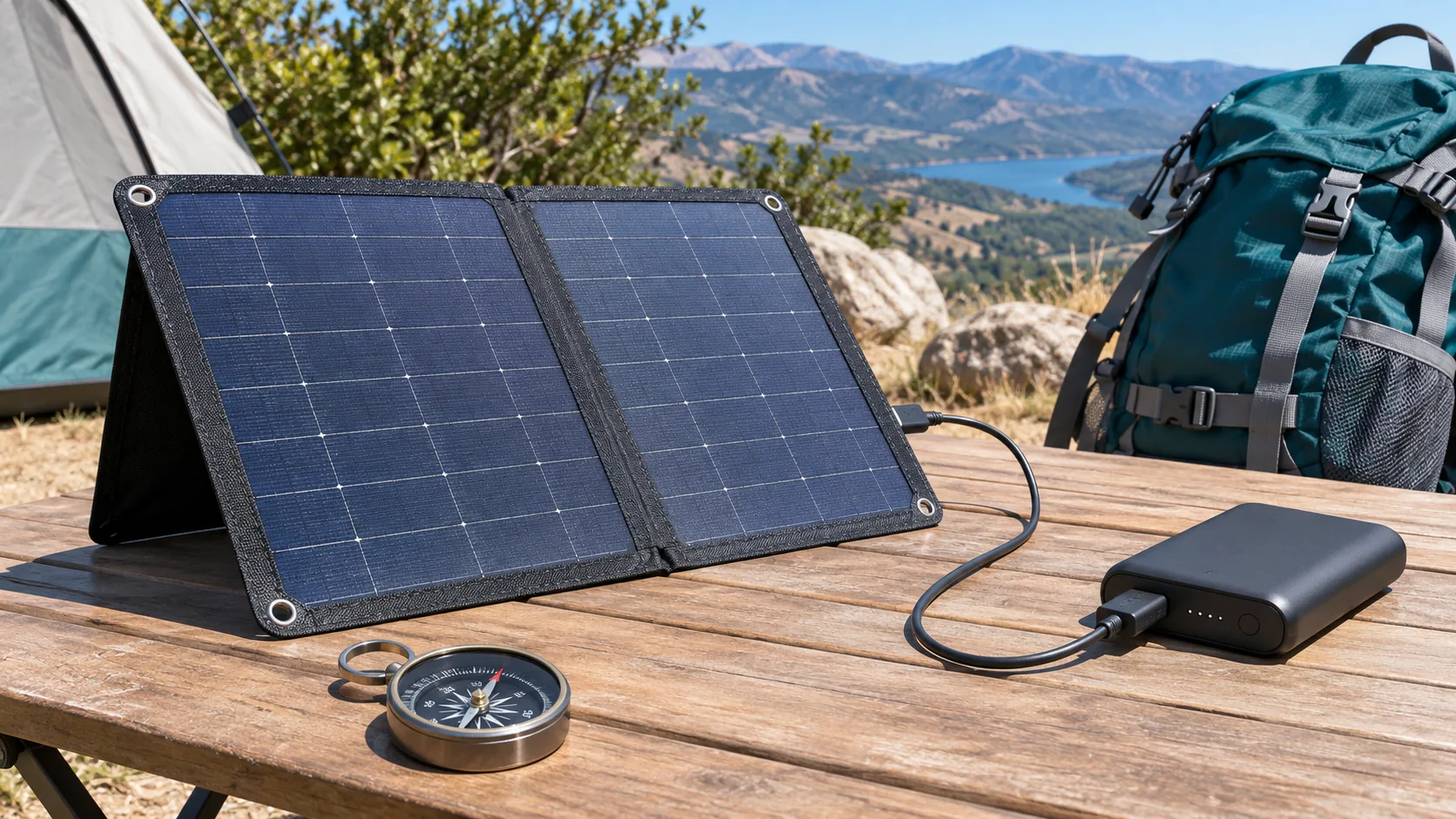
Start with the energy you need, not the largest mAh number
Battery capacity is often printed in mAh at a cell’s nominal voltage. To plan across solar panels and USB devices, convert to watt-hours: Wh = Ah × nominal V. For example, a hypothetical 10,000 mAh pack at 3.7 V contains 10 Ah × 3.7 V = 37 Wh at cell level. A 20,000 mAh pack under the same assumption contains 74 Wh. The energy delivered through a USB output will be lower because conversion and charging use energy. Likewise, the energy drawn from a solar panel or vehicle source to refill it will be higher than the cell-level Wh. Use the model’s label when available instead of assuming every pack uses 3.7 V.
| योजना प्रश्न | क्या जांचें | यह क्यों मायने रखता है |
|---|---|---|
| कितनी ऊर्जा संग्रहित है? | Wh or mAh plus nominal V on the pack label | पैनल आउटपुट और डिवाइस की आवश्यकता के साथ तुलना की अनुमति देता है |
| यह कितनी जल्दी ऊर्जा को स्वीकार कर सकता है? | USB-C or other input voltage/current and protocol | एक शक्तिशाली पैनल पैक की इनपुट सीमा को पार नहीं कर सकता |
| आपके डिवाइस कितना उपभोग करेंगे? | Device battery Wh or measured daily use | Prevents planning around a nominal capacity alone |
| सूर्य कब तक अनुपलब्ध हो सकता है? | मौसम, छाया, मौसम, अभिविन्यास और आरक्षित दिन | यह निर्धारित करता है कि क्या योजना को किसी अन्य ऊर्जा स्रोत की आवश्यकता है |
सौर: पैनल रेटिंग बनाम वितरित ऊर्जा
अमेरिकी ऊर्जा विभाग बताता है कि एक फोटोवोल्टिक मॉड्यूल के रेटेड आउटपुट को मानक परीक्षण स्थितियों के तहत मापा जाता है: 1,000 डब्ल्यू / एम² रोशनी और 25 डिग्री सेल्सियस सेल तापमान। वास्तविक धूप, पैनल का तापमान, कोण और छाया अलग-अलग होते हैं। डीओई प्रदर्शन अवलोकन और इसका सौर विकिरण प्राइमर देखें। एक तह पैनल की 20 डब्ल्यू नेमप्लेट का मतलब यह नहीं है कि यह हर घंटे बाहर के लिए 20 डब्ल्यू की आपूर्ति करता है।
एक पारदर्शी के रूप में नियोजन उदाहरण, suppose a 20 W panel delivers an average 10 W into a compatible charging circuit for four useful hours. That is 40 Wh at that point in the system, before losses and any interruptions. It might be enough to materially replenish a 37 Wh cell-level pack, but it is not evidence of a full recharge because both conversion loss and the final charge stage matter. If clouds halve the effective average, the input becomes about 20 Wh. These numbers describe assumptions you can replace with local measurements; they are not test results for a particular panel.
| उदाहरणात्मक दशा | कल्पित औसत इनपुट | बाद में नुकसान से पहले चार घंटे की ऊर्जा | व्यावहारिक निहितार्थ |
|---|---|---|---|
| अच्छा सूर्य और अनुकूल अभिविन्यास | 10 डब्ल्यू | 40 Wh | एक छोटे पैक के लिए संभावित रूप से उपयोगी |
| आंशिक बादल या खराब कोण | 5 डब्ल्यू | 20 Wh | आंशिक रिफिल की अपेक्षा करें |
| भारी छाया | 1 डब्ल्यू | 4 Wh | Do not count on this as the main source |
The panel’s actual output can drop sharply when it is partly covered. Place it according to the manufacturer’s instructions, keep electrical connections dry and avoid leaving a lithium pack where the sun can overheat it. If using a panel with an integrated battery, distinguish the panel’s measured output from the battery’s stored capacity. A 30,000 mAh pack such as the 30,000 mAh solar power bank अधिक ऊर्जा संग्रहीत कर सकता है, लेकिन इसका मतलब यह नहीं है कि एक छोटा एकीकृत पैनल इसे एक दिन में फिर से भर सकता है।
हैंड क्रैंक: उपयोगी बैकअप, सीमित ऊर्जा स्रोत
A hand crank can provide power without sun or a vehicle, but its output is limited by mechanical effort, generator efficiency and the pack’s electronics. Do not assume a rate from product photography or a generic “minutes of crank = minutes of phone use” slogan. Ask for a measured curve showing generator output, crank speed, input energy stored and test conditions for the exact model.
For scale, if a hypothetical crank supplies an average 2 W of electrical power for 15 minutes, that represents 0.5 Wh before storage losses. Compare that with a hypothetical 37 Wh cell-level pack: it is a small fraction of a full recharge. The calculation illustrates why a crank is best treated as a short-term contingency, not a primary source for a multi-day trip. The 20,000 mAh hand-crank model इसके वास्तविक मापा क्रैंक आउटपुट और चार्ज पथ के बारे में पूछने के लिए एक प्रारंभिक बिंदु है; यह आलेख मॉडल-विशिष्ट रनटाइम का दावा नहीं करता है।
वाहन चार्जिंग और पास-थ्रू चार्जिंग
A car’s 12 V outlet can be convenient when a vehicle is available, but the USB adapter plugged into that outlet determines available modes. Compare its per-port output with the pack’s input label, and follow the vehicle and adapter instructions. Secure loose cables so they do not interfere with controls. Never rely on an unattended running engine or a vehicle battery for emergency energy without considering fuel, ventilation and starting reserve.
“Pass-through” means the power bank receives energy while also supplying another device. Some products support it; others do not, or limit it to certain ports. It may generate extra heat and can make charge-state estimates confusing. Verify support in the exact product manual. If an emergency phone must stay powered, connect it directly to the best available source when safe and compatible; do not assume a daisy chain has no loss or interruption.
| विधि | मुख्य लाभ | योजना सीमा | सर्वोत्तम उपयोग |
|---|---|---|---|
| फोल्डिंग सोलर पैनल | दिन के उजाले में अक्षय इनपुट | प्रकाश और अभिविन्यास पर दृढ़ता से निर्भर | पैनल क्षेत्र के लिए कमरे के साथ बहु-दिवसीय यात्रा |
| एकीकृत मिनी पैनल | हमेशा पैक से जुड़ा | आमतौर पर छोटे क्षेत्र से विवश | पूरक टॉप-अप यदि मापा आउटपुट विश्वसनीय है |
| हैंड क्रैंक | सूरज के बिना काम करता है | निरंतर मानव प्रयास के लिए कम ऊर्जा | सीमित आकस्मिक शुल्क |
| वाहन यूएसबी एडाप्टर | अनुमानित स्रोत जब कोई वाहन चल रहा हो | संगत एडाप्टर और वाहन पहुंच की आवश्यकता है | यात्रा करें जहां एक वाहन पहले से उपलब्ध है |
एक ऑफ-ग्रिड योजना बनाएं जो एक बुरे दिन से बचे
- उन उपकरणों की सूची बनाएं जिन्हें आपको चलाना चाहिए और आवश्यक संचार को वैकल्पिक मनोरंजन से अलग करें।
- Estimate daily energy demand in Wh using device labels or a measurement, then add a reserve for poor weather or heavy use.
- पर्याप्त क्षेत्र और एक सत्यापित आउटपुट कनेक्शन वाला एक पैनल चुनें; पैक की इनपुट सीमा की जाँच करें।
- एक उपयुक्त केबल ले जाएं और कनेक्टर्स को नमी और तनाव से बचाएं।
- यात्रा से पहले पूरे सेटअप का परीक्षण करें: पैनल, नियामक यदि उपयोग किया जाता है, पावर बैंक, केबल और फोन।
- Keep a second charging path, such as a vehicle adapter or extra precharged pack, where safety needs justify one.
For emergency planning, avoid treating one solar power bank as the only way to call for help. If the battery is damaged, swollen, leaking or unusually hot, stop using it and follow the guidance in our power bank safety article.
OEM खरीद से पहले पूछने के लिए प्रश्न
Request model-specific solar wattage at the panel’s test conditions, measured output under stated real light, battery Wh, USB input profiles and a diagram of the charging path. Ask whether pass-through is supported and under what thermal limits. For a crank model, request a repeatable test with crank speed, duration and usable energy stored. Compare samples with the final bill of materials and insist that any public runtime claim quote its test conditions. Those questions are more useful than unverified statements such as “fully charges in the sun.”
बार बार पूछे जाने वाले प्रश्न
क्या एक छोटा सौर पैनल एक बड़े पावर बैंक को पूरी तरह से चार्ज कर सकता है?
It depends on measured panel energy over time, weather and the pack’s Wh. Small panel area normally limits output. Do not infer a one-day recharge from the battery’s mAh label.
क्या सामान्य दैनिक चार्जिंग के लिए हैंड क्रैंक पर्याप्त है?
Not usually a comfortable primary plan. Use measured output and your device’s Wh demand to decide, and reserve the crank for limited contingency use if the model supports it.
क्या मैं दूसरे पैक से पैक रिचार्ज कर सकता हूँ?
कुछ संगत उपकरणों को इस तरह से जोड़ा जा सकता है, लेकिन रूपांतरण नुकसान और संभावित प्रोटोकॉल या पास-थ्रू सीमाएं हैं। दोनों मैनुअल की जाँच करें और लूप या अनअटेंडेड सेटअप से बचें।
स्रोत और सीमाएं
प्राथमिक स्रोत: यू.एस. पीवी रेटिंग की स्थिति और फील्ड परिवर्तनशीलता पर डीओई और यू.एस. डीओई सौर संसाधन मूल बातें। उपरोक्त सभी वाट क्षमता और रनटाइम उदाहरणों को लेबल की गई धारणाएं हैं, न कि हमारे उत्पादों के परीक्षण के दावे।