There is no single time for every 20000mAh bank. The controlling numbers are the specific bank’s rated energy in watt-hours, its input power profile, the wall charger’s supported modes, the cable, and how charging slows near full. The large wattage printed on a product listing may refer to output to your phone rather than input into the bank. This guide shows how to estimate a useful time range for an exact model and how to check it without presenting a hypothetical calculation as a factory test.
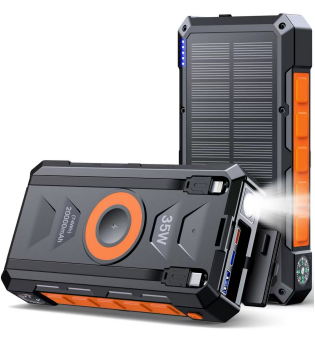
Look for input watts, not just capacity or output watts
The capacity label describes how much charge the internal battery can hold at its stated voltage. To make an energy estimate, use the battery’s Wh figure. The FAA’s lithium-battery guidance gives the conversion when only mAh and voltage are supplied: Wh = mAh ÷ 1000 × V. As an arithmetic example, a 20000mAh pack rated at 3.7V has 74Wh of nominal cell energy. That example is not a specification for the pictured bank. If the actual label says something else, use the actual label.
Then read the bank’s input label. It may list a USB-C input such as a voltage and current combination, or several USB Power Delivery modes. These are not interchangeable with the output ratings that describe how fast the bank can charge other devices. A bank advertised as a 35W or 65W output product does not necessarily refill at 35W or 65W. Ask for a per-port input table and clarify whether an integrated cable or solar panel is an input, an output, or both. The product manual should define the actual behavior.
| Specification | Role in the calculation | Common mistake |
|---|---|---|
| Battery energy in Wh | Energy to replenish, subject to charge-state and losses | Using mAh without its reference voltage |
| Bank input profile | Upper limit on power the bank may accept | Substituting the output wattage |
| Wall charger profile | Power source available to the bank | Assuming a higher-rated charger forces higher input |
| Cable rating and condition | Can limit or interrupt the available mode | Assuming any USB-C cable performs identically |
| Charge taper and heat control | Reduce average power near full or under thermal limits | Dividing Wh by peak W and treating that as an exact time |
Use a calculation as a lower bound, not a promise
For the hypothetical 74Wh bank, dividing 74Wh by a constant 10W gives 7.4 hours. Dividing by 20W gives 3.7 hours. These figures are idealized lower bounds because they assume that the bank accepts that power continuously and stores every incoming watt-hour without losses. Real charging takes longer: the bank’s charging circuit consumes energy, the battery does not charge at peak power for the entire cycle, and the unit may reduce input when it is warm. If a product page gives a measured time, compare its starting charge state, charger, cable and ambient conditions with your planned use.
Do not make the opposite mistake of assuming every unit will charge at the number printed on the charger. The wall supply and bank must agree on a mode they both support. USB-IF describes USB Power Delivery as a negotiation and power-management system. A 65W charger connected to a bank with a lower accepted input does not turn that bank into a 65W input device. Conversely, a bank that accepts higher input may charge slowly from an older low-power adapter. A USB-C connector also does not prove a specific Power Delivery profile; USB-IF’s Type-C labeling guidance makes that distinction explicit.
| Constant input assumption | Ideal Wh ÷ W floor | How to interpret it |
|---|---|---|
| 10W for the entire cycle | 7.4 hours | Actual full recharge will exceed this if losses or taper occur |
| 18W for the entire cycle | 4.1 hours | Not a forecast unless the bank and charger support the mode |
| 20W for the entire cycle | 3.7 hours | Still excludes losses and reduced current near full |
| 30W for the entire cycle | 2.5 hours | Only relevant if the actual bank has that input capability |
The table is a way to reject impossible-sounding claims, not to certify a product’s charging time. For example, a claim that a 74Wh bank charges from empty to full in less than its ideal 20W energy floor needs scrutiny if 20W is the maximum input. That conclusion follows from energy arithmetic, but the exact model label and measured average input remain essential. A bank with a different Wh rating or a deliberately limited charging range cannot be judged by this example alone.
How to time the exact bank fairly
Start from a defined battery state
A test from “one LED left” is not automatically a 0% to 100% test. Some indicators use broad bands, and the bank may reserve energy below the visible empty state. Write down the model, starting indicator and any battery percentage reading. If a supplier claims a full recharge time, ask how it defines empty and full. Use the same definition when comparing two models. A single partial-charge session can establish convenience for your routine but should not be extrapolated mechanically to a full cycle.
Record the whole charging path
Write down the wall adapter’s model and supported output modes, the cable type, the bank’s input port, the ambient conditions and the time charging began. A USB power meter can show instantaneous input, but a single peak reading is not the average over the session. A meter that integrates Wh over time is more informative, provided it is suitable for the negotiated voltage and connection. Note whether charging slows near the end, stops and restarts, or changes when another device is connected. Repeating the session is useful if the first run was interrupted.
Separate wired, solar and car charging
Solar replenishment depends on sunlight, panel orientation, temperature and the panel’s actual electrical rating. A compact panel built into a bank should not be assigned a full-charge time from a wired input calculation. A vehicle USB port also may have a different power limit than a wall charger. For any alternative input, verify the model-specific input specification and test under conditions that resemble the intended trip. If reliability matters, plan a wired charge before leaving and treat solar input as supplemental unless measured otherwise.
Compare two 20000mAh listings without assuming equal recharge speed
The site lists a 20000mAh solar power bank marked 35W and a 20000mAh power bank marked 65W. These are relevant comparison pages, but the 35W and 65W numbers should not be treated as recharge input values without the current input table. Ask for both models’ printed Wh, USB-C input profiles, supported chargers and a full-cycle test performed with named equipment. Capacity can match while input rate, conversion electronics and thermal behavior differ.
If your main concern is overnight readiness, check whether the bank will refill within your available window using the wall charger you already own. If your concern is quick turnaround between work shifts, measured full-cycle timing and charger compatibility matter more than a high output number. If you are sourcing a batch, ask for the test protocol and record a sample from the actual production version. A precise time without a stated charger, cable and starting state is not comparable across sellers.
Checklist before relying on a quoted time
- Use the exact model’s Wh label and input-power profile.
- Check that the wall charger offers a compatible voltage and current mode.
- Use a cable suitable for the negotiated charging mode.
- Define the starting and ending charge states.
- Distinguish peak input from average input over the full session.
- Record whether other devices were connected and whether the bank became warm.
- Do not carry a wired time estimate over to solar or vehicle charging.
The right answer to “How long?” is a model-and-charger-specific range or a measured full-cycle result with conditions. The 20000mAh label supplies only one piece of that answer.