Quick answer: Some smart glasses can be ordered with prescription lenses, but compatibility is specific to the frame, lens design, prescription range, and seller’s fitting process. Audio glasses and camera glasses may accept ordinary corrective lenses; glasses with an in-lens display can impose extra optical and service constraints. Do not assume that an empty-looking frame can be reglazed safely. Confirm the exact model and prescription with an authorized optical provider before ordering.
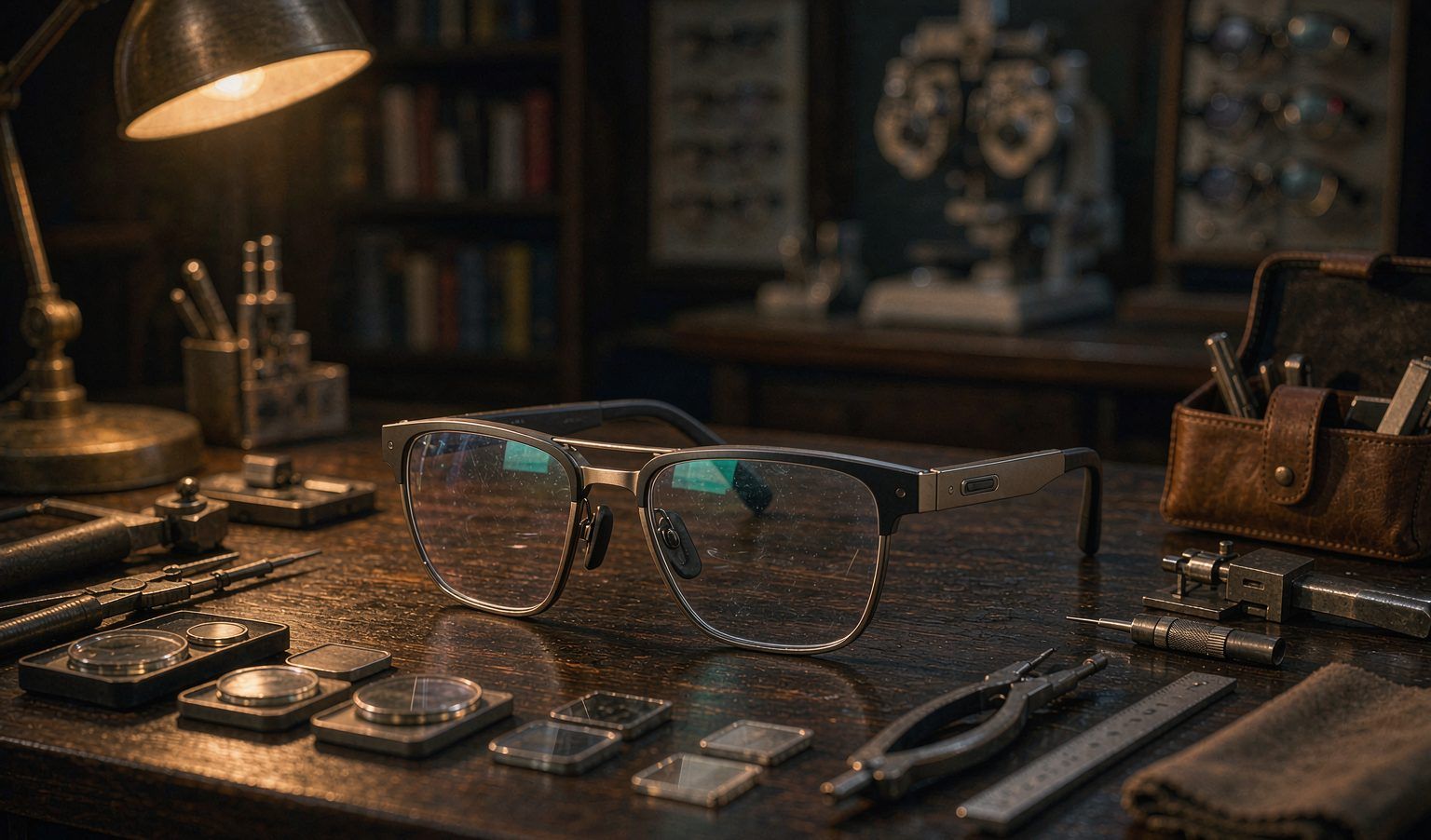
Separate vision correction from electronic features
Prescription lenses correct vision according to an eye-care professional’s prescription. Speakers, microphones, cameras, and displays are different features in the frame. A pair of smart glasses can have advanced electronics yet offer no approved path for your prescription; conversely, an audio frame may accept corrective lenses without offering any visual display. The words “smart,” “AR,” and “prescription ready” should not be treated as interchangeable.
A useful starting example is Ray-Ban’s official Meta FAQ. It says Ray-Ban Meta glasses are prescription compatible and can be ordered as a complete pair through its channels. It also discusses adding lenses later through an optical provider and notes a warranty condition for certified retailers. The same statement should not be extended to another frame, a different brand, or a different country without checking its own policy.
| Route | What you gain | What to verify first |
|---|---|---|
| Factory or brand prescription option at purchase | One coordinated order for frame and lenses | Prescription eligibility, region, lens options, returns and warranty |
| Certified optical retailer adds lenses | In-person fitting and potential after-purchase path | Whether the retailer is authorized for this model and what warranty remains |
| Independent reglazing | Possible flexibility where a maker permits it | Frame safety, lens retention, sensors, warranty and optician acceptance |
| Prescription insert or over-glasses solution | May avoid replacing the front optics on some display devices | Whether that exact device supports an insert and maintains display alignment |
These are purchasing routes, not promises that every brand supports all four. A “prescription insert” marketed for one headset cannot be assumed to fit another pair of smart glasses.
Why display glasses require extra questions
A display inside the lens introduces alignment considerations beyond normal frame fitting. The wearer must see the projected content clearly and comfortably while also seeing the outside world through the prescribed correction. Lens thickness, pupil position, frame adjustment, and the device’s intended optical path may all matter. The manufacturer and qualified optician should decide whether your prescription can be supplied within that model’s approved range. A home lens swap is not a responsible way to test the fit.
Ray-Ban’s Meta Ray-Ban Display FAQ says its display glasses are prescription compatible through participating certified retailers and states an eligible Rx range of -4.00 to +4.00 total power. That range applies to the specified product and market documentation. It is not a universal prescription limit for smart glasses. Ask the retailer to confirm how your full prescription, including any astigmatism or other requirements, is assessed.
Even within one brand, product generations differ. The ordinary Ray-Ban Meta line lacks an in-lens display, whereas Meta Ray-Ban Display includes one. If you need audio calls and clear distance vision, the former may be the relevant category. If you need text or navigation in the lens, ask to try the latter with the intended prescription arrangement. An electronics specification cannot replace an optical fitting.
A practical fitting checklist
- Get the current prescription: Use the document supplied by your eye-care professional and ask whether it is valid for the glasses and region where you will order.
- Confirm the exact frame variant: Check model code, size, lens shape, bridge and temple fit. A product family name alone may hide several physical frames.
- Check the authorized route: Ask the brand or retailer who may install lenses without affecting the warranty or electronics.
- Ask about lens options: Confirm whether single-vision, progressive, photochromic, polarized or tinted options are available for your specific model and prescription.
- Try the electronics in the fitted position: If a display is involved, check readability across your usual gaze positions. For audio models, confirm the speakers and microphones still align comfortably.
- Document returns and service: Personalized lenses may have different return rules. Ask what happens if the frame needs repair or the prescription changes.
If you buy for an employee group or reseller channel, test several common prescriptions and frame sizes with an optical partner before advertising a blanket “Rx compatible” claim. The required lens geometry and service route can vary by market. Keep the evidence for each approved frame and lens combination rather than extrapolating from a single sample.
What our product pages do and do not prove
Our YJ009-M2 magnetic dual-lens eyewear and YJ011-A03 audio eyewear illustrate different lens and frame approaches. The linked listings are a starting point for a technical inquiry, not independent proof that any prescription can be fitted or that a particular optician will accept the frame. Before an OEM order, request the precise model drawing, lens retention method, permitted lens materials, sample fit, and any available optical compatibility documentation.
For an OEM buyer, the safest specification is measurable: frame sizes, supported lens types, the verified fitting workflow, supplier responsibilities, a sample inspection checklist, and clear after-sales ownership. A vague “supports prescription” line is not enough to prevent an expensive return when the frame arrives in a market with no approved reglazing partner.
| Question for a supplier | Evidence to request | Decision it supports |
|---|---|---|
| Is this exact model Rx eligible? | Model-specific written policy and range | Whether to offer prescription at all |
| Who fits the lenses? | Authorized retailer or optical partner details | Warranty and service route |
| What lens styles work? | Approved material, thickness and lens-option list | Fit for the intended customers |
| Does a display remain readable? | Wearer trial with the approved correction | Real usefulness beyond a marketing label |
| What if the prescription changes? | Replacement and return terms | Long-term ownership cost |
Frequently asked questions
Can smart glasses replace regular prescription glasses?
Some approved frame-and-lens combinations can serve as everyday corrective eyewear. The answer for you depends on the prescription, fit, lens options and advice of a qualified optical provider.
Can an optician put lenses in any smart-glasses frame?
No. Electronics, frame construction, lens retention and manufacturer policy can restrict reglazing. Ask about the exact model before a lens order.
Does a prescription make an AR display sharper?
It may help a wearer see through an approved optical arrangement, but display clarity depends on the device design and fitting. Test the actual display with the approved correction rather than assuming that a prescription lens fixes all alignment issues.
Sources and review method
Brand-specific statements above are based on the official Ray-Ban Meta FAQ and Meta Ray-Ban Display FAQ. The buying checklist is an editorial framework, not a clinical assessment or a claim that we tested every prescription. Verify the current policy with the seller and optical professional before purchasing.